




![25th Dec: Us (2019), 1hr 56m [R] – Streaming Again (6.4/10)](https://occ-0-444-448.1.nflxso.net/dnm/api/v6/Qs00mKCpRvrkl3HZAN5KwEL1kpE/AAAABS4APfpVvLYAfTBtDQqLAU944CXUyMd1ynGXuCryIiK-rJxxHbGpOhyHkw0hUJ6b-RKD3YUv4awtevcvryPUmiIftDZyeN-P_vF9.jpg?r=ca8 "25th Dec: Us (2019), 1hr 56m [R] – Streaming Again (6.4/10)")


![25th Dec: Christmas Gameday: Cowboys vs. Commanders (2025), 5hr 30m [TV-PG] (6/10)](https://occ-0-858-92.1.nflxso.net/dnm/api/v6/Qs00mKCpRvrkl3HZAN5KwEL1kpE/AAAABfZmWpBCGO5MYy2v1v90g6x3UFl8rER4QHEp6Smc2bjcyLqN9xG-fq3mRbPm6Q8hpbDncdlXiqQe8Vx5AeBLWEmTgNk7e_Q8qt_Elr4Llnh8Z3qSL3DZqK0pqal9mHaUhgQk7VRCnJTkMmZLedNVCEuKKP86e4YJ7f8C4VuWUPsEjMaAjZBmrTMIg35aNJzzxn_Vt2yFYYSTkzQuuoYIBd_QLobFZBVo5y74rzEyDj081r3kmnsX7jtBwF2eQLhGTMMQbuJ5XVy7INrnD0pS6--33Zaicd05sQeo6VjXA7lnKPFt195QGOw.jpg?r=ed7 "25th Dec: Christmas Gameday: Cowboys vs. Commanders (2025), 5hr 30m [TV-PG] (6/10)")


The world as they knew it could be ending. Months ago, a blinding beam of light shot up into the heavens from the east, darkening the skies and unleashing all sorts of undead and monstrosities upon the land of Uta. What had the Demon Lord Shozai done? As the party ventured east with a risky plan to destroy what they called “The Anomaly,” they laid waste to a foundry where imperial Warforged were manufactured using the Druid Belric’s lightning magic. But as they rested in the forests nearby, a behemoth robot as tall as the trees assaulted the party, spewing molten metal and blasting them with a massive beam of energy from its chest.
As the group wavered, the Barbarian Kellnor leaped onto the construct’s back, plunging his Danzigsword into its neck, and unleashed every last one of the souls the blade had claimed in the many months he’d wielded it. Kellnor beheaded the massive construct thanks to the explosion of soul energy channeled by the sword. But the sweltering giant’s heat only grew, and a deafening beep increased in frequency until the heap of metal exploded. Not a single soul survived, until she came.
This is the story of the first time I ever experienced a total party kill (TPK) in Dungeons & Dragons, and it happened while I was running the game as the Dungeon Master. But it’s also the story of how a single gargantuan loot table with 979 items in it has continuously influenced the campaign we’ve been playing for almost an entire decade. And, more importantly, it’s also the story of how over time, I learned to embrace the randomness that happens in D&D to manufacture one of the coolest surprises I’ve ever had the pleasure of experiencing in the game.
Though this long-running adventure began with a heavily modified version of Waterdeep: Dragon Heist, we use a unique setting with a lot of homebrew lore. At some point in my early days as a DM, I discovered a Reddit post promoting something called “The One Loot Table to Rule Them All.” It’s been evolved and refined with community input over the years, but the general idea is a massive, customizable loot table that DMs can reference whenever players stumble upon a treasure chest, rifle through the pockets of a body, etc. You can sort it by different rarities to focus it more, but something about staring down a list of almost a thousand random items enticed me.
Our group plays digitally on Roll20 since we’re fairly spread out across the northeastern United States, so on a platform like that, you can literally roll a dice with any number of sides. So every time the players wanted to loot a fallen enemy, asked a benefactor for a gift, or stumbled upon some kind of treasure, I had them type in the command “/roll d979” to roll a digital dice with 979 sides. Whatever number they rolled determined exactly the loot they received on the corresponding table.
Roll a 2? Enjoy some “Oily Rags” in a wicker basket. Roll a 419, and you get a witch’s broom you can fly around on. There’s also a motley assortment of armor, weapons, and other gear with various uses — and like most rolls in the game, a lot of the best stuff is found among the highest rolls. In one memorable instance, someone in the party got a Crate of Chaos Mushrooms that, when eaten, causes them to roll on the Wild Magic Surge table. That means they roll on a d100 table and suffer a random magical effect that could be either amazing or terrible. The d979 roll is largely played for laughs at our table since it’s a lot of oddities and baubles, but over time the party began to realize that it can sometimes lead to some huge boons.


The earliest “good” roll came when our Ranger Iona rolled a 732 and received a Blink Dagger from a wily pirate captain. I put a twist on the default Blink Dagger and made it so that Iona could throw it 30 feet in any direction and teleport to where it lands. It came to redefine how she approached combat, especially since she wields a bow and arrow in addition to a magical scimitar. Using the Blink Dagger to teleport to a more advantageous location became the standard.
Some time later, the party was trapped inside an inn that was set on fire by Imperial Warforged. Iona, easily the most noble and “good” party member, insisted on rescuing everyone. Just as the roof was about to collapse, she held the last survivor in her arms and flung the Blink Dagger through a tiny window and tried to teleport herself and the other person. Technically, this is not allowed, so we adjusted it by making her roll a skill check to see if she could manage it. Embracing randomness and nurturing good role-playing is always more important than doggedly following the rules — at least in my book. D&D is about improvisation and telling a shared story. It’s not the DM’s job to stifle any kind of creativity.
The most campaign-defining roll on the d979 table, however, came much later. After the Anomaly sprung up in the skies, the party was tasked with leadership of the city that they’d spent much of the campaign in to venture east and shut it down, no matter the cost. In the forests beyond the city, they quickly encountered all sorts of twisted aberrations and undead.
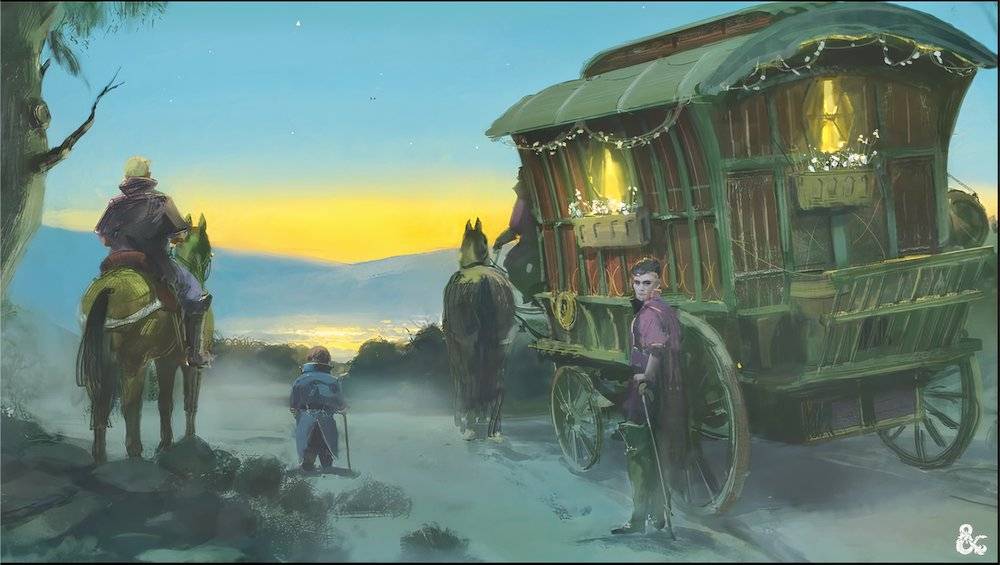
In the deathly quiet fog, they heard crows shrieking down the path and happened upon what appeared to be an ornate trader’s card. There were no bodies, but the cart had been smashed against a boulder on the side of the road and there were streaks of blood all over the place. As they looked inside the cart, they each rolled a d979. Belric claimed an expensive fist-sized gem. Toto the Monk discovered a cursed ring he quickly threw away. Iona picked up the aforementioned Crate of Chaos Mushrooms. But inside an expensive-looking chest, Kellnor discovered a legendary longsword.
I didn’t tell him it was the Soul Stealer, a sword that devours souls of those it defeats. But he sure was shocked and thrilled when he secured a kill with it not long after, and the soul of his foe shrieked as it was sucked inside the sword. As a bonus action, the souls can be released following an attack to deal an additional 1d4 psychic damage per soul. Over time, the nature and use of the sword evolved. Technically, you’re only supposed to let all the souls out at once, but I let Kellnor stockpile as many as he wanted and choose how many he’d release at any given time. And if he slew a boss or other major enemy, I started adjusting the size of the souls, so instead of a d4 it might be a d6, d8, etc.
Where did this sword come from in the game’s universe? We all wondered. And at some point it received the title Danzigsword after the American heavy metal band called Danzig. (You’ve probably heard at least the 1988 song “Mother.”) Like the Blink Dagger before it, the Danzigsword shifted how Kellnor and the rest of the party approached combat. It subtly became more about setting Kellnor up for the kill so he could claim the soul, so that it might eventually help the party down the line when they really needed it.
Behind the scenes, I kept thinking about Danzig. Who or what was it…or she? A vision emerged of some warmongering Old God who fed on bloodshed, some entity older than any of the Utar lore they were familiar with.
The perfect opportunity presented itself years later after the party destroyed the Foundry. They were supposed to infiltrate the facility and eventually face the Foreman of Embers, that hulking robot inspired by the EVAs from Neon Genesis Evangelion, complete with tethers to its power source and all. It always had a self-destruct mechanism after it transformed into its second phase. But because Belric carpet-bombed the Foundry with Call Lightning from afar, I had to improvise.


I didn’t necessarily need or want to kill the party with the Foreman, but they did struggle in the battle. Kellnor took a direct hit from a big laser blast, and watching him release more than a dozen souls to deal enough damage to finally kill it convinced me the time was ripe for her big reveal. The Foreman exploded, like an upscaled version of Fireball, and Kellnor was knocked down while the other party members struggled to stay up and save their friend amidst a raging inferno. The second explosion knocked the rest of them out.
As all the players were toasting to the deaths of their beloved characters over the Discord video call, Danzig herself strode into view, a massive, wiry, and unearthly-looking deity with disturbing features. She froze time and offered Kellnor a deal: the party could die, or he could become her Reaper. He eagerly accepted the deal, itself a Warlock Pact that mechanically gives him even more benefits for using the Danzigsword and a little dip into some dark magic.
Seeing the players’ reactions to this twist was one of the most satisfying experiences I’ve had as a Dungeon Master. And this entire subplot emerged because Kellnor rolled a 935 on his d979 back in May 2021 and found a really cool sword.
Particularly when you’re running a homebrew campaign, it’s easy to railroad the narrative to tell a certain story — or get frustrated when players pursue diversions. But it’s so important to lean into all of the random things that can happen in a game of D&D. As a DM, I could have just let Kellnor keep his sword as-is without ever delving deeper into it, but drawing inspiration from these unpredictable twists and using that to move even smaller stories forward makes for a much more enriching experience.
As daunting as it may seem, I’d encourage everyone to test out a massive table like this one and lean in to whatever emerges. See how the players respond. Think deeply about where you can bring it. If you’re lucky, the perfect circumstances might eventually arise for you to deliver an event that shocks and delights players in equal measure and grows out the lore of your world at the same time.
