






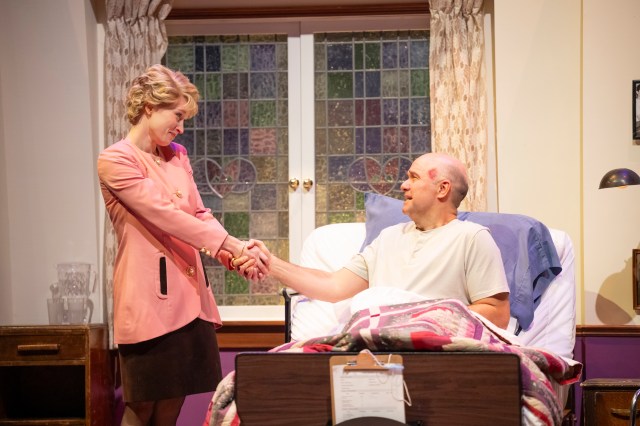
Emily Howard and Nathan Cuckow in Casey and Diana by Nick Green, Alberta Theatre Projects. Photo by Benjamin Laird for Alberta Theatre Projects.
By Liz Nicholls,
In 1991, as the AIDS crisis gained momentum, Princess Diana visited the residents of Casey House, Toronto’s groundbreaking AIDS hospice. And everything about that visit, including Diana’s very public display of compassion and warmth, helped move the dial on the stigma of the period, and the disease’s reign of terror.
To help support YEG theatre coverage, click here.
Playwright Nick Green, Toronto-based, was researching the archives of Canadian queer history for his Dora Award-winning queer media play Body Politic when a story caught his eye. A eureka moment: he earmarked it as an inspiration for the play that would be Casey and Diana, opening Thursday on the Citadel’s Maclab stage. “It had Casey House, an organization which set a lot of precedents for palliative care across the country” — a subject dear to his heart since Green the playwright is also Green the (full-time) social worker and palliative care volunteer. “And it had Princess Diana.”
“As a result of her coming to Casey House people there lived a bit longer, literally,” Green says of the so-called ‘Diana Effect’. “The true story is that the people who worked at Casey House didn’t tell anyone she was coming till seven days before the visit…. They didn’t want to instill false hope in family, or residents who, two weeks or a month out, might not make it.” And amazingly, “against all odds, no one died in that week.”
Josh Travnik and April Banigan, Casey and Diana by Nick Green. Photo by Benjamin Laird for Alberta Theatre Projects.
And there was a special Casey re-focusing for the occasion, as Green explains. “Casey House was very much about helping people have a good death, about offering comfort and compassion in the process of dying. But for one week they all just embraced the mission of trying to keep people alive. A big switch. And they succeeded!” And the Diana Effect meant that “everyone at Casey House — the residents, the nurses, the administrators, the volunteers, who’d all experienced stigma — all of them felt valued, an extra wind at their backs….”
Fast-forward a couple of years from his eureka discovery in the Canadian queer history archives …. Since the 2023 premiere at the Stratford Festival which commissioned it, Green’s Casey and Diana has done something new Canadian plays so rarely do: it’s gathered multiple remounts, no fewer than 12 productions across the country, coast to coast, with more to come. And it’s garnered raves and gathering full houses all along the way. “I’m unapologetically drinking it all in, and enjoying the hell out of it…. It may never happen again!” says the Vancouver-born playwright, a resonant and cheerful voice on the phone from his Toronto home. “And it’s so exciting to see some of the best actors in the country tackling these parts….”
This week, the Citadel co-production with Calgary’s Alberta Theatre Projects, directed by Shadow Theatre’s new artistic director Lana Michelle Hughes, returns Green’s hit to the theatre town where he went to theatre school at the U of A, where audiences know him as an actor and a playwright (Happy Birthday Baby J; Coffee Dad, Chicken Mom and the Fabulous Buddha Boi).
The origin story of Green the actor-turned-star playwright has a certain esprit de corps that’s pure Edmonton … and quite possibly unique in Canadian theatre. He was in the original cast of such Guys in Disguise productions as Two Queens And A Joker (which he co-wrote with that drag theatre collective’s presiding muses Darrin Hagen and Trevor Schmidt). “Trevor and Darrin were such a huge part of my birth as a writer!” Green declares.
Emily Howard, Nathan Cuckow, Norma Lewis in Casey and Diana by Nick Green. Photo by Banjamin Laird for Alberta Theatre Projects
The other source spring of his writing career was Fort Edmonton Park. Green, who started there as a waiter at Johnson’s restaurant on 1920 Street, wrote four shows a year for three years, including such effervescent offerings as Poof! the Musical (with Hagen), in which a fraught mother-teenage daughter relationship is complicated by the maternal expectation to be evil.
“Between Trevor and Darrin and Fort Edmonton” a playwright (and an appreciative one) was born. And having a play onstage at the Citadel is a big deal for Green, as he’s happy to point out. “The Citadel gave free tickets to theatre students,” he says of his BFA years at the U of A. “It was my formative theatre experience as a young adult; it’s where I formed my identity….
“It was a training for me, being able to see those shows. I’m just so, well, proud that (Casey and Diana) is going up there, a total pinch-me moment…. There’s a young me that’s having a fangirl moment!” And it’s enhanced by Hughes’s cast. Nathan Cuckow, for example, who plays the central character Thomas, “is one of my idols. The work that he did was so much the stuff I wanted to do as an actor and writer. ” Green remembers specific moments in Cuckow’s performance in Kill Your Television’s production of Shakespeare’s R&J.
Since he moved to Toronto in 2010 Green’s career has leaned almost exclusively into writing (“I miss acting sometimes, but I can’t really say I miss the lifestyle of being an actor”). And his burgeoning body of work includes three plays that deal with the Canadian queer experience: Body Politic, Every Day She Rose (about the collision of Black Lives Matter and the Toronto Pride Parade), and Casey and Diana.
“They say ‘write what you know’, Green says. “And I know about being a Canadian queer…. So many plays about queerness and the queer experience are American, and many are my favourites. But our experience in Canada is not the same.” “Darrin (Darrin Hagen) really set my mind in motion about writing about Canadian queer history. And I’m my mother’s daughter: Darrin really mentored me as a playwright….”
“In the next chapter of my writing,” he says of the four commissions he’s currently juggling (“across the country and one in New York), “I’m focussing on other things” than queer history. “I wish I didn’t need to use all my vacation time for writing, but….” The pairing of social work and the arts strikes him as a natural, though. Both “ask people to imagine what someone else is feeling and experiencing…. We all need training in empathy.”
Green was a gay kid in the single-digit age bracket, growing up in Vancouver, during the 1990s AIDS crisis of the 1990s. But as a teenager, he remembers coming to know about the “scary epidemic,” and it was a profound experience, he says. “My generation is marked by discovering you are part of a community that is dying. …”
And dying under cruel circumstances. “The residents of Casey Houser weren’t the only ones who experienced stigma,” he points out. “Even in medical settings. In hospitals they were often quarantined, and offered a low level of care….This play is about much more than the residents. It’s about the (largely) women who surrounded these residents and gave so much to help them in their final days.”
What inspired Green’s feeling that the Casey House story should be theatre? “Thematically, it’s a story about love and hope and compassion. And stories about us coming together and showing kindness to one another are (something) we’re all in need of,” he says. And there’s this: “Technically it’s a group of very different people in a single location, with a single objective, and very high stakes. Which is often a good recipe for theatre…. What I discovered was a natural story structure.”
Let no one argue that the Green resumé is monochromatic. The Last Timbit (a musical with a Green book, a score by Annika Johnson and Britta Johnson, and an elite cast), a commission from Tim Horton’s, had full houses at Toronto’s Elgin Theatre “cheering and screaming” as Green puts it, in the summer of 2024. Timbits and Casey and Diana are perhaps the opposite ends of my writing portfolio,” Green concedes, laughing. “Maybe they won’t be published in the same anthology.”
In any case, a hallmark of Green’s writing is its humour, even in circumstances like the story of Casey House during a remarkable week in 1991. “Life is funny, even in the darkest, unimaginable moments,” he thinks. “In exploring a story, I’m interested in what makes it hard and what makes it funny…. If I want to truly emotionally impact an audience, laughing together is as profound as crying together.”
And, after all, “historically, humour has always been an essential coping mechanism” of the queer community,” he says, citing a line from Casey and Diana: “you have to laugh to keep from dying.” When there’s laughter, “we let our walls down a little bit, and we open our hearts a little bit more.”
PREVIEW
Casey and Diana
Theatre: Citadel Theatre and Alberta Theatre Projects
Written by: Nick Green
Directed by: Lana Michelle Hughes
Starring: April Banigan, Nathan Cuckow, Emily Howard, Helen Knight, Norma Lewis, Josh Travnik
Where: Citadel Maclab Theatre
Running: through April 26
Tickets: citadeltheatre.com, 780-425-1820