![25th Jun: Borderlands (2024), 1hr 40m [PG-13] (5.35/10)](https://occ-0-171-92.1.nflxso.net/dnm/api/v6/0Qzqdxw-HG1AiOKLWWPsFOUDA2E/AAAABQstQko72xGI6jp7pjj1Z8VdogATbRV4euGHIgFjHd2O8A5Ea2GWTLnxYpurIbsjXHBSwNmyPRj_rUZsC2vFikJVcBtiuGFViV2MxyH6Qo79xFxBGSdzZQ-Z7EbIC0rDqb2RBCFI3s6SA3tejRiAnf0k0hut0FmQBL3Oq0AsCWbUCg.jpg?r=07f "25th Jun: Borderlands (2024), 1hr 40m [PG-13] (5.35/10)")







Bondi Beach was premiered on the 7th of October 2023 at the municipal theatre in Ingolstadt. Further Productions followed in Regensburg, and the Hans-Otto-Theater in Potsdam in 2024/ 2025, and Staatstheater Oldenburg and Theater Bielefeld in 2025/26. After the atrocity on Bondi Beach 2025 on 14th December, publishers Kiepenheuer and Theater Bielefeld changed the play’s title to Baga Beach, while Staatstheater Oldenburg, whose production this review is about, decided to stick with the original title, with a clear statement on the website for the production that signaled awareness of the terrorist attack, emphasized the position against aggression of any kind, and pointed to the fact that the play is not set on that beach and that it is not central to the play’s meaning and interpretation. As it is, the characters in the play refer to the Bondi Beach lifestyle at some point in the course of the play: strictly ascetic life from Monday to Friday but with a weekend of maximum excess.
The characters are five people from Germany, three male and two female. We first encounter them when they are probably in their early 30s. They have known each other for a while, and they are meeting up regularly for special events or activities, including birthday celebrations. On those occasions they talk a lot, reminisce about the past, share insights, and make fun of themselves and the others. The amount of alcohol they consume is central at most events, in terms of how much each of them is willing and able to stomach. The meetings occur as the characters grow older, and undergo potentially life-changing phases – a new, younger partner, the decision to emigrate, a turn towards spirituality, and the inevitable failures and quashed hopes that had come with those changes, followed by the need to admit their failure to the others, the fear of their responses, the despair when those responses turn out to be as malicious as feared, and the genuine surprise when those responses are rather indicative of heartfelt compassion rather than pity or ridicule.
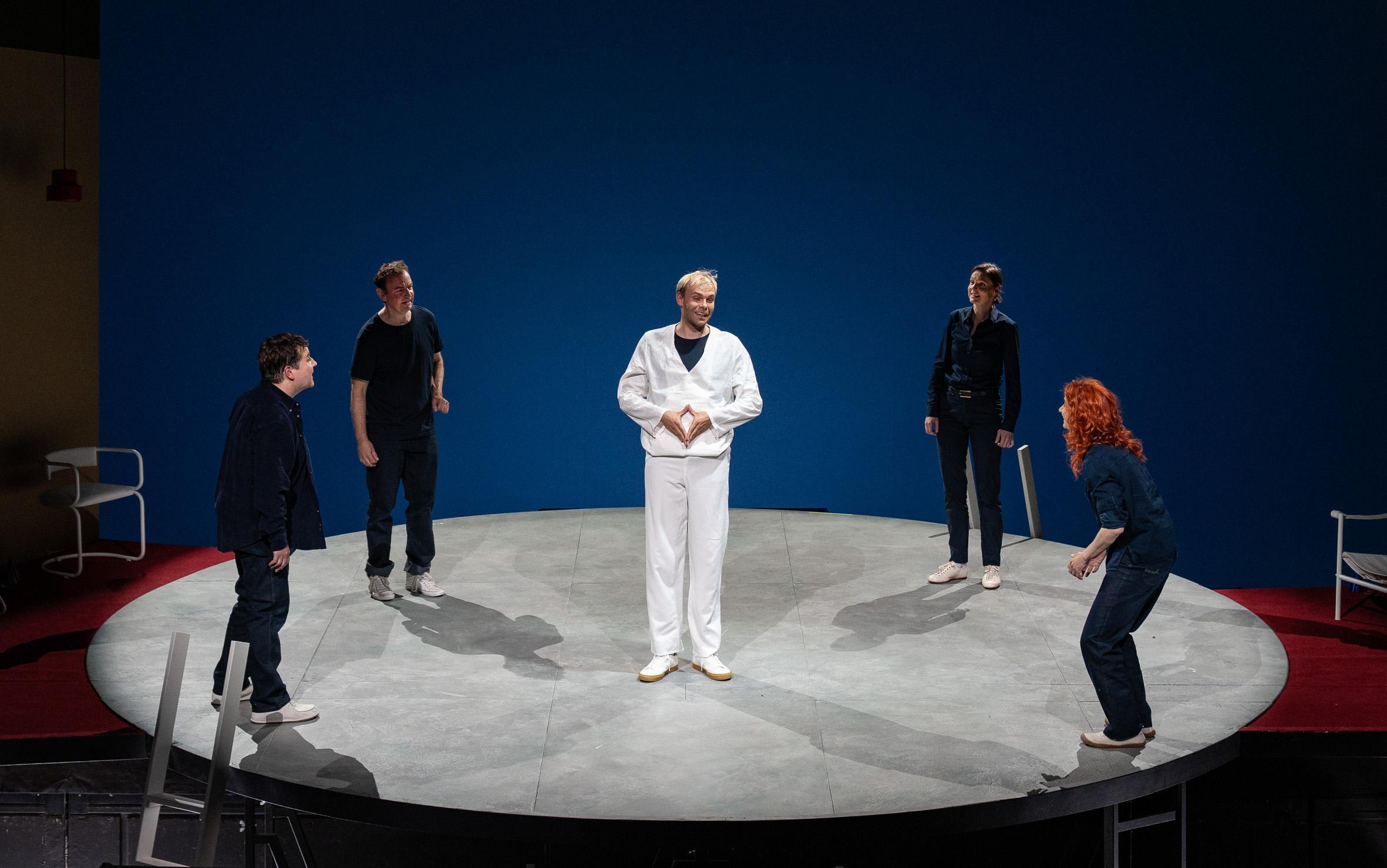
Across the 90 minutes without interval, the dialogue allowed for much laughter. The production’s set was cleverly designed by Ulrich Leitner: the action took place on a round disc, approached from the sides, with a drop to a lower level, to which the actors jumped in freefall, obviously landing on a well-padded surface. They then re-emerged to the disc using the number of ladders placed around the disc.
The characters are first and foremost defined by their thoughts and opinions, while their professions are not central to establish their respective natures. Dennis (Klaas Schramm) likes to hide his softness behind an outward macho image – very convincingly so, because his friends are frequently taken aback and are genuinely surprised and shocked when he is the first of the group to die – from suicide. Nico (Hagen Bähr) is always quirky and full of surprises, on one occasion of reunion, he has turned to Buddhism, wears an appropriate set of white garments and talks about mindfulness with a gentle, sing-song voice. Tristan (Gerrit Frers) appears to relish various episodes and variations on the theme of suffering, mishaps, and resulting depression. Fiffy (Franziska Werner) seeks to escape her current life, which she considers too conventional, by moving to the USA. Driven by major fear of ageing, she is sadly desperate at core, underneath an overly bubbly surface. Zoe (Julia Friede) comes across as the most intellectual of the group, reflecting on one occasion on her job as a solicitor. They all have in common their disillusionment with their lives and their aspirations for something better. While over the years they become increasingly eloquent in deploring the status quo and picturing their dream worlds, their despair also increases in relation to the extent to which they allow themselves to admit perceived failure.
Dramatist Rebekka Kricheldorf chose comedy as the vehicle to carry the ultimately serious content, and there were indeed plenty of funny lines evenly spread across the five characters. The production, directed by Moritz Peters, was fast paced, with a fine balance between comedy and seriously meaningful contents.
This post was written by the author in their personal capacity.The opinions expressed in this article are the author’s own and do not reflect the view of The Theatre Times, their staff or collaborators.