








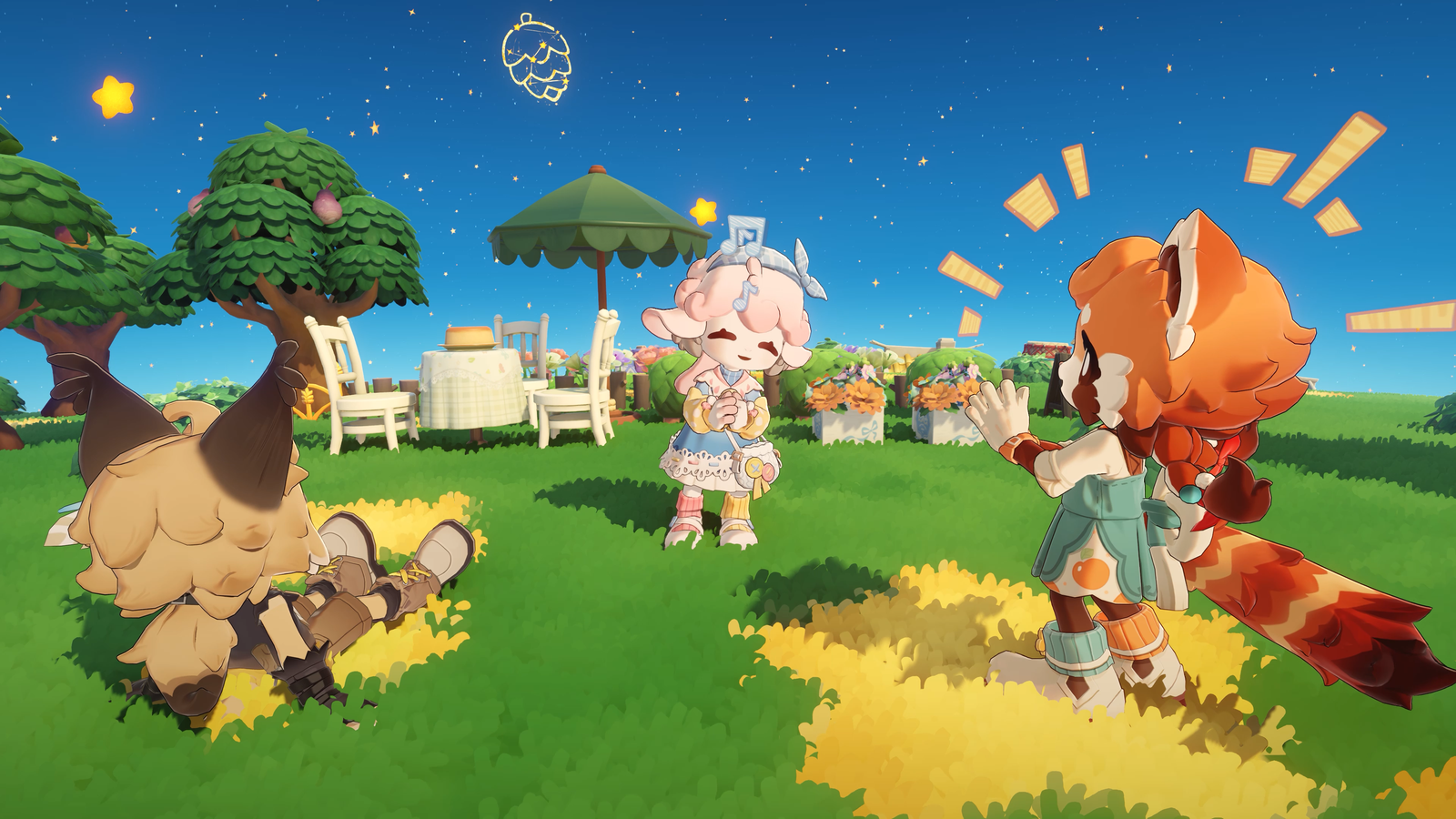
It is impossible to deny the similarities between Animal Crossing and Petit Planet, a new life sim from the makers of Genshin Impact and Honkai: Star Rail. Both games are twee crafting sims about managing small villages. Both feature a wide cast of anthropomorphic animals. Both are built around a feedback loop of meditative bliss.
But Petit Planet, which is developed by miHoYo and published by HoYoverse for a planned winter 2026 release, impresses despite its commitment to well-established form. I recently played an hour of the game at Gamescom 2026 and found myself drawn into its idyllic vibes, though left wondering about its long-term appeal.
Why Petit Planet could be a legit Animal Crossing replacement
The first person you’re introduced to in Petit Planet is… yourself. Though the game is populated with anthropomorphic animals, you play as a human. You’re hired by a company called Loomi Co. to help revitalize uninhabited planets in a solar cluster called the Starsea. When designing a character, you can choose from a variety of titles, like Hustling, Grass-Gathering, Stargazing, Laid-Back, Popular, and Essay-Writing. (Guess which one I chose.) You can also name yourself. I went with Ari1.
You then select a planet. I was given two options, though the wheel from which I selected them suggested more might be available in the final version of the game: Hexia, a mildly temperate world where plums grow with abundance, or Taffeh, a savanna world drenched in red sunset and home to forests of mango trees. From what I can tell, the most important factor here is the fruit choice, which will serve as the basis of your cooking, trading, gifting, and eating at the start of the game.
Mangoes are obviously better than plums, but, look, it’s been a hot summer, so I went with Hexia. From there, I strolled around my planet — which seemed comparable to the worlds from Mario Galaxy in size — shook some plum trees, gathered some plums, spoke to a bear named Mobai, learned how to make his special tea (key ingredient: plums), and met with some of the other residents of Hexia, including a bunny with pink fur named Elsasani. Mobai also taught me how to fish and catch bugs, giving me a fishing rod and bug-catching net to do so.
The minigames, while not terribly stress-inducing, give Petit Planet a level of interactivity beyond merely gathering and building things. Basically, you point your tool at the bug or fish you want to catch, and click on a fleeting icon when it shows up. It’s a straightforward but essential quest category for some early-game missions of the “catch five different types of bugs” variety. In short order, I reeled in a Black Carp, Mosquitofish, and Black Tilapia; snagged a Pearl Oyster and Moon Crab from shallow waters; and caught a variety of bugs whose names I tapped through quickly because I am scared of bugs — yes, even the cutesily rendered ones — and wanted to move them off my screen as fast as I could.
As you collect creatures, you can bring them back to Mobai to increase the overall ecology of your planet. (From what I could tell, this seems to be the primary “mission” of Petit Planet, though the game doesn’t really force you to stick to structure.) Growing your planet draws more animal neighbors to it, each of whom has a unique name and personality. You quickly get a kit that lets you build a house. You eventually get more kits that allow you to build houses for your citizens. Soon, you have a burgeoning neighborhood.
In one notable deviation from its inspiration, the animals in Petit Planet speak with fully voiced dialogue, unlike the cutesy gibberish of Animal Crossing. But back in May, HoYoverse caught some flak for reportedly planning to invest $14.6 billion in AI tools over the next three years, including for use of “AI-powered NPCs” in Petit Planet, as GamesIndustry.biz reported. (A 2025 early beta of the game appeared to use AI-generated text for character speech bubbles, as noted in a Polygon preview at the time.)
When asked whether or not Petit Planet’s Gamescom demo included AI voices, a representative for HoYoverse sent over the following statement: “All voice performances in the playable demo were delivered by real human voice actors. No AI-generated voices were used. We remain committed to working with talented voice acting professionals to bring our characters to life.”
My demo ended shortly after a visit to Galactic Bazaar, the de facto hub area for Petit Planet. There, I unlocked the ability to chat with other human players, and earned a signpost for my planet, which also allowed me to name it. (I called it… Planet1.) You can also play a rhythm minigame, trade items, and sit around in social areas, like cafes, fire pits, and public squares.
It is clear there will be a gacha element of some sort to Petit Planet, and though I did not experience it in my demo, I started to imagine all the ways a premium currency, by its nature, could get in the way of the game’s inherently idyllic vibes. This is the existential question at the heart of Petit Planet. A good cozy game promises limitless creativity. But when that brushes up against the very tangibly limiting bounds of capitalism, which one wins?
Petit Planet will be released in winter 2026 for Windows PC. A limited beta will be conducted in late September.
HoYoverse provided Polygon’s flight and hotel for purposes of attending this preview. Read more about Polygon’s travel and ethics policy here.
