






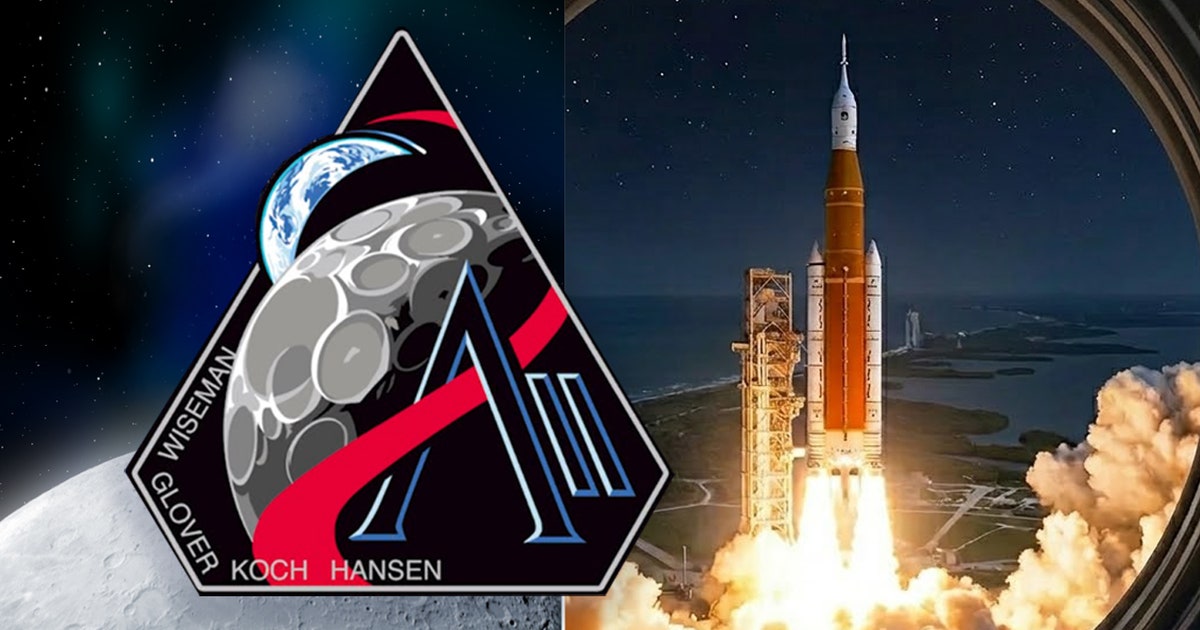
CAPE CANAVERAL, Fla. – Artemis II lifted off from Launch Pad 39B at Kennedy Space Center in Florida on Wednesday, sending four astronauts on a 10-day mission into deep space, around the moon, and back to Earth.
The Artemis II crew includes Commander Reid Wiseman, 50; Pilot Victor Glover, 49; Mission Specialist Christina Koch, 47; and Mission Specialist Jeremy Hansen, 50, of the Canadian Space Agency. The 2-hour launch window opens at 6:24 p.m.
Follow along for live mission updates on Artemis II, the Space Launch System (SLS) rocket, the Orion spacecraft, and the crew. Watch live-streaming coverage in the video player above.
Artemis II mission timeline
What’s next:
NASA’s Artemis II mission will orbit Earth for a day, travel to the moon for a flyby beyond its far side, and then return along a free-return trajectory, culminating in Orion’s reentry and a Pacific Ocean splashdown.
- Earth orbit (Day 1): The Artemis II astronauts will orbit Earth for one day to confirm all spacecraft systems are functioning properly.
- To the moon (Days 2–5): Orion’s main engine will fire to propel the capsule out of Earth orbit toward the moon, roughly 244,000 miles (393,000 kilometers) away.
- Moon flyby (Day 6): Orion will reach its farthest point from Earth, passing about 5,000 miles (8,000 kilometers) beyond the moon. Astronauts are expected to document the flyby with cameras and smartphones before heading back to Earth.
- Return (Days 6–9): Using a free-return trajectory, Orion will use the moon’s and Earth’s gravity to guide the spacecraft safely home.
- Reentry: The service module separates, and the capsule re-enters Earth’s atmosphere, facing temperatures up to 3,000°F (1,650°C).
- Splashdown: The Artemis II crew will parachute into the Pacific Ocean, completing the mission much like Apollo astronauts did decades ago.
Orion solar arrays deploy successfully
NASA’s Artemis II mission reached another milestone as Orion’s four solar array wings fully deployed, officials confirmed. The arrays, extending from the European Service Module, give the spacecraft a wingspan of roughly 63 feet and begin generating electricity for life support, avionics, and communications.
Each wing contains 15,000 solar cells and can rotate on two axes to track the Sun, maximizing power during Orion’s orbit around Earth and on its outbound path to the moon.
The Orion spacecraft in orbit (NASA artist concept)
The next major steps are the perigee raise maneuver and apogee raise burn, which will adjust Orion’s orbit in preparation for deep-space operations.
NASA plans a postlaunch news conference at 9 p.m. from Kennedy Space Center, after which the crew will begin a proximity operations demonstration to test Orion’s manual maneuvering relative to the separated interim cryogenic propulsion stage.
SLS core stage separates
NASA’s Artemis II mission reached a key milestone as the Space Launch System core stage completed main engine cutoff and successfully separated from Orion and the Interim Cryogenic Propulsion Stage, officials reported.
The transition marks the end of the first major propulsion phase and the start of upper-stage operations.


the Space Launch System core stage completed main engine cutoff and successfully separated from Orion. [Credit: NASA]
The next critical step is deployment of Orion’s four solar array wings, scheduled about 18 minutes after launch. Once extended, the arrays will provide continuous electrical power for life support, avionics, communications, and spacecraft systems for the journey to the moon.
Orion fairings jettisoned
NASA’s Artemis II mission successfully jettisoned the spacecraft adapter fairings that enclosed Orion’s service module and launch abort system, officials reported.
Now above the densest layers of Earth’s atmosphere, Orion no longer needs the protective structures used during the high-pressure early phase of launch.

Artemis II mission successfully jettisoned the spacecraft adapter fairings that enclosed Orion’s service module. [Credit: NASA]
The next key milestone will be separation of the SLS core stage and ignition of the Interim Cryogenic Propulsion Stage to continue propelling Orion toward orbit.
Artemis II solid rocket boosters separate
NASA’s Space Launch System twin solid rocket boosters have successfully separated, officials reported, clearing the way for the core stage to continue propelling the Orion spacecraft, named Integrity, toward orbit.
Each booster stood 177 feet tall and produced more than 3.6 million pounds of thrust at liftoff, providing most of the rocket’s power during the first two minutes of flight. Separation reduces mass, allowing the core stage to maintain acceleration.

NASA’s Space Launch System twin solid rocket boosters have successfully separated. [Credit: NASA]
In the next phase, the spacecraft adapter jettison fairings protecting Orion’s service module and launch abort system are scheduled to separate, exposing the spacecraft for the remainder of its journey.
Liftoff!
NASA’s Artemis II mission lifted off at 6:35 p.m. EDT from Kennedy Space Center’s Launch Complex 39B, sending four astronauts aboard the Space Launch System rocket and Orion spacecraft on a journey around the moon, officials said.

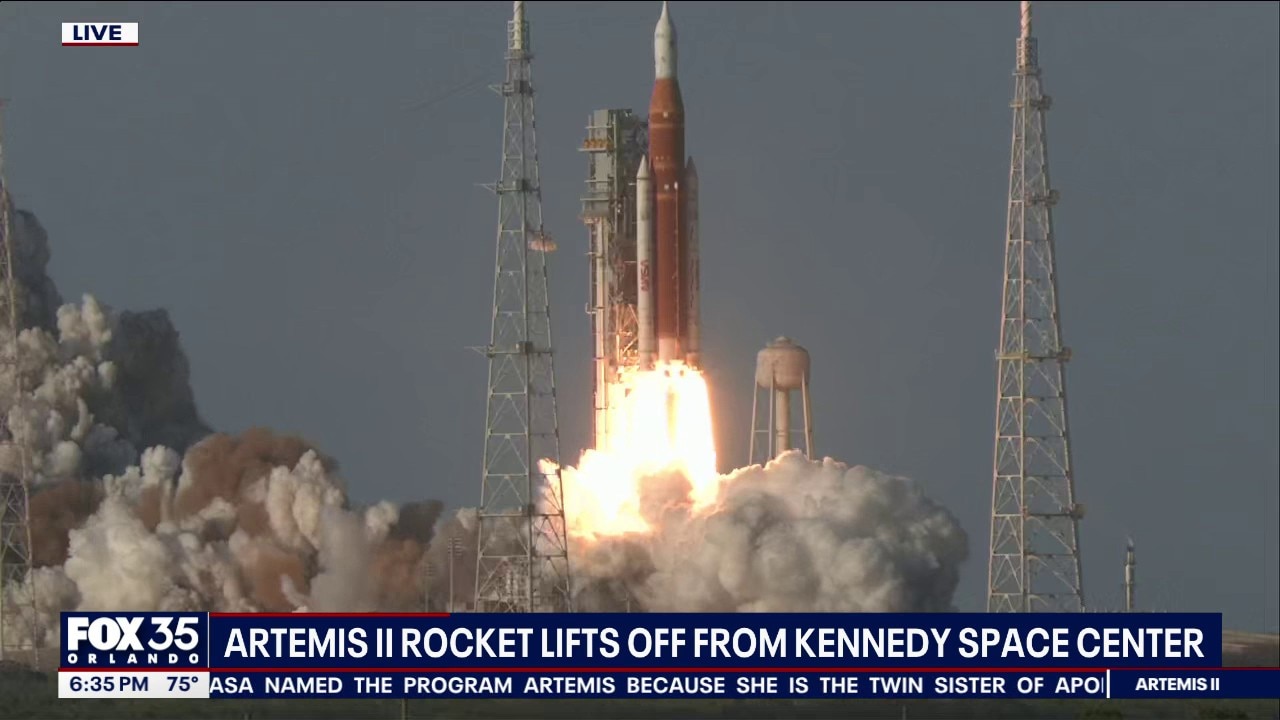
Artemis II rocket lifts off from Kennedy Space Center
NASA’s Artemis II mission lifted off at 6:35 p.m. EDT from Kennedy Space Center’s Launch Complex 39B, sending four astronauts aboard the Space Launch System rocket and Orion spacecraft on a journey around the Moon, officials said.
The crew includes Reid Wiseman, Victor Glover, Christina Koch and Canadian Space Agency astronaut Jeremy Hansen. The mission marks the first crewed flight of NASA’s Artemis program.

Artemis II launches from Kennedy Space Center in Florida, April 1, 2026.
At liftoff, the rocket’s twin solid boosters and four RS-25 engines generated about 8.8 million pounds of thrust to propel the 5.75-million-pound vehicle into flight. Umbilical connections supplying power, fuel and data detached as the rocket cleared the pad, allowing it to operate independently.

Artemis II soars after launch from the Kennedy Space Center, April 1, 2026. [Credit: NASA]
The roughly 10-day mission will test systems needed for future deep space exploration as NASA prepares for more complex lunar missions and eventual human travel to Mars.
Countdown resumes with 6:35 p.m. launch
NASA’s launch team has allowed engineers to complete final preparations for the Artemis II liftoff, officials said. The new launch time is 6:35 p.m.
‘Go for launch’
NASA officials said Artemis II is “go for launch.” The countdown clock has been held at 10 minutes to allow teams to finish their final checks.
“The launch team has made the decision to extend the T-10 minute hold ahead of today’s launch to give engineers time to work through final preparations for liftoff. There is a two-hour window in which Artemis II could launch, and a new liftoff time will be set shortly,” NASA said.
NASA’s 2-hour launch window opens at 6:24 p.m.
Artemis II enters final countdown phase
NASA’s Artemis II closeout crew has completed its work and departed Launch Complex 39B at Kennedy Space Center, leaving the Orion spacecraft sealed and ready for flight, officials said.
The team spent hours assisting astronauts with suit-up, hatch closure and final checks before exiting the White Room, marking the handoff to the launch control team for the remainder of the countdown.

Engineers also reviewed a temperature reading from a sensor on the launch abort system and determined it was likely an instrumentation issue that will not affect the launch.
Weather conditions have improved, with forecasts now showing a 90% chance of favorable conditions for liftoff.
With the hatch secured, Orion has entered its final configuration, marking one of the last major steps before fueling and launch.
‘Godspeed, Artemis II!’
NASA astronaut Jessica Meir posted a video message recorded on the International Space Station as the ISS crew sends well-wishes for a successful launch.
Issue resolved, Orion hatch secured
Engineers have resolved a hardware issue affecting communication with the Space Launch System’s flight termination system, clearing a key safety concern ahead of launch, officials said.
The problem had prevented ground controllers from sending a destruct signal if the rocket veered off course. A follow-up confidence test confirmed the system is now ready to support liftoff.
At the same time, technicians completed closure of the Orion spacecraft’s launch abort system hatch, sealing the crew module for flight. Teams verified alignment, locking mechanisms and pressure integrity to ensure the hatch can withstand launch conditions and function properly in an emergency.
With the hatch secured, Orion has entered its final configuration, marking one of the last major steps before fueling and launch.
NASA reviewing technical issue
The countdown for NASA’s Artemis II launch is continuing as engineers address a communication issue with the rocket’s flight termination system on the Space Launch System rocket, officials said.
The Eastern Range identified the problem, which affects its ability to communicate with the safety system designed to destroy the rocket if it strays off course during ascent.

The countdown for NASA’s Artemis II launch is continuing as engineers address a communication issue with the rocket’s flight termination system on the Space Launch System rocket, officials said. [Credit: NASA}
An operator has been dispatched to the Vehicle Assembly Building to retrieve legacy equipment from the space shuttle era that can interface with the system.
Without confirmation that the system works properly, the launch would be scrubbed.
Engineers have developed a method to verify the system’s functionality and are preparing to test the solution as the countdown proceeds.
Weather improving for launch
Conditions continue to improve for the Artemis II launch.
The 45th Weather Squadron, based at Patrick Space Force Base, Florida, provides specialized weather forecasts and “Go/No-Go” decisions for rocket launches at Cape Canaveral Space Force Station and Kennedy Space Center. In its final launch mission execution forecast, officials said the cumulus cloud and ground wind rules could play a factor in delaying the Artemis II launch.
A launch cannot proceed if there are cumulus clouds within 10 miles of the launch site, as these clouds can hold an electrical charge, posing a risk of triggered lightning. Sustained winds must also remain below 33.4 to 44.9 mph.

Second-grader designs ‘zero gravity indicator’
A second-grade student from California has designed the mascot that will join NASA’s Artemis II mission to the moon. Known as the zero gravity indicator – or ZGI – the item, which is sometimes a toy or stuffed animal, will help alert the crew when they’ve reached zero gravity in space. It also serves as a friendly reminder about the “human element” to their mission.
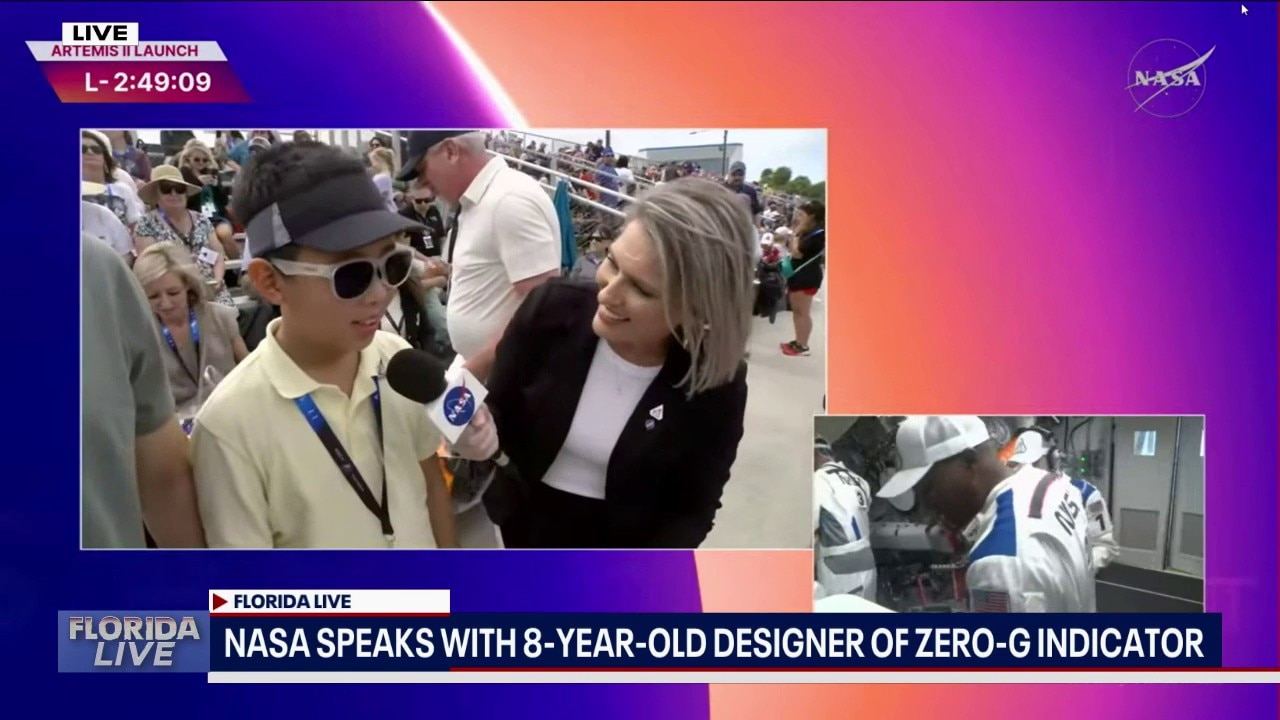
Artemis II: California 2nd-grader designed Zero-G Indicator
All eyes are on NASA and Kennedy Space Center where Artemis II is expected to launch on a 10-day mission to the moon — and back. It is the latest flight test with the goal of landing humans back on the moon — and eventually building a moon base there. NASA talked to Lucas Ye, a second-grade student from Mountain View, California, who submitted the mascot for Artemis, known as “Rise.” It’s known as the zero gravity indicator. When Artemis II reaches zero gravity, “Rise” will float.
Artemis II Mission Specialist Christina Koch announced March 27 that “Rise,” a moon-like plush with an Earth-inspired cap, designed by Lucas Ye, of Mountain View, California, has been selected to join their mission.
NASA tests Orion hatch system
NASA engineers have completed work on a counterbalance mechanism and are now testing hatch seal integrity inside the White Room at Launch Complex 39B, officials said.
The mechanism offsets the weight of Orion’s crew module hatch, allowing it to open and close smoothly while protecting hinges and seals from stress. Technicians verified that the system’s springs, dampers and locking features function properly under conditions simulating launch.
Teams are also conducting pressure decay tests on the hatch seal, monitoring for any loss of pressure over time. The checks are intended to confirm the hatch can maintain an airtight seal, a critical requirement for astronaut safety during all phases of the mission.
Artemis II crew boards Orion
NASA’s Artemis II astronauts have begun boarding the Orion spacecraft, where they will conduct communication checks to confirm voice links with mission control and onboard systems ahead of launch.
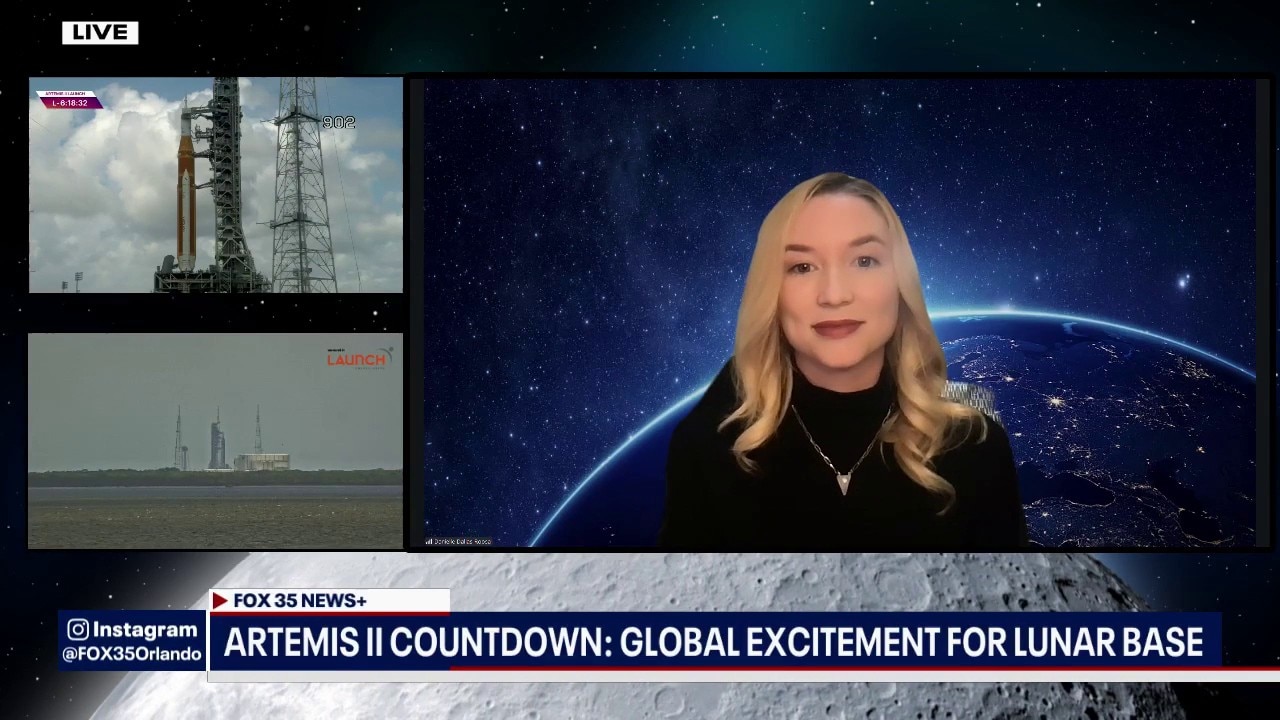
Artemis II: Expert talks worldwide excitement over moon mission
FOX 35’s Garrett Wymer talked with Danielle Dallas Roosa, the founder of Back to Space, about the Artemis II mission and the worldwide excitement about the next step in a potential lunar landing. Roosa’s grandfather was part of Apollo 14 astronaut Stuart Roosa. “It’s time to go back to space,” she said.
President Trump celebrates moon mission
President Donald Trump on Tuesday celebrated NASA’s Artemis II mission, which is set to send U.S. astronauts beyond low-Earth orbit for the first time in more than five decades.
The president released a statement ahead of the Artemis II mission launch.
“Tonight at 6:24 P.M. EST, for the first time in over 50 YEARS, America is going back to the Moon! Artemis II, among the most powerful rockets ever built, is launching our Brave Astronauts farther into Deep Space than any human has EVER gone.”
“We are WINNING, in Space, on Earth, and everywhere in between — Economically, Militarily, and now, BEYOND THE STARS. Nobody comes close! America doesn’t just compete, we DOMINATE, and the whole World is watching.”
“God bless our incredible Astronauts”
The Artemis program was established during President Donald Trump’s first term in 2017 as part of a broader push to return American astronauts to the moon.
Artemis II crew begins traditional walkout
NASA’s Artemis II astronauts have started the traditional walk from crew quarters to the launch pad at Kennedy Space Center, a ritual followed by crews since Apollo 7 in 1968.
Before departing, the crew took part in a longstanding prelaunch custom of playing cards, continuing until the commander loses.

Commander Reid Wiseman was the one to end the game, in keeping with the tradition meant to bring good luck for the mission.
Suiting up
As the countdown to the Artemis II launch continues, NASA has shared video of the astronauts suiting up for the mission.
Pilot Victor Glover and commander Reid Wiseman are seen in the suits they will wear for the launch.
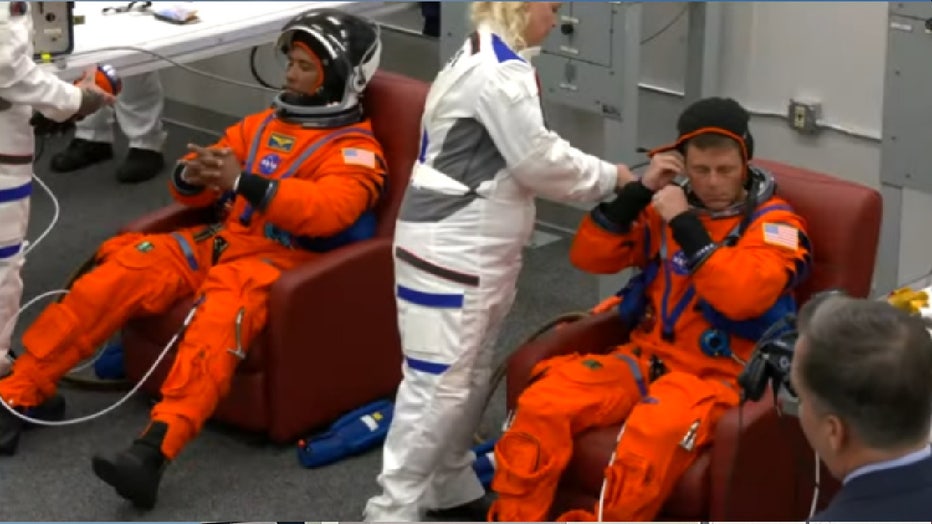
Artemis II pilot Victor Glover and commander Reid Wiseman get suited up for the mission. (Courtesy: NASA)
Space expert talks about historic Artemis II mission
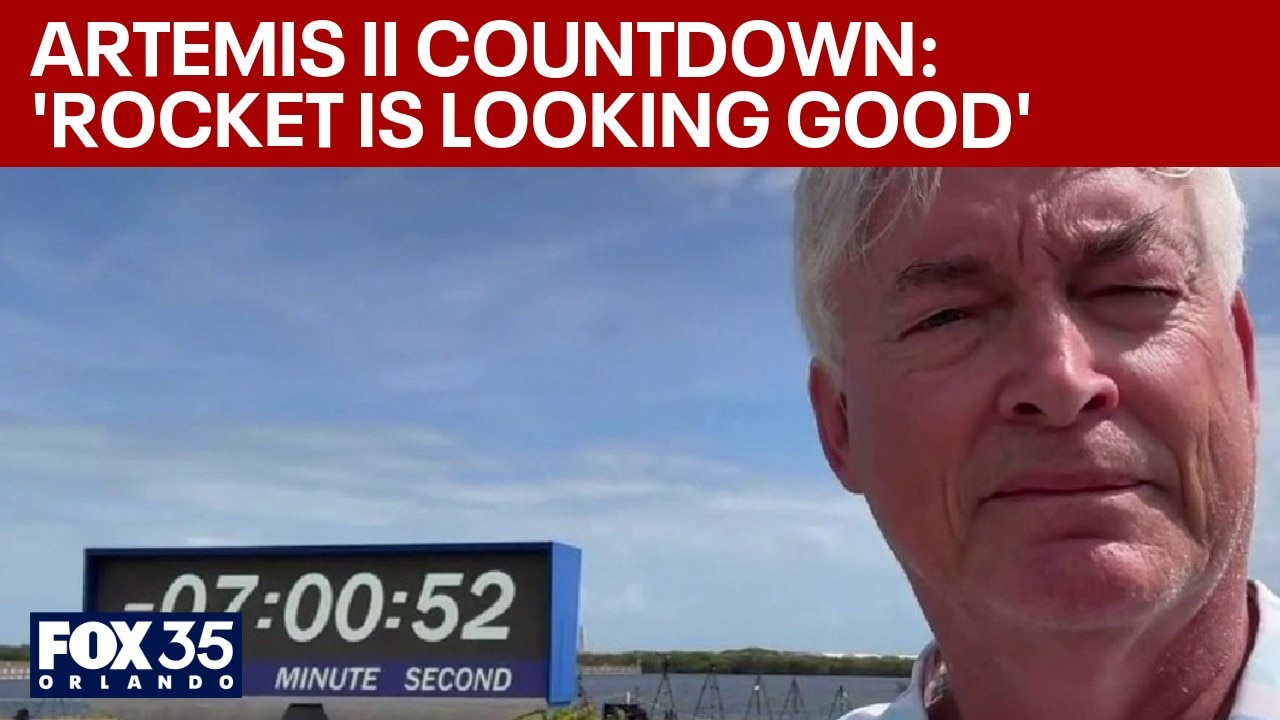
Countdown to Artemis II launch | ‘Rocket is in good shape’
Dr. Ken Kremer from Space UpClose spoke with FOX 35’s Garrett Wymer about the previous hydrogen leaks regarding Artemis II. Kremer reported that NASA is testing the hardware and software ahead of the launch set for 6:30 p.m., April 1. “That’s all fixed now. Everything is looking really great,” Kremer said.
Artemis II: NASA teams continue to fill rocket, conduct safety checks
NASA teams have transitioned the interim cryogenic propulsion stage liquid hydrogen tank to replenish mode during the Artemis II countdown. This phase follows the successful topping process and ensures the tank remains at flight-ready levels all the way to launch.
Visitors flock to Jetty Park for Artemis II launch
FOX 35’s Amanda Ruiz talked with Terry and Debbie, who are snow birds from Indiana, who extended their trip by a few more days to catch the launch of Artemis II.

Artemis II: People excited for Florida rocket launch
FOX 35 talked with Terry and Debbie, who are snow birds from Indiana, who came to the Space Coast for the Artemis II rocket launch. Artemis II will send four astronauts on a 10-day mission to the moon and back.
What is launch day like for the astronauts?
A launch is an exciting time, especially for the astronauts.
FOX 35 talks with Winston Scott, a retired Navy captain and former astronaut, about what launch day is like for the astronauts.
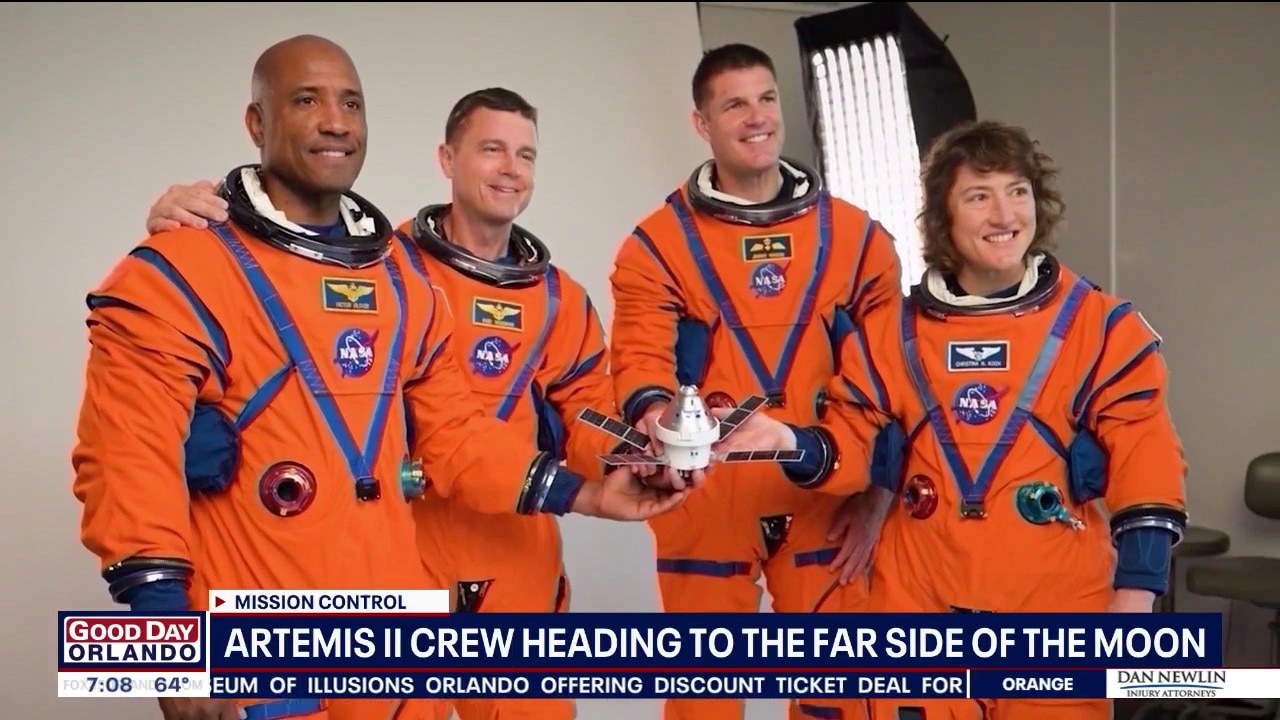
Artemis II crew prepare for historic launch
Artemis II prepares for liftoff from Florida. The mission will take four astronauts on a trip around the moon and back. Good Day Orlando talks with retired Navy captain and former NASA astronaut Winston Scott about what launch day is like for astronauts.
Artemis II crew begins their launch day
NASA astronauts Reid Wiseman, Victor Glover and Christina Koch and Canadian Space Agency astronaut Jeremy Hansen officially began their launch day with a scheduled wake-up call at 9:25 a.m.
NASA begins slow fill for Artemis II
The launch team has begun the slow fill phase of the tanking process. Liquid hydrogen and liquid oxygen are being loaded into the Space Launch System (SLS) rocket core stage.
“This phase introduces the super-cold propellants at a controlled rate, allowing the rocket’s plumbing and tanks to gradually adjust to cryogenic temperatures,” NASA said.
Once the slow fill is completed, the team will begin the fast-fill phase.
The rocket’s tanks can hold over 750,000 gallons of liquid hydrogen and oxygen.
“Go” for tanking
NASA teams are getting ready to start loading the Space Launch System rocket’s propellants.
Artemis II launch director Charlie Blackwell-Thompson gave the official “go” for tanking at 7:33 a.m.
“This essential step kicks off with the chilldown of the core stage liquid oxygen and liquid hydrogen transfer lines, preparing the rocket for its historic mission,” NASA said.
Weather good for launch
Good weather? Check.
The forecast is looking good for the Artemis II launch.
The FOX 35 Storm Team says there will be a few showers possible this afternoon, but the rain should clear out before launch time.
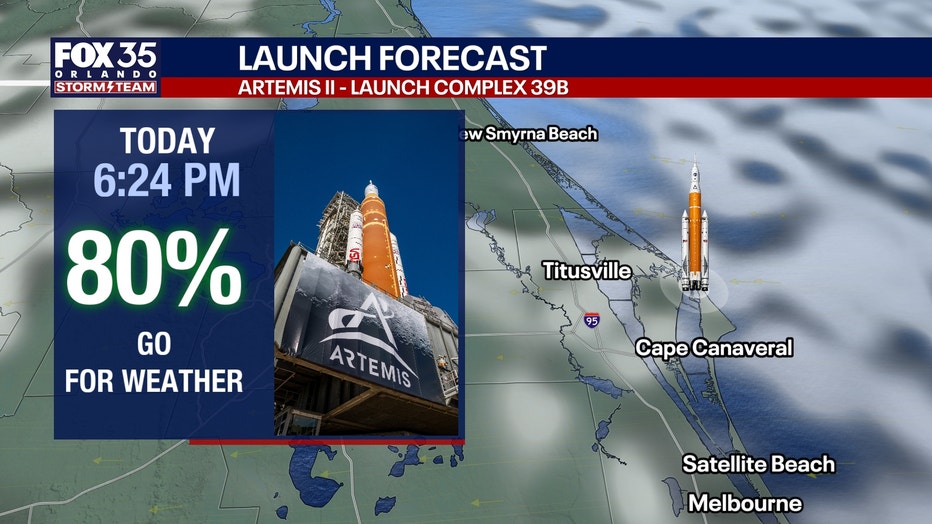
Here’s a breakdown of Wednesday’s weather forecast for Central Florida.
How to watch the launch
The two-hour launch window opens at 6:24 p.m. ET, but FOX 35 will have all-day coverage of the historic launch.
You can watch along in the video player above. NASA will also live stream the launch. The space agency’s coverage is scheduled to begin at 12:50 p.m. ET. Watch the live coverage below:

Check out our watch guide, which tells you how you see the launch live.
NASA Administrator: ‘The next era of exploration begins’
NASA Administrator Jared Isaacman shared some thoughts the night before Artemis II’s first launch attempt from Kennedy Space Center in Florida.
Artemis II visibility map
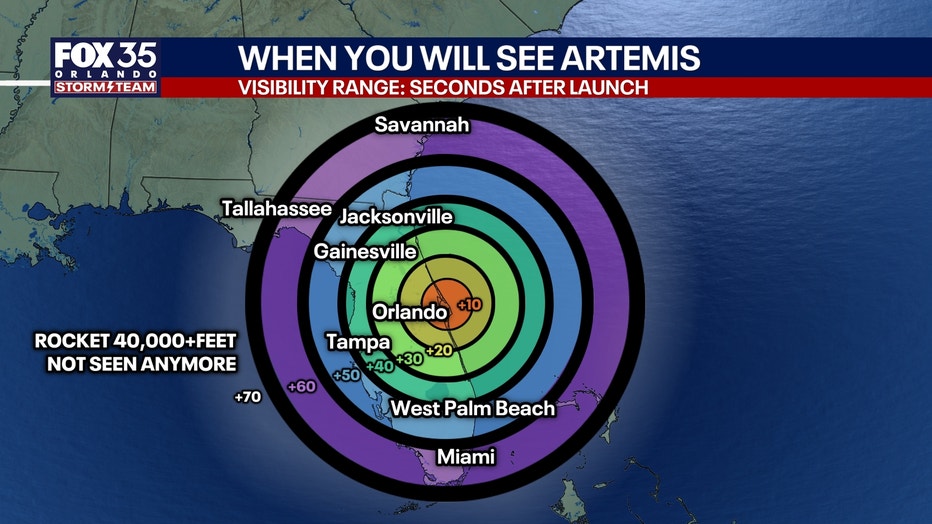
People across Florida and southern Georgia will have a chance to see Artemis II fly through the night sky into space. The map shows who will be within range to potentially see Artemis. The +10 number means those within that ring will be able to see the rocket 10 seconds after it launches.
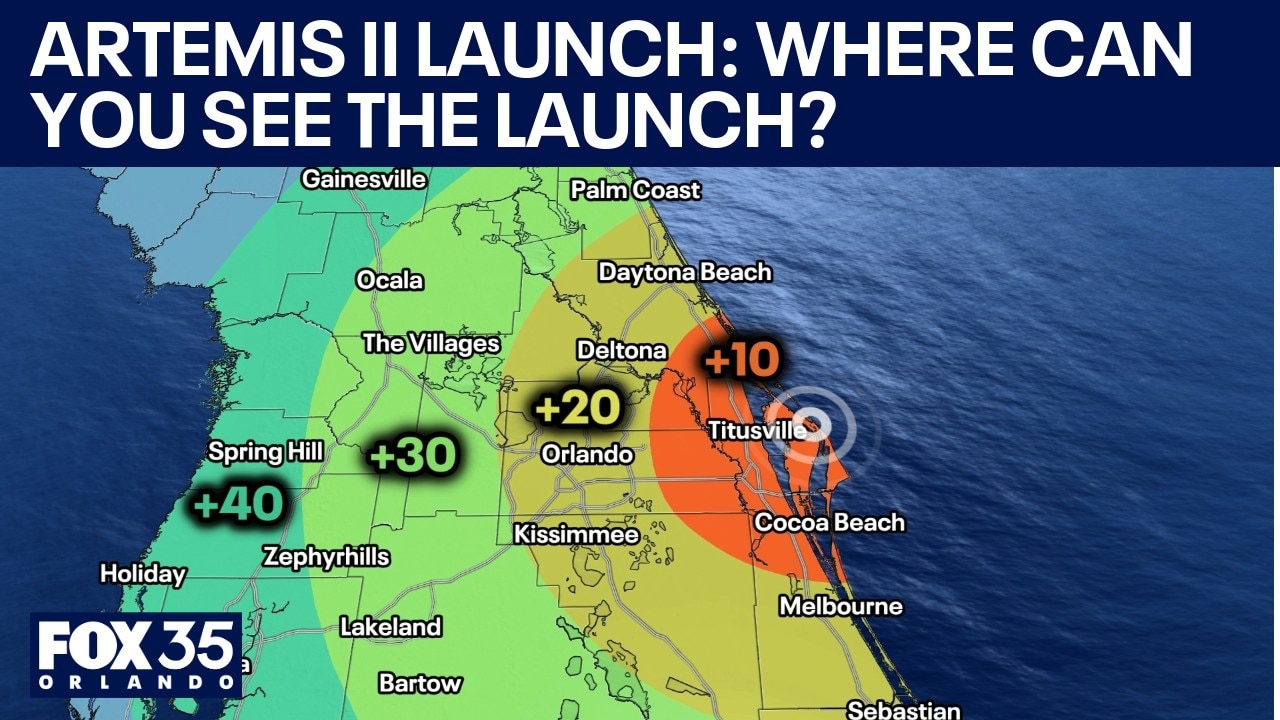
Artemis II weather forecast: Where can you spot the launch
The greatest threat to an April 1 Artemis launch is the rain, which should be clearing up hours before the launch window opens. The showers should push further inland closer to the launch time. If the launch is scrubbed, weather on Thursday look less favorable.
Once the rocket hits 40,000 feet, it will not be visible at all.
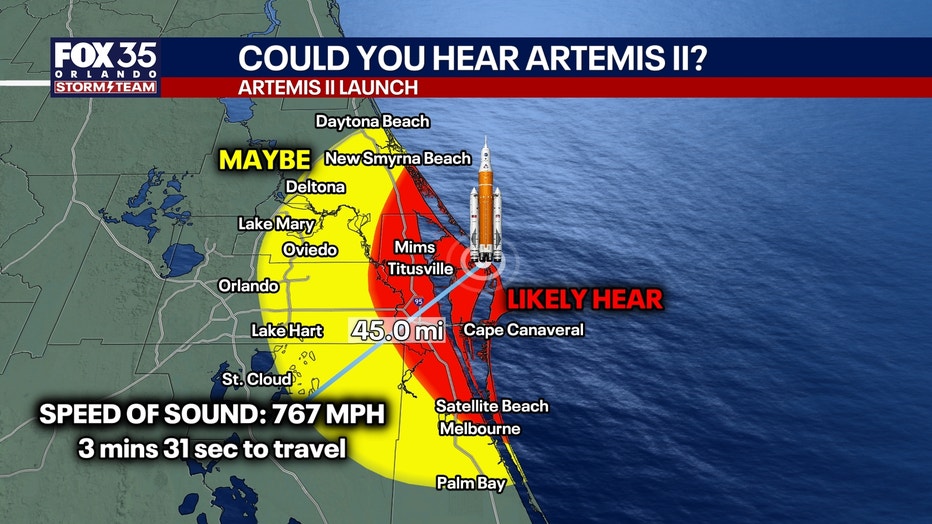
Artemis II “roar”: Will you hear it?
It’s not a sonic boom, but those who live near Kennedy Space Center and the Space Coast may be able to hear the “roar” of the SLS rocket launching Artemis II into space.
Artemis II weather forecast
We are watching the likelihood of showers in the early-mid afternoon to impact Launch Pad 39B. The good news is these showers should move out before 5 p.m.
That said, there are cloud restraints from NASA. Any clouds must be:
- 3+ miles from t-storm remnants
- 5+ miles from clouds at least 4,500+ feet thick
- 10+ miles from any cumulus clouds
- no smoke plumes in the nearby area
5.6M names headed to the moon with ‘Rise’
“Rise” was designed by a second-grade California boy and will serve as the zero gravity indicator aboard Artemis II.
It will also hold a small memory card with more than 5.6 million names of people who wanted their name to be part of the Artemis II moon mission. NASA collected several names before launch.
The Source: This live blog is managed by the digital teams at FOX 35 News in Orlando, Florida. It features live updates on Artemis II from NASA and Artemis II teams, FOX 35 photographers and reporters at Kennedy Space Center, Jetty Park, and other areas along the Space Coast. It will also feature news and updates from NASA leaders and verified social media accounts.

![1st Apr: Toriko X One Piece Collaboration Special (2011), 6 Episodes [TV-14] (6/10)](https://occ-0-1381-999.1.nflxso.net/dnm/api/v6/Qs00mKCpRvrkl3HZAN5KwEL1kpE/AAAABSdV1Dw5hbE9kmmq0_BmAZPt9D2BgyMMd6ZhGIHa20fv9HHTpCMw-wAinCE9JUDEJdtSib3RnrwPC2j1UmdrA8NQBFo9moeL8lVClieNjc0mOh58nCQqdIQcGjpMoh3ss4x-9BTcX7jb0pUhpwNNQQjaCj-vH4AZYWwjHlnwds0goQ.jpg?r=148 "1st Apr: Toriko X One Piece Collaboration Special (2011), 6 Episodes [TV-14] (6/10)")