





Prime Minister Mark Carney was elected on a platform to stand up to the United States on tariffs, and diversify trade so Canada is no longer as dependent on the U.S. as it has been.
Carney said on Saturday, hours after he suspended trade talks with the United States, that the U.S. had made unacceptable demands, including efforts to restrict Canada’s ability to have other trade deals. He called the move a “power play” that became an issue of sovereignty.
Speaking to reporters Wednesday, International Trade Minister Maninder Sidhu said “we won’t let another country tell us who we can and who we can’t negotiate with.”
“Right now, we have access to about 1.5 billion consumers around the world. We are going to double that to over three billion people,” he said. “We need to get our goods out to new markets and that’s exactly what the focus is.”
Carney and the Liberals repeatedly boast that Canada is the only G7 country with free trade agreements with all other G7 countries.
They have also set a goal of doubling non-U. S. exports over the next decade and Carney’s government has boasted about signing more than 20 strategic trade and defence agreements around the world over the past year.
In the first few months of 2026, Global Affairs Canada says Canadian goods and services exports to non-U.S. markets totalled $96.2 billion.
In 2025, non-U. S. exports totalled $333 billion, up from $299.7 billion in 2024.
Here is a list of some of the major agreements that Canada has pursued and signed since Carney took office.
Indonesia
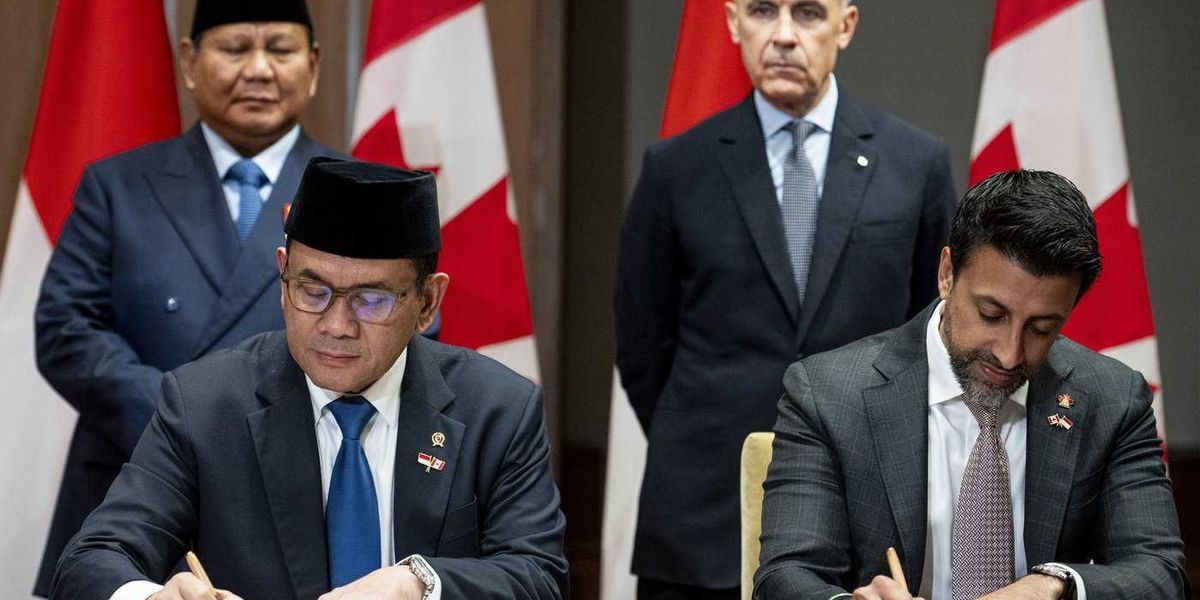
In September 2025, Canada and Indonesia signed both a free trade agreement and a defence agreement.
In November 2024, when Justin Trudeau was still prime minister, both countries announced they had finished trade negotiations that started in 2021. The signed trade deal opens up trade in multiple industries with the world’s fourth-most populous country.
The trade deal is expected to come into force sometime this year and is Canada’s first-ever bilateral trade agreement with a country in the Association of Southeast Asian Nations, known as ASEAN.
Once it’s fully implemented, over 95 per cent of current Canadian exports to Indonesia will have tariffs either reduced or fully eliminated. Carney’s office says it will make Canadian exports, such as wheat, potash, wood, and soybeans, far more competitive in Indonesia.
Last year, the countries also signed a defence co-operation agreement, which Carney’s office said “will deepen collaboration on military training and education, maritime security, cyber defence and peacekeeping.”
European Union
In June 2025, Carney signed a security and defence partnership with the European Union during a visit to Brussels. That agreement included joining the defence borrowing and procurement agreement known as Security Action for Europe (SAFE).
Canada is the only non-European country to join the SAFE program, which grants preferential access to defence contracts financed through low-interest loans. It’s part of a broader initiative aimed at reducing the continent’s military reliance on the United States.
At the G7 summit in June 2026, the government announced that Montreal-based Marconi Technologies was the first Canadian company to land a contract under the SAFE agreement.
Ecuador
In July, Canada and Ecuador signed a free trade agreement. Negotiations on the trade pact concluded in January 2025.
Global Affairs Canada said by eliminating tariffs and reducing trade barriers, the agreement will improve market access for Canadian exporters.
United Arab Emirates’ Minister of Foreign Trade Dr. Thani bin Ahmed Al Zeyoudi, left, and Canada’s Minister of International Trade Maninder Sidhu sign a joint agreement at a press conference in Toronto, on Friday, July 24, 2026.
THE CANADIAN PRESS/Sammy Kogan
United Arab Emirates
In July, the governments of Canada and the United Arab Emirates concluded negotiations on a free trade agreement. The next steps include legal review, the signing of the deal and ratification.
UAE Minister of Foreign Trade Thani al-Zeyoudi said at a press conference in Toronto that the agreement was reached in 47 days, which he called “record time.”
Al-Zeyoudi said the deal will reduce tariffs on the vast majority of products and reduce technical barriers to trade.
Ongoing free trade agreement negotiations
The federal government is negotiating free trade agreements with a handful of countries, including the Philippines, Thailand and Turkey.
Sidhu has said Ottawa is looking to sign three major trade deals before the end of the year — with Mercosur, the Association of Southeast Asian Nations and India.
Samantha Lafleur, a spokesperson for Global Affairs Canada, said the government is also negotiating foreign investment promotion and protection agreements with Argentina, Pakistan, Qatar, Tanzania, Saudi Arabia, Uruguay and Zambia.

Canadian Defence Minister, David McGuinty and Philippine Defence Secretary Gilberto Teodoro Jr. sign an agreement in Manila, Sunday, Nov. 2, 2025. (AP Photo/Jim Gomez)

Other agreements Canada has signed
Canada has signed several other agreements with countries around the world since Carney took office, many of them covering security and defence.
Last November, National Defence Minister David McGuinty signed a defence co-operation agreement with the Philippines while visiting Manila. The government said the agreement would allow the Canadian and Philippine armed forces to work closer together by participating in operations and exercises in each other’s territories.
In February, Canada signed a military-industrial memorandum with Denmark and a joint declaration with Germany on artificial intelligence that touches on technology sovereignty.
The same month, Canada and South Korea signed a defence agreement, relating to the exchange and protection of classified military and defence information.
In March, Canada and Japan signed a strategic partnership agreement that looks to boost co-operation on defence, energy, trade and technology.
While in Australia that month, Carney said Canada and Australia had signed a series of new agreements on critical minerals, including Australia joining the G7 critical minerals alliance.
In June, Canada and France announced they would deepen their defence and industrial co-operation through a new general security of information agreement. Carney’s office said the agreement will expand access to French defence procurement opportunities and make Canadian industry more competitive when pursuing contract opportunities in France.
Conservative MPs have been critical of the agreements signed by the Carney government, arguing they’re non-binding and “aspirational.”
Sidhu, however, has defended the agreements. In a July interview with The Canadian Press, he said the deals have paved the way for larger agreements.
This report by The Canadian Press was first published Aug. 25, 2026.
-With files from Anja Karadeglija and Dylan Robertson
By Catherine Morrison | Copyright 2026, The Canadian Press. All rights reserved.