









European officials are warning that Russia’s meddling in the Baltic Sea is likely a preview of tactics Moscow could someday deploy in Canada’s High North.
A recent panel discussion in Ottawa hosted by the Polish embassy touched on how Estonia, Poland and Nordic countries like Sweden, Norway, Finland and Denmark are responding to Russian threats that emerge from the sky, sea and online.
Polish Ambassador Witold Dzielski gave the example of an explosion last November on a rail line used to transport military goods to Ukraine, which his government suspects was orchestrated by Russia.
“Saboteurs are hired in order to conduct kinetic attacks,” he said.
Researchers have argued Moscow tends to recruit and pay disenfranchised youth to carry out acts of sabotage through anonymous online contacts.
“That includes arsons, that includes planting bombs on railroads. We are being harassed by drones coming in from the east. In the Baltic Sea, our energy and communication lines are being harassed quite regularly,” Dzielski said.
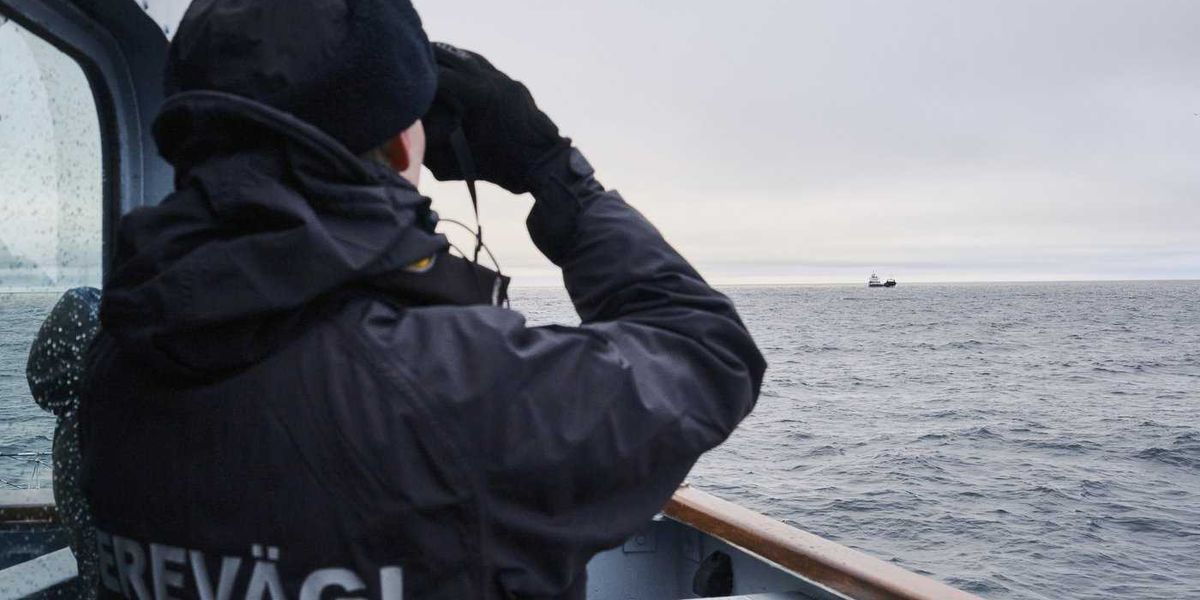
He said Russia’s attacks on energy infrastructure dovetail with its use of a “shadow fleet” of ships that are either unregistered or are linked to other countries in order to evade sanctions on Russian oil. Those ships, which seek to avoid detection, sometimes cut undersea fibre optic cables or jam GPS signals.
The Polish Institute of International Affairs, an independent think tank funded by the Polish government, said in a report last month that these acts of sabotage are meant to undermine European security and digital industries that depend on fibre optic cables in the Baltic Sea.
“We believe that the region is now a sphere of active conflict between Russia and NATO below the threshold of open aggression,” said the think tank’s Washington head Pawel Markiewicz.
“This is a strategic area of competition. And it has the potential of being a high-intensity conflict area with Russia.”
The Polish Institute of International Affairs also argues Canada is under threat. In October 2024, Polish prosecutors announced arrests in an alleged plot — which Warsaw has linked to Russia — to mail explosives to targets in Canada and the United States.
Liberal MP Ahmed Hussen told the panel the nature of war has changed and countries need to change accordingly.
“We would be very wise to learn from our partners, to work with them, to learn from them and to make those necessary investments, so that we can make our society more resilient,” said Hussen, a former cabinet minister who chairs the House foreign affairs committee.
Swedish Ambassador Signe Burgstaller said people in the region are increasingly seeing a link between threats in the Baltic and those in the Arctic.
“From our perspective up in northern Europe, this is one strategic, operational domain,” she said.
“Strengthening our defensive deterrence capabilities on the eastern flank also contributes to the defensive deterrence up in the northern flank.”
Burgstaller said Canada’s military deployment in Latvia aimed at preventing a Russian invasion is helping to deter more Russian activity in the North.
“It does also help overall to defend and deter in that whole geostrategic area,” she said.
She said Russia’s goal is to chip away at the unity of the NATO alliance.
“As all our neighbours in the Baltic Sea region are allies, we are increasingly exposed then to threats and hybrid attacks,” she said. “This is something that goes on daily and continuously.”
Sweden has been hit with sabotage attacks on telecom towers and aggressive cyberattacks. Airports in Denmark, Norway, Germany and Lithuania grounded flights last fall when drones appeared in the skies nearby.
Sweden has even reactivated psychological defence techniques it had shelved at the end of the Cold War. It has issued pamphlets to coach citizens and businesses on what to do in the event of an armed invasion, or the collapse of internet access.
This “total defence system” includes critical thinking and media literacy initiatives that seek to bolster civilians against acts meant to intimidate them or make them feel insecure.
“It is about enhancing our situational awareness. It is about building our resilience,” Burgstaller said.
“You involve the whole of society in strengthening the collective resilience of the country, meaning also that you would be able to hopefully deter and enhance the will to defend the country in the event of war or emergency situations.”
Hussen told the panel Canadian governments could learn from Sweden’s approach to defending itself from Russia’s increasingly brazen tactics.
“We can’t do that without our friends and our allies. So more co-operation — deepening that co-operation, exchanging information, making sure we work together, making sure that we demonstrate to our enemies that we are pretty much aligned on defending the Arctic (and) defending our territorial integrity,” he said.
Hussen said he’s particularly concerned about the threat of Russian cyberattacks on provincial health and education systems.
“There is a vulnerability, which is the subnational governments. Not all of them have the same capacity to withstand these frequent attacks, cyberattacks, on their very critical systems,” he said.
Hussen also suggested Canadians tend to see threats to the Arctic as more remote, thanks in part to Norad responding to aerial incursions that are far away from major population centres.
“We have the fortune of distance, and so Canadian and American joint patrols are able to intercept (them) before they enter Canadian airspace,” he said.
“Forty per cent of Canadian land mass is in the Arctic. I didn’t know that. And I think a lot of Canadians don’t know that. So I think we can start there … to really sensitize people about how much activity is going on there and the potential vulnerability that we have.”
This report by The Canadian Press was first published May 10, 2026.
By Dylan Robertson | Copyright 2026, The Canadian Press. All rights reserved.

