






Mark Rosenblatt’s new play Giant is a sensational, admirable, and courageous effort to Make Anti-Semitism Despicable Again. MADA baseball caps coming soon. You read it here first.
The play, just opened on Broadway after much acclaimed London runs in 2024 and 2025, is about the venomous, defiant, and utterly unrepentant anti-Semitism of the renowned British children’s author Roald Dahl, author of James and the Giant Peach, Charlie and the Chocolate Factory, The BFG, and many other beloved and critically lauded works. Directed by Nicholas Hytner, it stars John Lithgow as a magnificently textured, deliciously bitter, thoroughly repellent Dahl.
This is a pinnacle role for a storied actor, unforgettable even by his lofty standards. The play takes place in 1983 when Dahl ignited short-lived public outrage by comparing Israel to Nazi Germany in a book review about the 1982 Lebanon war. The review, some of which is quoted verbatim in the play, expressed understandable outrage about civilian deaths in Beirut but also slung stereotypes about Jewish greed, cowardice, and secret cabals, and then went on to lump all Jews together, suggesting none had opposed the Beirut bombing, all were now akin to Nazis, and Israel had no right to exist: “Now is the time for the Jews of the world to become anti-Israeli. But do they have the conscience?”
Other still more hideous remarks from Dahl are also worked into the play. For instance: “there is a trait in the Jewish character that provokes animosity.” And: “even a stinker like Hitler didn’t just pick on them for no reason.” The resonance with today’s rants around the Gaza war, as well as with Trump’s runaway egomania and indifference to hurtful language, are glaring and fascinating.
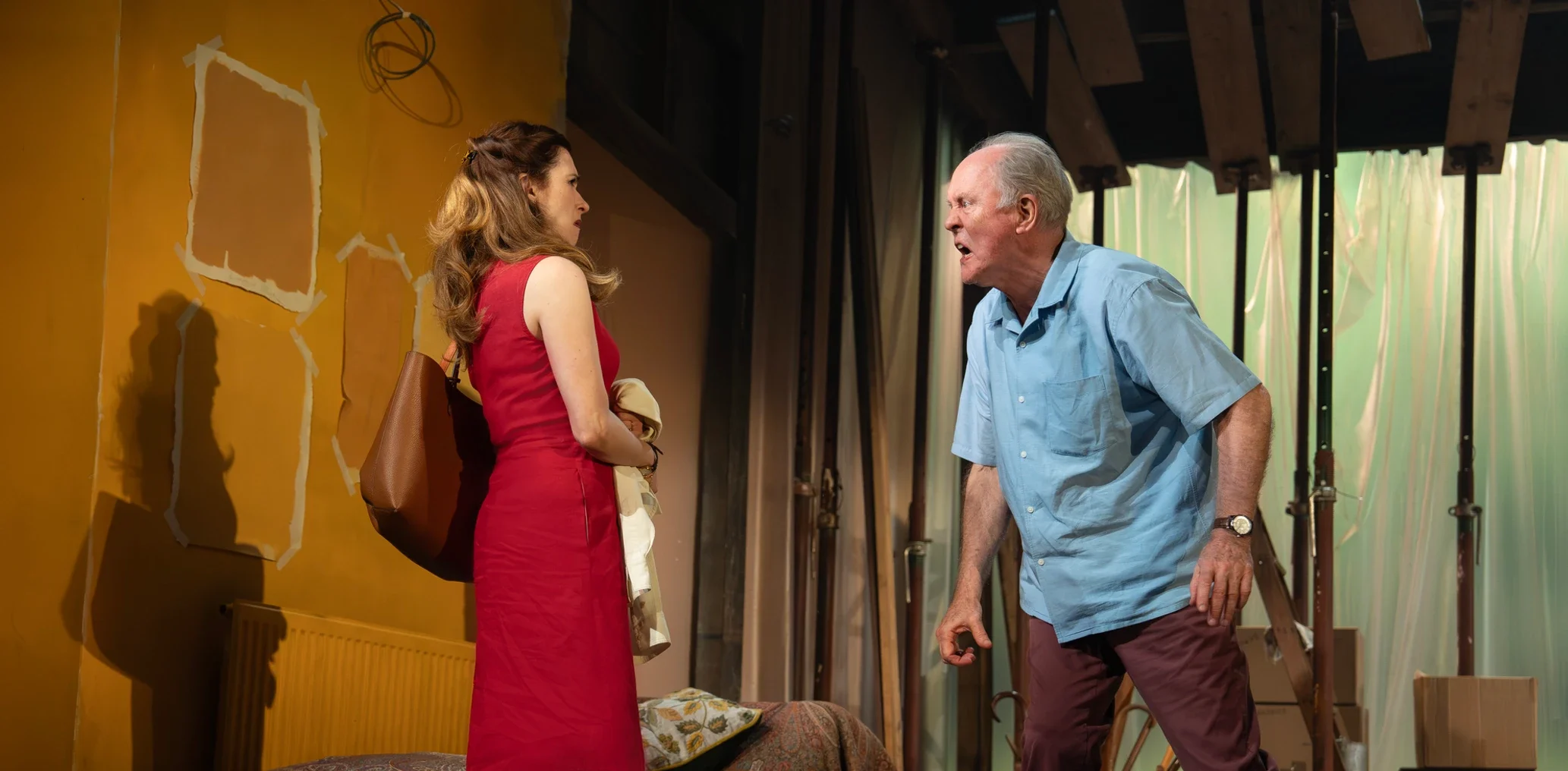
Giant is, impressively, Rosenblatt’s first play. It dramatizes a fictional visit to Dahl’s village home, in the wake of the book review, by his British and American publishers, attempting damage control. Both are Jewish and hope to elicit a mollifying statement from him, if not an apology. That the house is under renovation has made the always prickly author downright irascible. One of the publishers knows him much better than the other. The Briton Tom Maschler (played by an excellent Elliot Levey) tiptoes around his gargantuan ego with euphemisms and discrete circumlocutions. It does him no good—he’s dismissed as a “Spootlicker.” The American Jesse Stone (Aya Cash, gripping) is polite but tries directness. This does her no good—she’s dismissed as a “dragon.”
Dahl has no intention of cooperating. Quite the contrary, merely being questioned makes him double down, deflecting, baiting, and bullying not only Tom and Jesse but also his indulgent fiancé Liccy (Rachael Stirling) and their sweet, young Kiwi cook Hallie (Stella Everett).
His behavior is breathtakingly offensive and hypocritical. He calls the publishers money-grubbers who care more about book sales than dead Palestinian children, for instance, though we’ve just seen him begrudging his own illustrator duly earned royalties. Later, he browbeats Hallie into declaring whether she’d travel to Israel or buy an Israeli avocado. “Does the avocado know it’s Israeli?” is her answer.

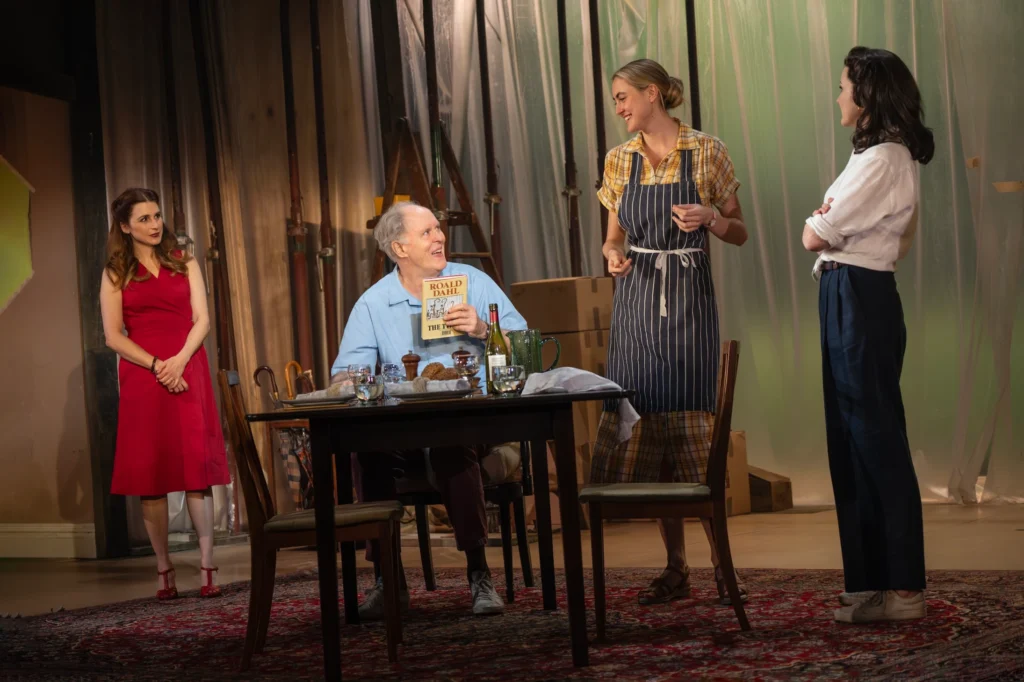
Aya Cash (Jesse), John Lithgow (Dahl), Stella Everett (Hallie), and Rachael Stirling (Liccy) in Giant. Photo: Joan Marcus.
Rosenblatt’s Dahl is a petulant baby who happens to be 6’ 4” (Dahl was 6’ 6”)—a big, fatuous giant who lives walled off in a fortress of ego and keeps everyone off balance with nonstop provocations. The play depicts his intransigence over two and a quarter hours, as he refuses to understand any objections to what he wrote, even when Jesse succinctly and indignantly explains the obvious ones in a rousing Act 1 climax.
This role is indeed “red meat” for Lithgow, as he has put it. He’s the best actor alive at bringing narcissistic monsters to life, having played Lear, Tartuffe, Winston Churchill, and Donald Trump. The playwright’s key perceptions about Dahl give the role full human dimension, as he is seen as both damaged by searing personal tragedy (gloomy youth, British boys schools, the deaths of his wife, child, and sister) and convinced that his childlike self-absorption is necessary to his work. His writing is of course celebrated for its honesty about the dark and nasty side of childhood.
Lithgow has the perfect resources for such a portrait—a deep and inimitable repository of demonic sneers and guffaws, exasperated cheek-waggles, furrowed brows, tactical moues, grumpy gasps, and much, much more. His loathsome Dahl is specific, fine-shaded, and chillingly credible.
Given the power and deserved buzz of this production, my brain has been running circles since I saw it around the promise and pitfalls of its larger MADA ambitions. My uncertainty concerns what can be reasonably expected of a Broadway show, even a major hit, in the eternal project of making bigotry durably ugly.
The main challenge in this case is that anti-Semitism has never had a very high social cost, especially among smugly ascendant classes like the British elite. We New Yorkers are easily misled on this matter, because Jewishness has long been exceptionally normal here. Living almost anywhere else will set you straight. The legal scholar Anthony Julius offers a telling story in his book Trials of the Diaspora. Shortly after World War II, Britain’s Chief Secretary of Palestine remarked to Golda Meir that “you must agree that if the Nazis persecuted the Jews, they must have had some reason for it”—remarkably similar wording to Dahl’s. Meir reportedly walked out of the room, and the Secretary couldn’t understand why.
Another big hurdle for Giant is the most obvious one: the much-lamented disappearance of commonly accepted red lines of speech and behavior in our society since the firehose of Trumpian lies was uncapped and incivility became epidemic. What can a single play do about value-chaos? Or about Trump’s cynical pretense of protecting Jews to press right-wing policies?
Still another challenge is the juggernaut of the Dahl media machine. Dead since 1990, he continues to sell millions of books world-wide, Hollywood regards him as undamaged property, and a vigilant fan base jealously protects his online reputation (the current, 15,000-word “Roald Dahl” article on Wikipedia mentions his anti-Semitism only in one deeply buried paragraph).
Let me be clear: I am no canceler. Most efforts to blackball and deplatform prominent creative figures, including anti-Semitic stinkers like Dahl and Richard Wagner, are shallow and shortsighted. Such artists, I believe, should be taught and studied, even enjoyed, provided their heroic reputations are complicated by the full truth. If we consistently remember their vicious hatreds whenever we speak about them, their fame can be used to teach the dangers of their bigotries. Only then can those who don’t shrink from complication truly enjoy them again.
Whether Giant can help foster such a habit with Dahl, and make it stick, remains to be seen. I wish it improbable success. In the meantime, it may have to make do with a few Tonys.
Giant
By Mark Rosenblatt
Directed by Nicholas Hytner
The Music Box
This article appeared in TheaterMatters on April 3, 2026, and has been reposted with permission. To see the original article click here.
This post was written by the author in their personal capacity.The opinions expressed in this article are the author’s own and do not reflect the view of The Theatre Times, their staff or collaborators.
This post was written by Jonathan Kalb.
The views expressed here belong to the author and do not necessarily reflect our views and opinions.