



![24th Jul: Ghost Town (2008), 1hr 42m [PG-13] (6.35/10)](https://occ-0-953-999.1.nflxso.net/dnm/api/v6/0Qzqdxw-HG1AiOKLWWPsFOUDA2E/AAAABTEswF2jp7ORmPT5p05PO3rHjALjqmzyCws-gU1qXGQFes7yuQoRMIL-oU_8RcfZW3QwFcJm37F_6FB18eEys7flhkkAdQelmecn.jpg?r=8af "24th Jul: Ghost Town (2008), 1hr 42m [PG-13] (6.35/10)")


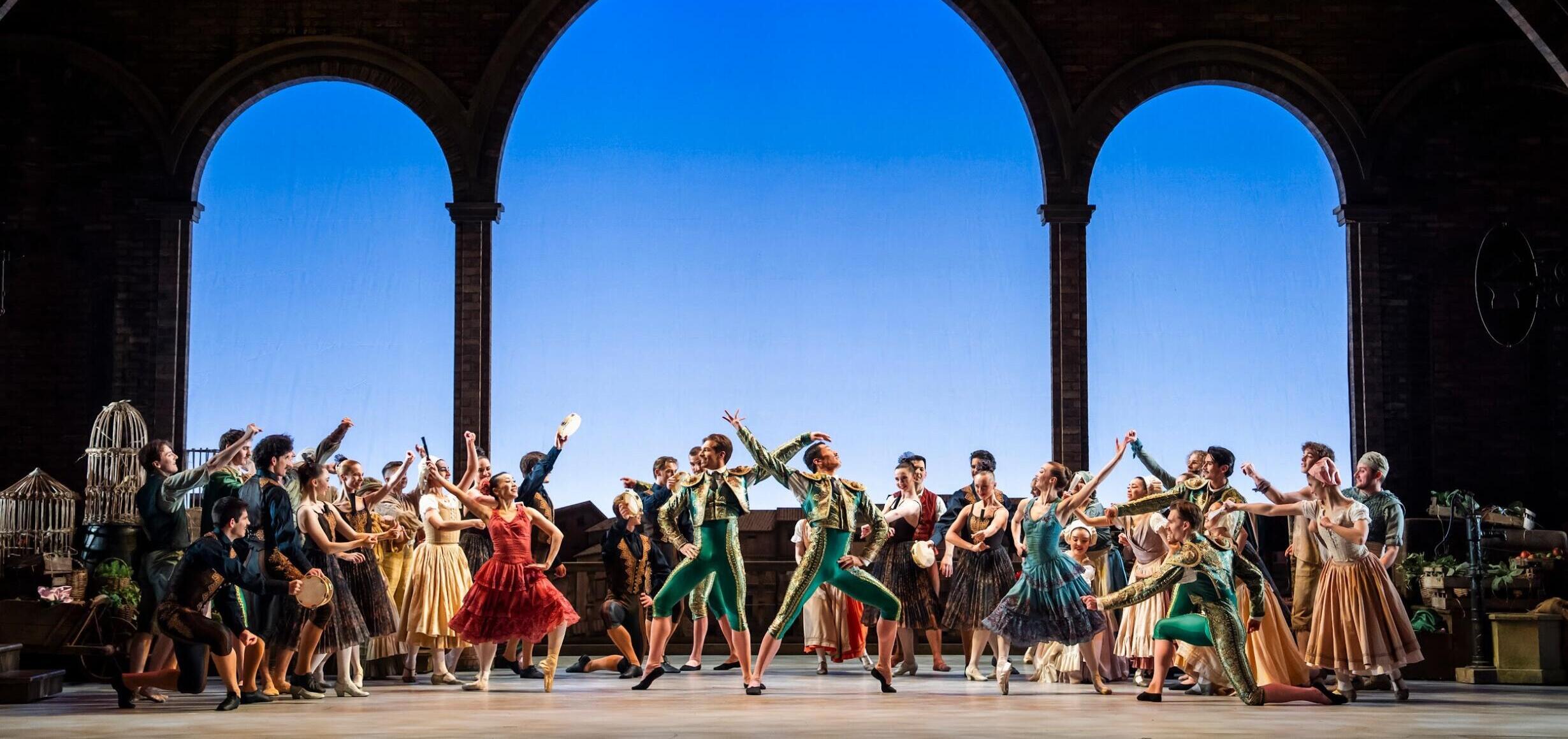
There are ballets about death, betrayal and ghosts. Then there is Don Quixote, where people clap, flirt, lie, fake death, shake tambourines and somehow expect all of this to end in a wedding. Carlos Acosta’s production for Birmingham Royal Ballet, after Petipa, understands that silliness is part of the pleasure. On a warm April evening at Sadler’s Wells, that brightness feels welcome. The evening, however, does not blaze at once. It has all the ingredients of a fiesta, but takes time to turn them into heat.
Tim Hatley’s colorful designs and Peter Mumford’s warm lighting create a world of sunlit squares, trickery and theatrical bustle. Acosta fills the stage with cheers, flamenco-like clapping, tambourines and street-life detail. That looseness is part of the production’s charm, though later it sometimes slips from bustle into untidiness. At its best, however, the staging finds simple theatrical poetry. The two on-stage guitarists, Tom Ellis and Alexander Crawford, are especially effective in the gypsy scene, seated by the campfire as Don Quixote slips into hallucination. Music, image and setting come together beautifully.
The first act still struggles to catch fire. Sadler’s Wells can feel too tight for a ballet that wants to expand sideways, and the main couple take time to settle. Katherine Ochoa’s Kitri has brightness and strong technique, but at first lacks the crispness and easy command the role needs. Tzu-Chao Chou’s Basilio is charming, handsome and likeable, though more sweet than roguish. Their early partnership feels polite rather than combustible.

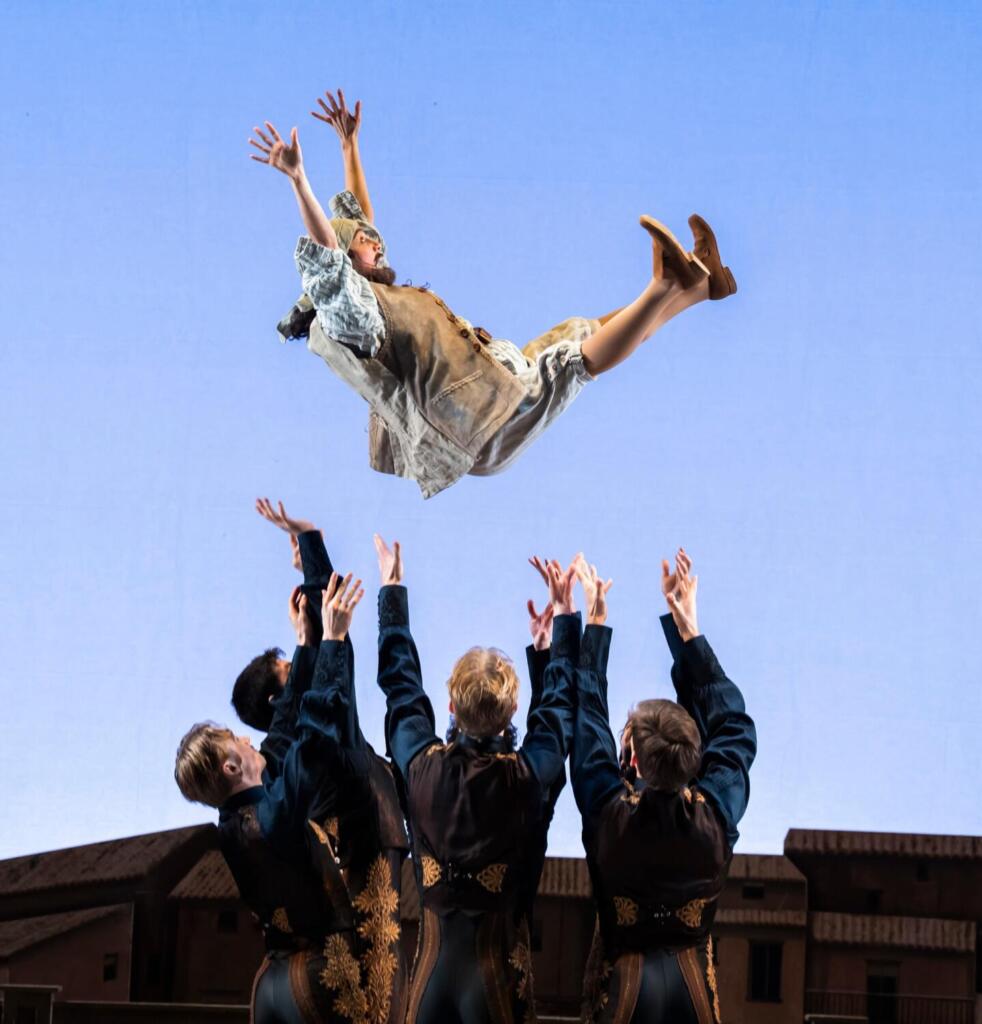
Olivia Chang-Clarke as Sancho Panza and the Artists of Birmingham Royal Ballet in Don Quixote. Photo © Tristram Kenton.
Around them, the men bring much of the life. The matadors, villagers and town boys repeatedly lift the stage, giving the square the warmth and rough playfulness it needs. Olivia Chang-Clarke’s Sancho Panza is also a pleasing comic presence, physically clear and well timed. She plays the role with confidence, which matters in a ballet where comic business can easily become empty noise.
The second act is stronger. The gypsy couple bring a welcome earthier heat, especially Ryan Felix as Lead Gypsy Man, whose dancing has real force and flavor. The atmosphere around the campfire also helps the production breathe. Here, the stage feels less cramped and the fantasy begins to work.
The evening’s most unexpected comic turn comes when Ochoa’s left pointe shoe decides to leave the ballet before she does. Held only by its ribbons around her ankle, it dangles through part of the gypsy scene while she carries on with admirable composure. It is an accidental Cinderella moment, except this Kitri has no need of a prince. She finds her chance, fixes the shoe herself, and returns to finish the job.
Ochoa looks increasingly at home in the dream scene. Her solo has control, line and clarity. In this more classical register, she becomes brighter and more secure. Yuki Sugiura’s Queen of the Dryads dances elegantly, though with less authority than the title suggests. Tom Hazelby’s Amour is charming too, less tiny sprite than playful beautiful youth, but appealing all the same.


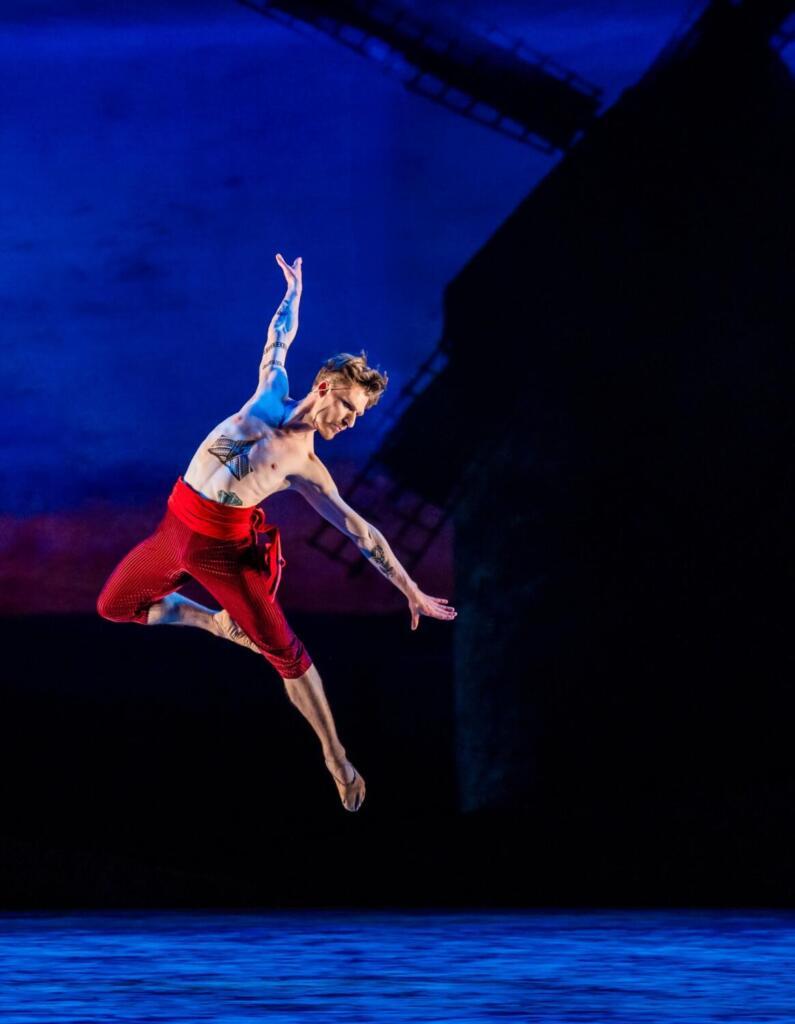
Ryan Felix as Lead Gypsy Man in Don Quixote. Photo © Tristram Kenton.
The third act is the best. Chou comes into his own in Basilio’s fake death scene, where his sweet, slightly odd innocence suddenly works. He may not have quite the roguish danger of the role, but here his gentle absurdity becomes funny and endearing. A table dance for Kitri and Mercedes also brings unexpected spark, with both women seeming freer, more playful and more connected to the world around them.
The wedding pas de deux gives Ochoa her strongest moment. Her balances are secure, her arabesques on pointe are clean, and her small pointe jumps glitter with precision. Most impressive are the fouettés, attacked with confidence and flashes of multiple turns. After an uneven start, she ends the ballet firmly in command. Chou also looks more settled, and the partnership finally warms.
There are still questions. Acosta’s production seems to want the looseness of street life, with people moving, reacting and playing in different directions. That looseness can be useful, but too often the ensemble slips from bustle into untidiness. Don Quixote can be busy, noisy and gloriously foolish, but its disorder still needs shape.
Even so, the evening gradually wins ground. It never quite becomes an effortless fiesta, and some of its sunshine has to be assembled in plain view: by the men, the gypsies, the guitarists, the comic business and finally Ochoa’s sparkling third act. Not every flame catches, but enough does. In a repertory so often crowded with doomed women, ghosts and tragic princes, there is still something welcome about a ballet that lets everyone be foolish, noisy and alive, even when the joy arrives slightly late.
Birmingham Royal Ballet
Don Quixote
Sadler’s Wells, London
25 April 2026
This post was written by the author in their personal capacity.The opinions expressed in this article are the author’s own and do not reflect the view of The Theatre Times, their staff or collaborators.