



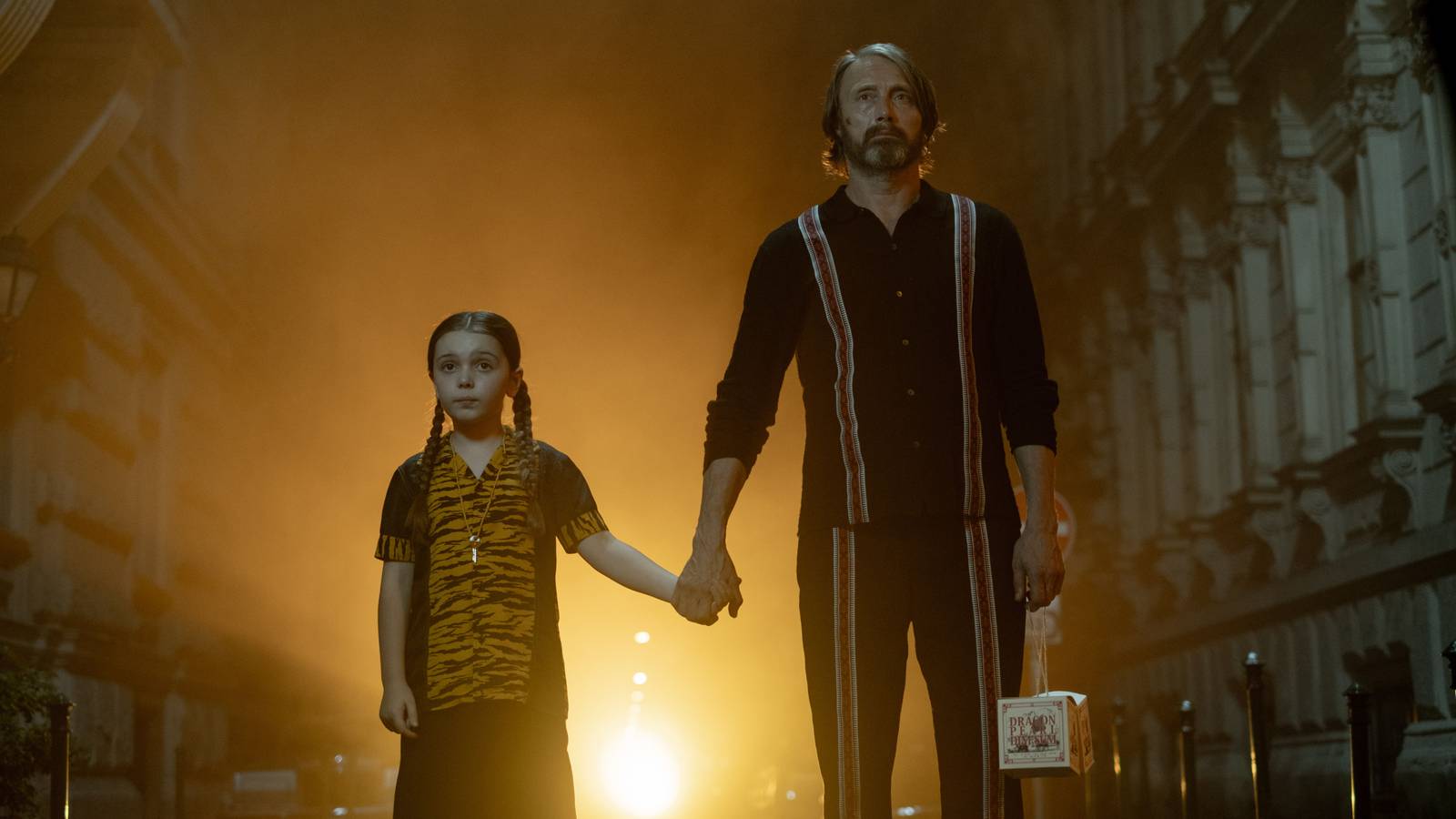
Bryan Fuller’s feature-film directorial debut, the horror fairy tale Dust Bunny, has a few connections to Thomas Harris’ Hannibal Lecter novels. One is simple and obvious: Fuller’s R-rated horror movie co-stars Mads Mikkelsen as a soft-spoken but menacing hit man, credited as “Intriguing Neighbor.” Mikkelsen also previously co-starred as cannibalistic serial killer Hannibal Lecter in Fuller’s enchantingly morbid psychological horror TV series Hannibal.
But the other connection between Fuller’s film and Harris’ psychological horror series isn’t apparent until Fuller explains it. Dust Bunny follows a young girl, Aurora (Sophie Sloan), who hires her hit man neighbor to deal with the monster living under her bed after the creature eats her parents. The books follow Hannibal Lecter and the FBI agents in his orbit. Dust Bunny, despite its R rating and a fair number of character deaths, was made with children in mind. By contrast, Harris’ books feature one character eaten alive by pigs, and another vivisected and served his own brains as a meal.
Yet, as Fuller tells Polygon via Zoom, the two are inextricably linked by their portrayal of children and how they react when faced with horrifying circumstances.
“I love children being their own heroes,” Fuller explains. Some of his favorite examples, he says, are the kid protagonists of the 1985 junior thriller The Goonies, and Short Round in Indiana Jones and the Temple of Doom. “Willie Scott and Indiana Jones would be sacrificed to Kali if it weren’t for this little boy saying, I have to be my own hero. I have to take action,” Fuller says. “Even The Shining is a story about a little boy who becomes his own hero. Yes, he has a wonderful mother who’s looking out for him and trying to protect him, but there are going to be circumstances where it is up to him to navigate his survival. And I’m always inspired by those stories.”
Fuller was drawn to this train of thought by an unexpected character from Harris’ first Hannibal novel, 1991’s Red Dragon. Francis Dolarhyde is a frenzied serial killer whose delusions drive him to kill families — an irony that isn’t lost on Fuller. He laughs at the idea of including Dolarhyde in his point about children being brave — but says that character’s childhood was an important part of Red Dragon.
“One of my favorite lines in Red Dragon that Thomas Harris wrote about Francis Dolarhyde — you know, family killer, kind of a different background. But one of the lines is, Francis learned something very early on that most people don’t figure out until they’re in their forties. And that is, ‘No one is coming to save you.’”
Dolarhyde grew up neglected, mistreated, and facing cruelty from others about his cleft lip. The abuse stirred his lack of empathy for others and drove him to violence. Like a wounded animal, Dolarhyde snapped back at his abusers. He’s only a hero to himself.


Dust Bunny’s Aurora, on the other hand, is a potential alternate version of Dolarhyde who had someone to care for him and protect him. Aurora faces overwhelming odds, including an order of assassins eager to silence her. Instead of waiting around to be eaten by the monster or murdered by the cadre of killers, Aurora uses her wits to navigate the world outside of her New York City apartment to find a defender. In the process, she inspires change in both herself and the hit man she befriends.
Typically for Fuller’s work, the sweet, innocent characters (such as Abigail Hobbs and Alana Bloom in Hannibal) either don’t stay that way for long, or have always had a dark side that they’ve carefully hidden away from society. So it’s no surprise that Aurora isn’t just a sweet little girl. She carries her own darkness in a way that reflects Dolarhyde. For one thing, Dust Bunny complicates Aurora’s relationship with her parents, implying that they deserve their fate for the ways they’ve mistreated her. And it complicates Aurora’s relationship with the creature under the bed as well. Harris’ books and Fuller’s films both explore the neglect that forces a child to grow up too soon and fight for survival, albeit in different ways.
“When we get into our 20s, or even sometimes in our 30s, we still may be looking for heroes and saviors,” Fuller says. “And if we can recontextualize our self-worth and our self-power to realize that we are going to be our own hero, then that’s a valuable story.”
Dust Bunny is now available for digital rent or purchase on YouTube, Google TV, Prime Video, and Apple TV.