




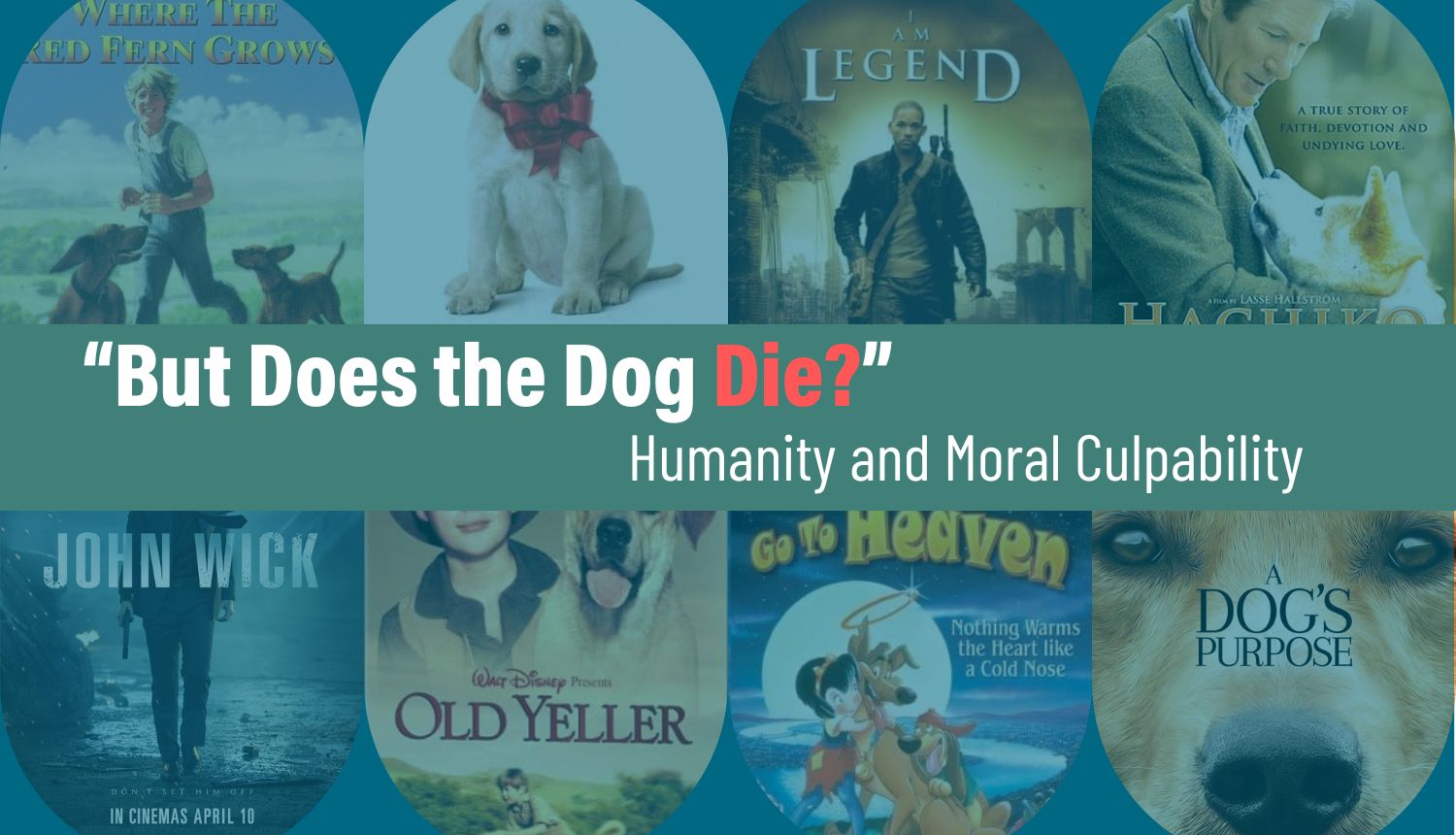
If you watch a movie like John Wick or I Am Legend, you’ll be confronted with many human deaths. Many men and women meet their ends before the credits roll, yet society typically does not lose any sleep over it.
But in those movies, it’s not just humans who die: In both cases, the lead protagonist’s dog is killed. In one case, the pup is executed by thugs; in the other, its owner is forced to strangle it to prevent a sort of vampirification.
And it’s the death of those dogs that catches people off-guard. In general, very few viewers will bat an eye when a human dies onscreen. However, many will refuse to watch a movie if they know the dog won’t survive to the end. This has even led to the creation of websites that specifically track whether movie dogs die.
But why is “Does the dog die?” a far more common question than “Does the human die?”
Well, it may be that we’re far more desensitized to human death, since entertainment showcases far more of it. On a statistical scale, dog deaths (and really, all animal deaths) are astronomically less represented onscreen than human deaths.
But I’d argue there’s a deeper understanding to be had here, too, one that doesn’t demean the inherent worth of human beings over other creatures. Rather, I’d postulate that our heart-wrenching feelings about movie dog deaths reveals something a little deeper about our hearts.
Lovable Goofs
But before we get into that, I think the first question to wrestle with is why is it “Does the dog die?” and not the fish, the cow or the Texas blind salamander? In other words, why do we care so much for the suffering of dogs, specifically?
The answer, I think, is that it is in a dog’s nature to be relational. A fish, for instance, tends to be more independent. It’s happy to just swim around in its tank all day, with or without people around. Livestock are seen as a utilitarian source of food. And wild animals are participants in the morally neutral natural order.
But dogs seem to carry no conditions for their loyalty and obedience. No other creature is quite as passionate in its excitement when its master returns. We connect with dogs because they, by nature, commit to us. They dedicate their short lives to us in steadfast submission.
So, is that the reason we care about the dog’s death? Because we hang out with it more than other animals?
I believe it goes even deeper than that.
Human Sin and Moral Culpability
As innocence implies, dogs (and all animals) are morally blameless; they have no moral agency, and so they cannot sin or rebel. An animal acts only by its natural instincts. It has no true understanding of right and wrong. But because of their sociability, we’re confronted by a dog’s moral innocence far more than any of God’s other creatures.
It is precisely because they are morally blameless creatures, however, that a dog’s suffering can be harder to stomach. When we watch such a trusting creature bear the consequences of pain that is morally undeserved, it causes us to wonder why the dog died.
And if one wonders long enough, they’ll find the answer: humanity.
Unlike animals, humans are morally culpable. It is by our actions that innocent creatures like dogs suffer—for we are the ones who, through original sin, disordered the creatures we were meant to steward.
And this is why I’d argue that, even though we are greater than dogs by virtue of the Imago Dei, it seems like a man’s death in a movie is easier to handwave away than that of a dog’s. A person is infinitely more valuable than a dog, but a person is also able to merit punishment on a moral level that a dog cannot.
We intuitively understand that, because we are culpable creatures, humans stand under judgment in a way that animals do not. And because animals are not created in the image of God, their deaths cannot be morally justified within the creatures themselves. So, when the dog dies, it forces the viewer to look beyond the creature and toward the fallen order wrought by humanity.
The dog’s death stands as a moral mirror, the derivative consequence of our Fall, forcing us to confront our own guilt and poor stewardship of the world. With each whimper, a dog reminds humanity that, despite its natural trust in us, we betrayed it and every creature through our original moral breaking of the world.
The Wolf and the Lamb
And perhaps this is why “Does the dog die?” holds so much weight over our hearts. It’s not because we confuse the moral worth between dogs and humans; it’s because the answer speaks to our implicit understanding that the world’s brokenness is our doing—and creatures that were never complicit in our rebellion still live in its shadow.
But Christian thought does not end with the world permanently broken. We are promised that God Himself will restore us to glory. He will also fix the world we have destroyed through our redemption.
“For the creation waits with eager longing for the revealing of the sons of God. For the creation was subjected to futility, not willingly, but because of him who subjected it, in hope that the creation itself will be set free from its bondage to corruption and obtain the freedom of the glory of the children of God.” (Romans 8:19-21)
Creation shall share in the effects of humanity’s glorification. And just as the wolf’s violence against the lamb is not its own sin but ours echoed through creation, so too will that violence give way to peace when all things are made new.
The hope is that one day the trusting creature will not have to pay for the sins of its keeper. And that hope is being achieved by Jesus, who came down and—like the innocent lambs slain in the Old Testament to cover sins—willingly bore the weight of our guilt in His innocence.
And in that day, the wolf shall dwell with the lamb, the lion will live with the calf (Isaiah 11:6), and the dog will not die for our failed stewardship.