






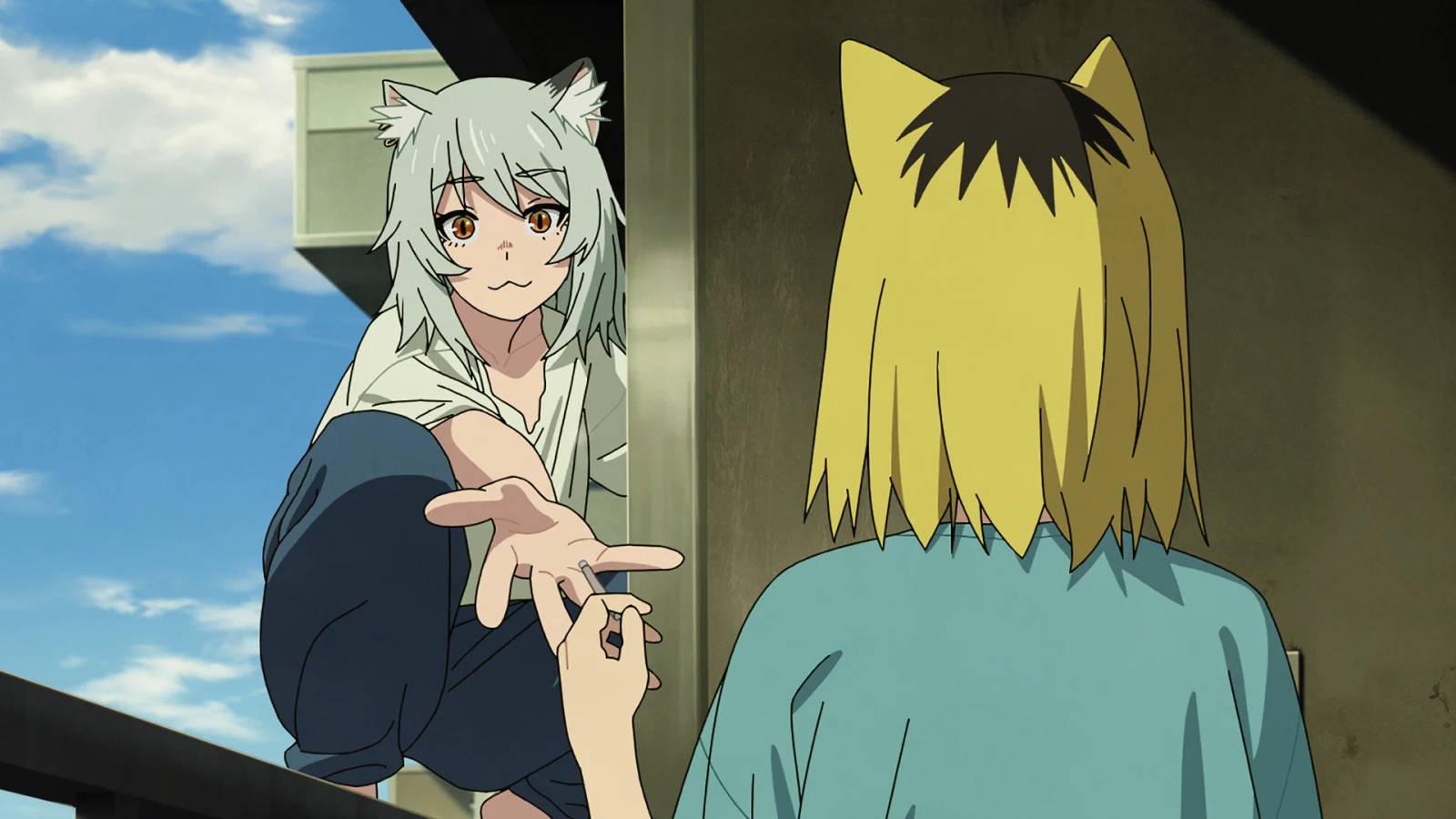
There are plenty of anime protagonists I’d gladly spend an afternoon with, whether it’s Megumi Fushiguro from Jujutsu Kaisen or Kikuri Hiroi from Bocchi the Rock! Yet Yaniko, the titular star of Netflix’s Chainsmoker Cat, isn’t one of them. The young “beastfolk” is filthy and reeks of stale cigarettes. Her apartment is a biohazard of overflowing ashtrays, empty bottles, and garbage that seems to have fused with the floor. She’s perpetually behind on rent, chronically broke, and so dependent on nicotine that she’ll rifle through discarded cigarette butts just to get another drag.
Chainsmoker Cat frequently plays these moments for laughs and uses Yaniko’s condition for lighthearted comedy beats, but the punchline is never that addiction is funny. The joke is that addiction has a way of humiliating you. It strips you of your dignity. That’s a distinction Chainsmoker Cat understands better than most stories willing to tackle this rather touchy subject, one that so few seem to get right.
I’ve struggled with addiction myself, and one of the most agonizing things about the condition is how grotesque it makes you feel; not necessarily in a physical sense, but mentally. Even when your apartment is clean and your clothes are washed, addiction makes your brain feel like it’s rotting from the inside, like no amount of shampoo or detergent will wash away the stink of your mistakes. Every promise to quit is followed by yet another excuse. Every rational thought is interrupted by the voice insisting one more drag, one more drink, just one more, whatever it is, will somehow make life easier, but it never does.
Most media tends to swing between two extremes, from the seductive mythology that surrounds films like Blow and Trainspotting, where addiction becomes entangled with the allure of living fast, to the redemptive arcs of Flight and 28 Days, where confronting the problem becomes the story’s climax. Chainsmoker Cat lands somewhere far messier. The series allows Yaniko to be funny, but never enviable. Every cigarette makes her life smaller. Every shortcut digs the hole a little deeper. That ugliness is what makes the series ring true for those who know the decrepit lifestyle of existing solely for your next high.
Beneath the perils of addiction, however, Chainsmoker Cat is hiding another debilitating factor of life many people struggle with that few take seriously: poverty. An excellent writeup from Unseen Japan argues that the series is secretly about Japanese poverty and the precarious work, social stigma, and invisible arithmetic of barely surviving. Yaniko’s addiction doesn’t just exist alongside her poverty — it feeds it, while her poverty, in turn, feeds the addiction. The two become impossible to separate, a never-ending cycle of depression, temporary relief, and inevitable regret.
That’s the part that hit me hardest. People who’ve never experienced addiction always ask the obvious question: “Why not just stop?” But addiction isn’t an isolated decision; it finds a way to weave itself into almost every aspect of your life, and even when you’re poor, those hard-earned dollars become fuel for the coping mechanism of escaping your abysmal life. You might know, deep down, that buying another pack (or whatever illicit substance it might be) means sacrificing something else, like food or even your water bill — the latter of which Yaniko herself left unpaid. But your brain has already convinced itself that surviving the next hour matters more than surviving the next month.
It’s impossible math. Watching Yaniko scrape together enough money for cigarettes while everything else collapses around her might seem funny to some people, and the way she lives her life might gross a lot of viewers out. But I remember that kind of thinking; the bargains you make with yourself, the confidence that tomorrow will be different, and the certainty that this is the last time, right up until it isn’t.
That’s why the show’s disgusting imagery, despite being gross at the best of times and downright repugnant at the worst of times, feels so important. The stained walls, the overflowing trash, the ash piling up everywhere all externalize what addiction and poverty do to a person. Even if your own surroundings aren’t covered in grime, that’s often what your mind feels like: cluttered, sticky, and impossible to escape.


Chainsmoker Cat certainly could have softened those edges and turned Yaniko into an adorable mess whose bad habits are just another quirky character trait. Instead, it forces viewers to sit with the consequences of her actions without abandoning a strong sense of humor. That balance is difficult to pull off, and it’s what elevates the series beyond shock value.
The saddest part is that the cigarettes are almost incidental. They’re simply the visible symptom of a life spent calculating impossible odds, where every decision is shaped by the desperate hope that one small comfort might make tomorrow bearable. As anyone who’s lived through addiction knows, it never does. But Chainsmoker Cat understands that, before you can escape the cycle, you have to recognize it. Sometimes the most meaningful stories aren’t the ones that offer easy answers.
Maybe that’s why I still can’t stop thinking about Yaniko. Beneath all the cigarette butts, overflowing ashtrays, and absurd comedy is a show that understands addiction better than most prestige dramas ever have. It just happens to tell that story through a broke catgirl who really, really needs to quit smoking.

![25th Sep: UNABOMBER (2026), 1hr 40m [R] (6.05/10)](https://occ-0-171-92.1.nflxso.net/dnm/api/v6/0Qzqdxw-HG1AiOKLWWPsFOUDA2E/AAAABSHKOxDs_gE5lCil__PAU8wSDr669b8W9LkmKgS2diGFCd-rpWn7pYIsjIXW47pOJSjoNf6Pd7A7ztryBztnCQZ7B2UfF7ANTk3f0k5EnS8fHCV6iGInVdzn0lsQBCs_29DZgjul5YOPGZJR8lI3eFt5CGeRIUtV5MvN2ez8Dstumg.jpg?r=286 "25th Sep: UNABOMBER (2026), 1hr 40m [R] (6.05/10)")