






Annie Baker’s Circle Mirror Transformation is currently enjoying a highly acclaimed tour to major Italian theatres. The play made its debut in an Off-Broadway production in 2009, after which it has had many productions in America and elsewhere. After nearly two decades, it has reached Italy and in late April I caught this Pulitzer Prize-winning play, at Milan’s Piccolo Teatro Strehler. The set, designed by Guido Fiorato, immediately suggests the clutter of miscellaneous items, one might find in a community center, where, in fact, the play unfolds. There are three doors, upstage, one of which was open, through which one could see a mirror; stage left, three large circular rings, one on top of the other; downstage, a row of three wooden chairs; upstage right, a large, undefined object covered with a plastic sheet.
Baker’s concept couldn’t be simpler: five characters of different ages, three women and two men, are beginning a six-week drama workshop in Shirley, a small provincial town in Vermont, where Marty, a drama teacher, is determined to train them to act. There is no play, no plot, no climax or anticlimax, but rather a series of drama exercises, interrupted now and then by an interval, when the characters reveal a more intimate side to themselves. In one interval, the middle-aged Schultz, who up to then had seemed quite shy, finds himself alone with Teresa and confesses his need for a relationship; his wife has thrown him out, leaving him homeless.
Some of the exercises proved fascinating, like the one where the participants were invited to pretend ‘I am you’ and deliver a monologue where they put themselves in the shoes of another person in the group. As they performed their monologue, the other characters had to guess – and this includes the audience – who they are talking about. The exercise, as Marty pointed out, aimed to improve the participants’ ability to listen to, and empathize with others, giving rise to some surprising revelations about group members. Fundamental to Marty’s method is her refusal to give her students a play and consequently a character to perform. While this decision is excepted by the older participants, sixteen-year-old Lauren, the youngest person in the group, challenges her instructor. She has joined the workshop in the belief that acting means interpreting a character, and feels deeply uncomfortable being denied this.

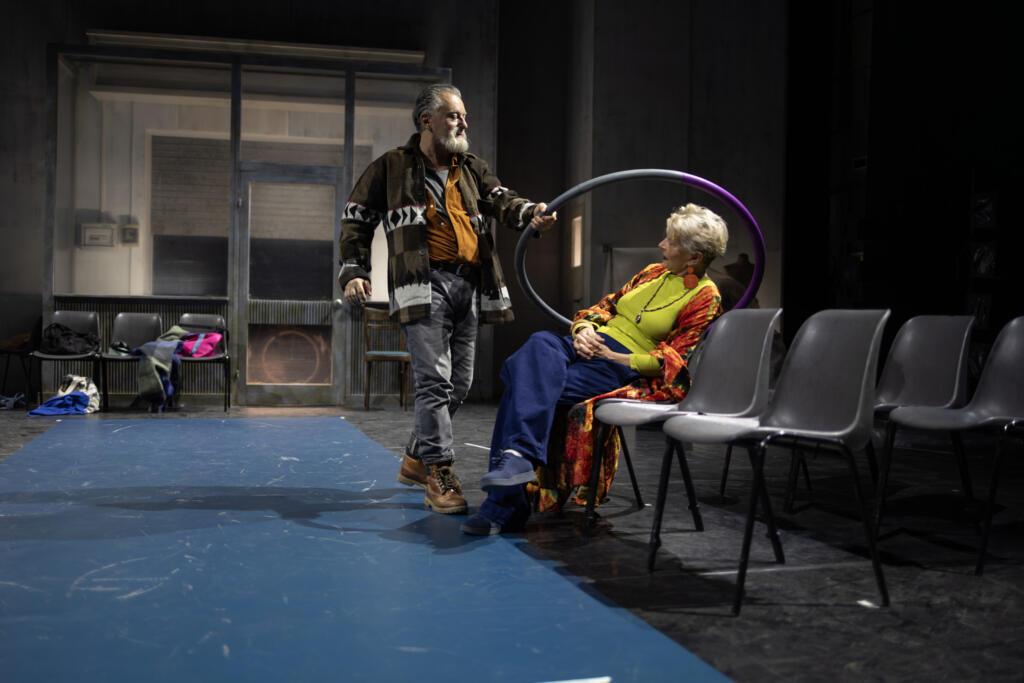
Circle Mirror Transformation, by Annie Baker, directed by Valerio Binasco, at Piccolo Teatro Strehler Milan. Photo credits: Virginia Brown.
At the beginning of the play, it seemed as if nothing of significance would happen. Was it going to be an hour and half of chitchat? Fortunately, this wasn’t the case and multiple facets of each character gradually surfaced. For instance, initially Marty came across as in total control of the group and of herself as she gave participants clear instructions how to do the exercises, spurring them to improve. Then, out of the blue, she went berserk, tearing the plastic sheet off the mysterious object mentioned earlier, revealing a naked torso of a woman, perhaps representing Marty’s unveiling of a part of herself hitherto kept hidden. Gradually it came to light that she was going through a crisis in her relationship with her husband, who was one of the participants (played by Valerio Binasco).
During a panel discussion in Turin, director Valerio Binasco explained how he had chosen to become a director because of his fascination with acting not with theatre. Consequently, when he came across Circle Mirror Transformation, it seemed like a dream come true. Together with the cast, with whom he has worked on other occasions, he has encouraged each actor to dig deep into their character, and convey the spoken but also unspoken which emerges in these only apparently banal dialogues. The result is not a psychodrama the aim of which would to cure participants, but a creative process which invites each individual to seek greater insight into their psyche.



The cast of Circle Mirror Transformation, by Annie Baker, directed by Valerio Binasco, at Piccolo Teatro Strehler Milan. Photo credits: Virginia Brown.
Circle Mirror Transformation
by Annie Baker
Translated by Monica Capuani E Cristina Spina
Featuring Valerio Binasco, Pamela Villoresi, Alessia Giuliani, Andrea Di Casa, Maria Trenta
Staging: Valerio Binasco
Set Design: Guido Fiorato
Costumes: Alessio Rosati
Lighting: Alessandro Verazzi
Sound: Filippo Conti
Video: Simone Rosset
Production: Teatro Stabile di Torino – Teatro Nazionale, Teatro di Roma – Teatro Nazionale
This post was written by the author in their personal capacity.The opinions expressed in this article are the author’s own and do not reflect the view of The Theatre Times, their staff or collaborators.
This post was written by Margaret Rose.
The views expressed here belong to the author and do not necessarily reflect our views and opinions.