






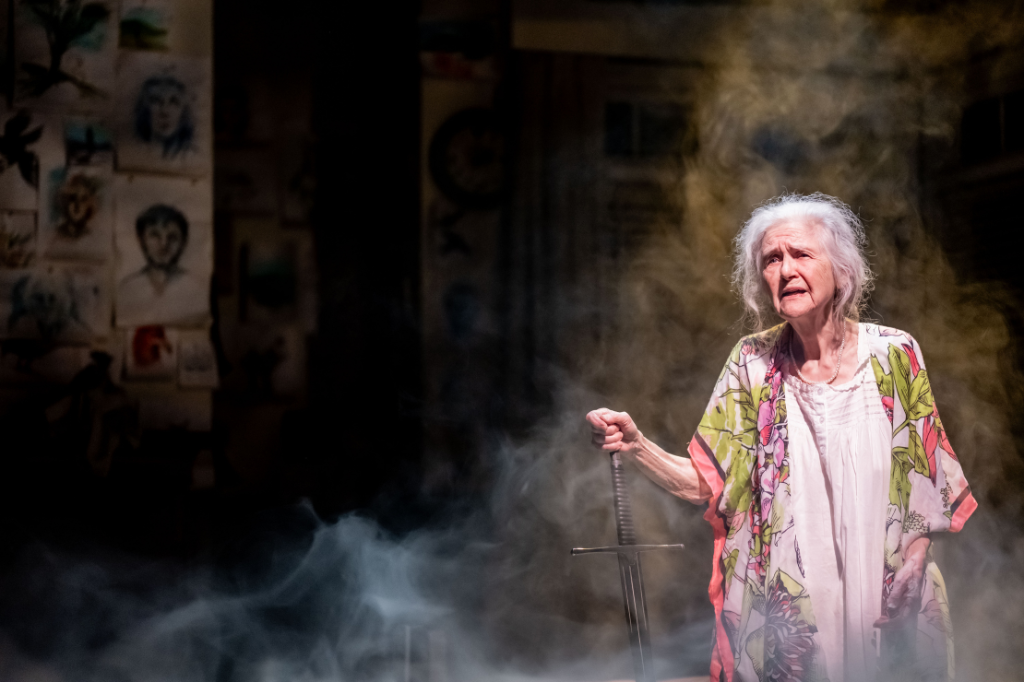
It’s fitting that a play about a queen reunites Canadian theatre royalty.
Judith Thompson’s Queen Maeve, premiering at Tarragon Theatre, marks the celebrated playwright’s sixth premiere at the theatre, in a career that’s spanned more than four decades. Thompson’s body of work, which has received two Governor General’s Awards, often foregrounds outcasts: Plays like Lion in the Streets and Watching Glory Die burrow into lives and experiences disavowed by middle-class Canadian society.
Her most recent drama continues that excavation. Queen Maeve’s central character is a woman in her 80s, isolated in a nursing home, who believes herself to be the titular Maeve: a warrior monarch from Irish mythology. In Tarragon’s production, staged by artistic director Mike Payette, veteran stage and screen actor Clare Coulter plays the protagonist.
“I think that Judith is interested in how violence erupts out of a domestic situation,” Coulter said over video call. “In this play, [my character is] in the nursing home, and there are things that she absolutely cannot deal with as a domestic [everyday] person. So, she becomes a violent warrior.”
Coulter said that, despite the play’s title, she doesn’t see her character as royalty. “She’s called a queen, but she’s really a fighter, a soldier,” she explained. “I imagine her dying, probably in her 30s, on the battlefield. She probably didn’t get to be my age.”


Is Coulter’s character really an ancient being, or is this identity an attempt to cope with loneliness and estrangement? Both play and performer prefer to leave the question open.
“The audience will answer for themselves,” said Coulter. “I’m hoping that this play will ask the audience: ‘What are the limits or the boundaries of our reality?’”
Coulter is no stranger to testing boundaries. In 2013, she played another, traditionally male, monarch — King Lear — in a stripped-down production directed by Philip McKee. She also has a long history with Thompson’s plays, having performed in four premiere productions by the writer: White Biting Dog in 1984, I Am Yours in 1987, Pink in 1986, and the aforementioned Lion in the Streets in 1990. Despite the long acquaintance, Coulter said that Thompson’s writing continues to offer fresh surprises.
“I feel that I’m just learning some of the extraordinary aspects of Judith’s writing,” she reflected. “What it does and what it offers. The material is unusually raw, and penetrating. It’s the dynamic of ripping the carpet out from under you over and over again. [What I’m] just beginning to see — and I hope I’m right and not betraying Judith [by saying this] — is the amazing musicality of her writing.
“Once you begin to let those sentences rip through your body,” she continued, “you can feel as if you’re practically a member of a symphony. You’re on this musical road, whipping along at 80 miles an hour.”
Coulter continues to find surprises in her own craft, as well. “I’ve been doing [film and television] now for a long time,” she explained. “It’s changed my understanding of how I need to articulate words on a page.” Recent screen credits include a guest appearance on the hit TV show Severance, and performing alongside Alan Cumming in the 2024 film Drive Back Home. Millennial readers might have grown up watching Coulter in the children’s fantasy series The Worst Witch.
“I’ve learned to really love what the camera can do,” said Coulter. “You have no need to do any presentation of anything [as an actor]. You just need to think and feel, and open your mouth and let [the lines] come out slowly and quietly, and the camera will pick every single minutia up.”
Screen acting allowed Coulter to live in her characters’ moment-to-moment thoughts more completely than she’d been able to onstage. “As an actor, I always wanted the delicacy of a kind of meditative thought,” she explained. “[For example, if your line is] ‘I never loved my daughter,’ there’s thought in arriving at the articulation of that sentence.”
By contrast, theatre often requires a more presentational performance. “That’s where [your acting] can slip into something that isn’t true,” said Coulter. “For decades, I was always trying hard as a theatre actor to stay in that internal meditative state. I did very well on [small-scale projects].”


During the 1990s, Coulter toured internationally in The Fever, a solo piece by the American playwright Wallace Shawn. She said that watching Shawn perform in other productions of his own work helped teach her how to bridge the divide between stage and screen acting.
“You can see that when [he’s] presenting something to an audience, the line of what is the stage and what is the audience is broken,” Coulter said. “He steps right to where they are. I never thought that I needed to learn that, but I did.”
Now, Coulter is eager to put a lifetime of learning at the service of Thompson’s text. “This is the first stage play I’ve done in such a long time,” she said, “but I feel I’ve really learned what the stage asks of the actor: that they go beyond what we used to call the footlights and settle in to where the audience is.”

She’s also learned that there’s no use being precious about the feelings she conjures onstage night after night.
“Emotions are tricky,” she said. “For me, [at the end of a performance], it’s as though you’re left with a script that’s covered in garbage. The garbage is all this emotional brilliance that you’ve just produced, but it’s going to die within the night as you sleep. It’s going to decompose.
“You have to return to the script after that wonderful run of emotional height,” she continued, “by reading it aloud to yourself before you go to bed. [You have to take] your broom, or your scrubbing brush, as it were, and rid the lines of all that emotional kerfuffle. Then, when you come [onstage] the next day, you’re ready to burst out in a brand new emotional blizzard.”
Coulter was in rehearsals at Tarragon when the interview took place. She planned to take her brush to Thompson’s script that evening. “[I] become a cleaning woman at night,” she joked. “[I have to] scrub off all that emotion again, clean it right out.”
Queen Maeve runs until March 29 at Tarragon Theatre. More information is available here.
Tarragon Theatre is an Intermission partner. Learn more about Intermission’s partnership model here.


WRITTEN BY
Nathaniel Hanula-James
Nathaniel Hanula-James is a multidisciplinary theatre artist who has worked across Canada as a dramaturg, playwright, performer, and administrator.
LEARN MORE