











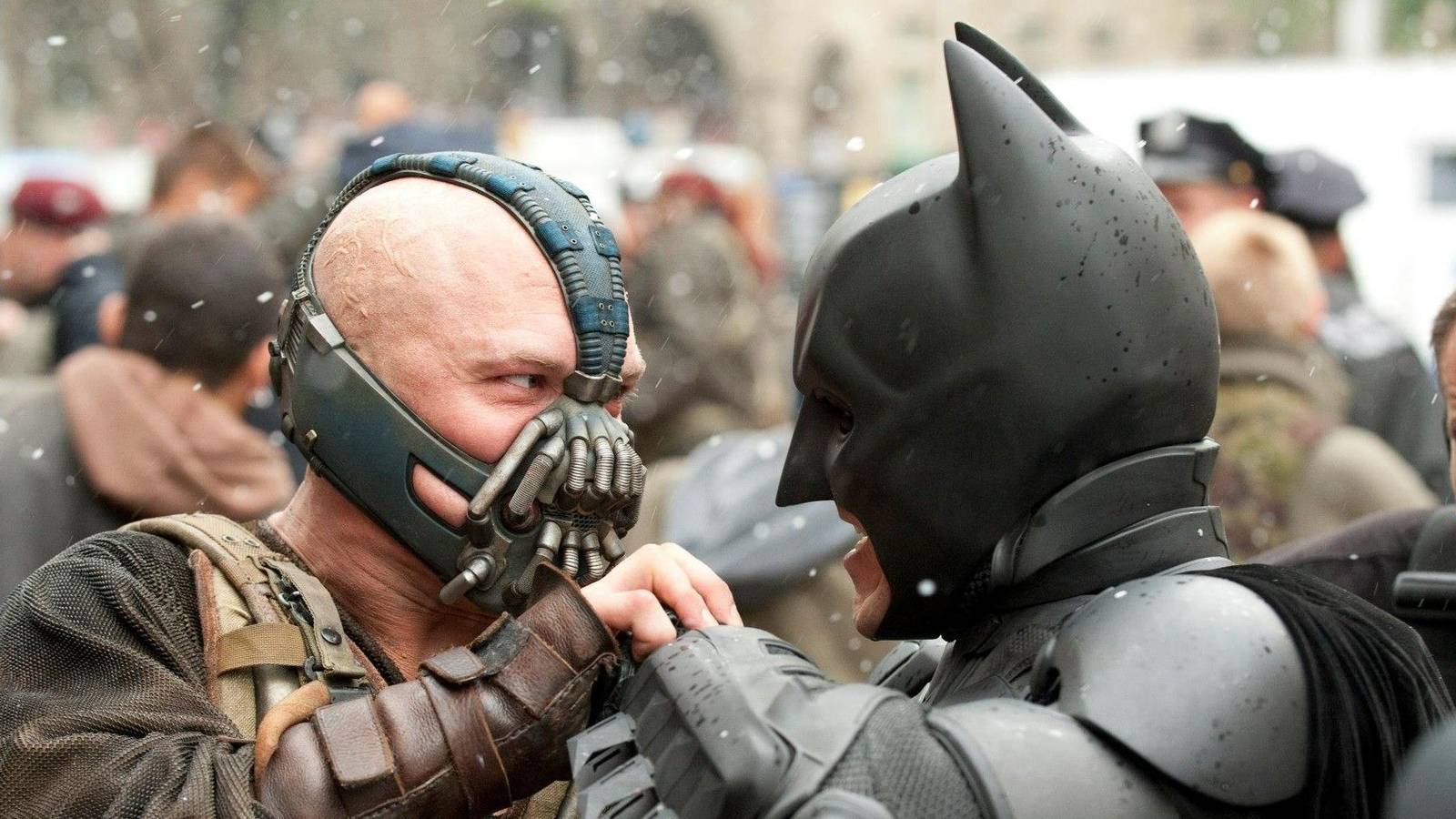
Christopher Nolan did an impressive job of bringing Batman villains to the big screen. Heath Ledger’s Oscar-winning performance as the Joker in The Dark Knight set the high-water mark for the series, but other highlights included Cillian Murphy’s appropriately creepy Scarecrow, the sinister paternalism of Liam Neeson’s Ra’s al Ghul, and the dark charisma of Aaron Eckhart’s Harvey Dent. Tom Hardy’s take on Bane was the low point of the series, thanks to his bizarre voice and the character’s convoluted schemes. But now a new Batman trilogy is finally doing justice to one of Gotham’s most terrifying villains.
[Ed. note: This article contains spoilers for Batman: Knightfall – Part 1]
Batman: Knightfall, which premiered at Annecy Festival, is a faithful adaptation of the DC Comics arc of the same name that ran from 1993 to 1994. The storyline overlapped with The Death of Superman, part of an era when DC execs were trying to fight declining sales by shocking readers. The writers of The Death of Superman introduced Doomsday to temporarily kill the Man of Steel, leading to a mix of new heroes and villains jockeying to take his place. The writers of Knightfall mirrored that structure, with a new villain, Bane, who incapacitated Batman and led to the creation of the Bat-Family.
Nolan wedged Bane in at the end of his trilogy and undermined the villain by making him a weapon of Talia al Ghul (Marion Cotillard). It’s not as bad as the insult Joel Schumacher dealt the character in his big screen debut in 1997’s Batman & Robin, but Nolan’s twist wound up being a disservice to both villains, since Talia doesn’t get much time to properly manipulate Batman. The only good thing about Hardy’s Bane is that he provided Harley Quinn with plenty of good material for jokes.
While The Dark Knight Rises relegated Bane to attention-grabbing muscle, Knightfall director Jeff Wamester and writer Jeremy Adams positions him as equal parts brawn and brains. The Dark Knight Rises borrowed from The Dark Knight Returns by portraying Batman as old and physically in decline before Bane shows up. In Knightfall – Part 1, Bane (Michael Mando of Spider-Man: Brand New Day) actively works to wear down Batman (Anson Mount of Star Trek: Strange New Worlds) to give himself a powerful edge.
Bane learns patience in a brutal Santa Prisca prison. (His Knightfall origin is admittedly about as ridiculous as the pit in The Dark Knight Rises.) Bane is trapped alone in a hole with a magazine profile about the Wayne family and Gotham as his only respite from doing crunches and protein maxing by eating rats. He’s already shockingly jacked when the prison’s warden subjects him to an experimental medical treatment, pumping him full of a super-steroid that seems to make him as big, strong, and tough as the Hulk.
The Knightfall trilogy will use three films to tell Bane’s story, but Wamester also doesn’t waste any time in Part 1, which clocks in at 80 minutes. A pair of tiny flashbacks to Dick Grayson leaving Wayne Manor and the events of Batman: A Death in the Family reveal Batman’s already in a bad place before new trouble arrives. Bane makes things much worse by blowing up Arkham and releasing most of Batman’s rogues. As Batman rushes between fights with the Mad Hatter, Scarecrow, Victor Zsasz, the Riddler, and others. Each skirmish takes a physical and mental toll, leaving Batman bloodied, exhausted, and psychologically brittle.
The other edge Knightfall has over The Dark Knight Rises is its R rating. Nolan kept things PG-13 by mostly having Bane favor explosives, but Wamester and the animators at Studio Mir let him really unleash bloody, close-quarters carnage. Bane shows off his immense physical power by crushing skulls and ripping out spines. This Batman is still reeling from the death of Jason Todd, and it’s easy to understand why he tries to bench Tim Drake (Jack Giffin) out of concern for his safety. Bane’s victory feels inevitable, and it’s just a matter of how much bloodshed he causes along the way.
Knightfall’s Bane understands Batman is the linchpin of Gotham, so he doesn’t need to secure a nuclear bomb or trap the entire police force underground to get what he wants. The setup makes the fight between Batman and Bane far more satisfying than the matchup in The Dark Knight Rises. The whole film leads to the moment when Batman faces a foe he can’t actually defeat. When Bane breaks Batman’s back with a visceral crack, it represents the city itself being shattered. That’s why Bane doesn’t hide Batman away to teach him a lesson about his own awful backstory — he delivers the battered hero to the Gotham Police Department to demonstrate his absolute dominance.


The methodical work Bane put into defeating Batman in Knightfall will also make the resolution of this story far more satisfying than in The Dark Knight Rises. Nolan’s Batman inexplicably recovered after a few months in a hole. Then Catwoman killed Bane while Batman dealt with Talia, an arc that further marginalized Bane as a villain. Assuming the Knightfall trilogy continues to stick to the source material, it will make Batman’s road to recovery far more arduous, while requiring him to confront his biggest weaknesses in order to win the rematch.
As an animated, direct-to-video trilogy, Knightfall will have a tiny fraction of the reach of Nolan’s $1 billion blockbuster. That means Nolan’s version of Bane will remain the most famous take on the character for the foreseeable future, especially given Matt Reeves said The Batman 2’s villain hasn’t been in a movie before. But comics fans, or anyone who left The Dark Knight Rises wishing for more from Bane, should be sure to watch Knightfall when it’s released later this year. More than 30 years after the character was created, Bane has finally gotten the movie he deserves.
