








Dea Loher (b. 1964), has been a prominent German dramatist since the world premiere of her first play, Olgas Raum, in 1991. Her publisher, Verlag der Autoren, lists 24 plays. Frau Yamamoto ist noch da was premiered in 2024 in Tokyo, with the German language premiere in Zürich and the first German production in Stuttgart, both in 2024. A production in Bremen opened in 2025 and productions in Giessen, Osnabrück and Ingolstadt have opened in, or are planned for, 2026. The play consists of twenty scenes, for one, two or three characters, with different settings: a riverbank, a hospital room, a swimming pool, a cemetery, and various locations in relation to a block of flats, such as different flats or entrance areas or staircases. Recurring characters (in more than one scene) are robotics specialist Erik and his partner, Nino, who meanders through life and is seen developing plans for a run-down restaurant. Frau Yamamoto is a resident in the block of flats whom Nino meets by coincidence in the staircase. She has decided to leave the door to her flat open, allegedly to allow air circulation to ease the impact of a current heatwave, but more likely as a means to overcome loneliness. Other characters are Eric’s niece, Milena, who asks probing questions especially about death; a woman looking for a flat to rent (she appears at the beginning and at the end of the play and is told on each occasion that although the flat in question looks empty, it is still occupied – with reference to the play’s title, “Frau Yamamoto is still here”. Two female anglers in conversation, a man and a woman in a restaurant, a man writing a poem for the woman he hopes to find and fall in love with, a woman who cannot move in with her partner because she is the sole carer for her mother, a woman on a rural road who does not want help to extinguish the fire in her burning car because the insurance will not pay for minor damage, and others.
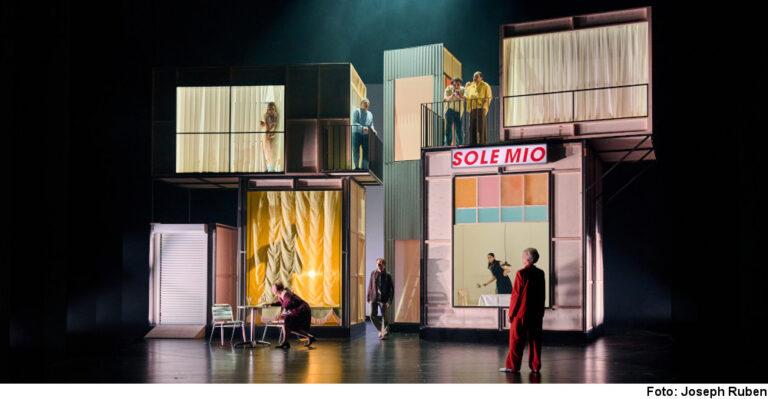
The Osnabrück production emphasized the loneliness of the characters, whether they are seen with partners, have got partners according to what we are told, or are explicitly lonely. Frau Yamamoto was played by 80-year-old Angelika Thomas, who launched her impressive stage and screen career as an actress at the theatre in Osnabrück, with the other characters cast from within the resident company. Marleen Johow’s set focused on the revolve, which turned a lot, to show the passing of time, or to allow shifting of perspectives. Individual units of living spaces were stacked above each other, in desolate container fashion, with metal stairs leading from the ground to the higher levels. The characters lived their isolated, empty, pathetic lives in this relentless environment, with, and due to, a severely restricted ability to communicate with others or even with themselves. Only Frau Yamamoto was different, in her matter-of fact cheerfulness in view of, and despite, loneliness, at least with lively memories of some events in her life, and with the courage to leave her door open to allow for random communication with the strangers living in the same building.

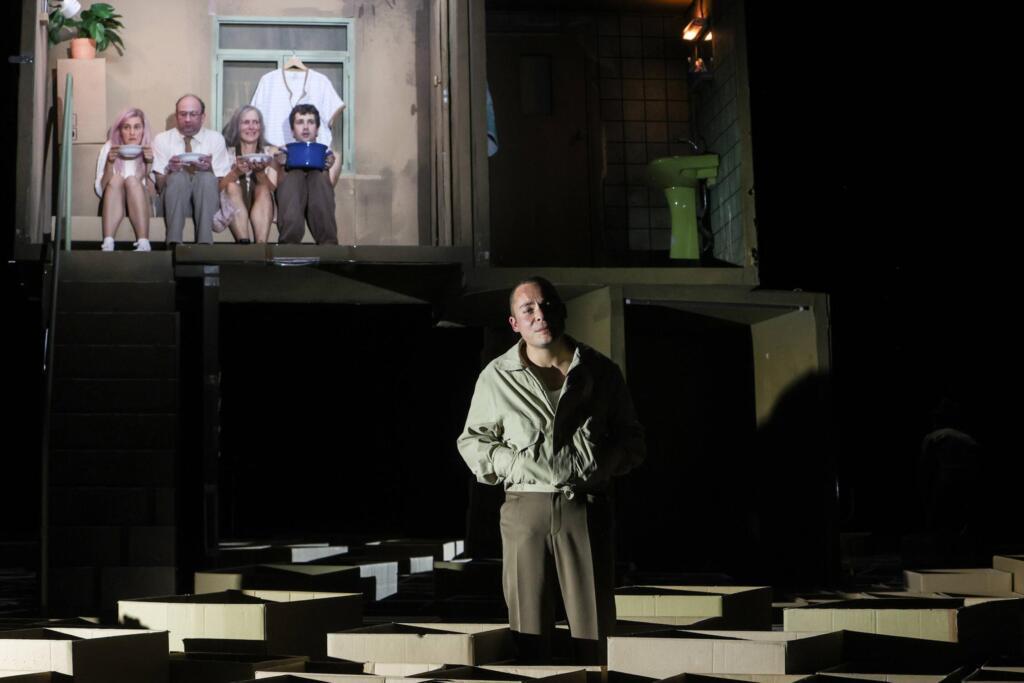
The set (designed by Thomas Rupert) in the Bremen production. © Jörg Landsberg.
The environment created by set designer Thomas Rupert for the Bremen production had some cramped stacked living units at the back, also with metal stairs. The majority of the large stage floor, however, was covered with cardboard removal boxes of different sizes, some rectangular, some square, some open, some closed. Characters emerged from these, disappeared into them, walked through these as if they did not exist, or while acknowledging the difficulty of the obstacles to normal walking that they represented. Loneliness thus immediately became more bearable to watch. The set mediated or ameliorated the potentially stark impression of the events carried by the twenty episodes and their characters. Director Alize Zandwijk has worked on eight productions of Dea Loher’s plays and has been able to develop a deep understanding of her dramaturgy. Her Bremen production benefited from this intimate experience particularly in its emphasis on the way Loher handles the language written for the characters. It was not as televisually realistic and rather flat as in the Osnabrück production. Rather, in Bremen, the ways the actors uttered their lines was driven by an awareness of the poetic nature of the language. The poetic nature of the language was delivered consistently with an ongoing, increasing or decreasing, wave-like sense of wonder, or surprise, sometimes accompanied by a smile, sometimes more an experience of something shocking. The surprise that the actors portrayed was such that it was transmitted to the audience as well. It created a distance which brought the shades and nuances of, and perspectives on sadness, central to the twenty episodes, into relief in a way that was more bearable than its realistic rendering in the Osnabrück production. Because it was more bearable, it became also more palpable. It was not merely depressing, but both invited and enabled one’s own thinking about issues raised, rather than merely deploring the fate of others whom one could then easily dismiss as anonymous, unknown and relatively uninteresting.
This post was written by the author in their personal capacity.The opinions expressed in this article are the author’s own and do not reflect the view of The Theatre Times, their staff or collaborators.