![23rd Sep: The Matchmaker's Playbook (2018), 1hr 29m [TV-MA] (6.1/10)](https://occ-0-75-1007.1.nflxso.net/dnm/api/v6/0Qzqdxw-HG1AiOKLWWPsFOUDA2E/AAAABRV9ozzRCdL7ZrVYXCSGoVSobYjABrxXcZ9-lbS5H0Q0vlEUu_U0JP29FKF8TLm4jB4l4i012Yg5w_SxPxp6LQ1EFpOMFHbkJX1GUs6Wksz01ivrb-tT07VOYlmamEH5mfU4ue6bQakT3-HdxKDQUlppKGIzLAO0eXf_NtbbsiJx-A.jpg?r=6b4 "23rd Sep: The Matchmaker's Playbook (2018), 1hr 29m [TV-MA] (6.1/10)")





The TIFF26 Film Review: Simon Stone’s “Elsinore” Is a Love Letter to Ian Charleson and the Theatre
By Ross
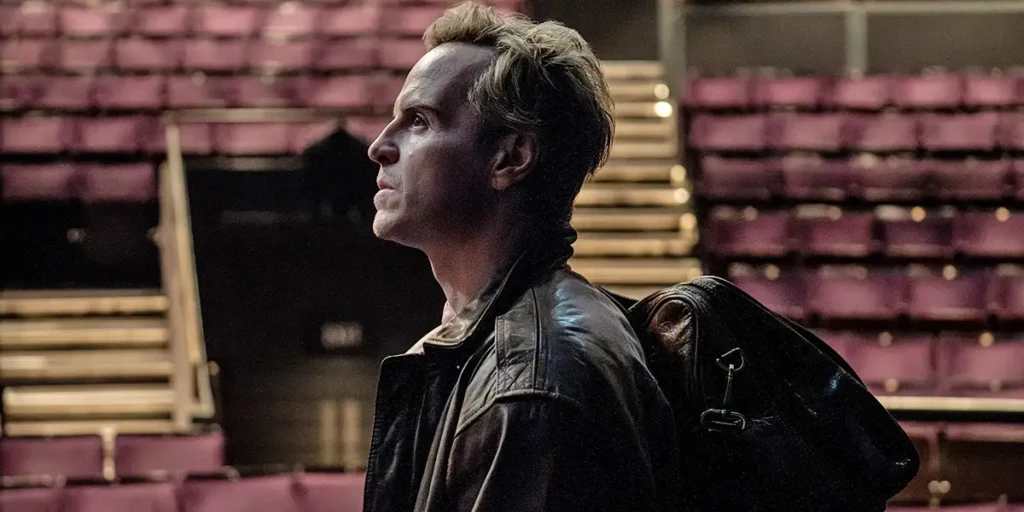
“Hamlet just walked off the stage.” That announcement ripples through the first few moments of the incredibly beautiful, touching, and surprisingly funny “Elsinore.” The film has now won TIFF’s International People’s Choice Award, and I would be very surprised if this is the last recognition it receives. Somehow, that news feels like the perfect way into a film that understands exactly what theatre can mean to someone who has built his life around it. That Hamlet is the one Ian Charleson is about to inherit, after Daniel Day-Lewis unexpectedly leaves the production mid-show after his ghost father asks for revenge at London’s National Theatre in 1989, and from that moment, “Elsinore” begins a journey into the life of an incredibly determined actor who knows exactly what he wants, even as his body is beginning to tell him that time is running out.
The film, directed by Simon Stone (BAM’s Medea) and written by Stephen Beresford (“Pride“), places Andrew Scott (West End’s Vanya; “Sea Wall“) firmly at the centre of that journey, and he is extraordinary in the role. He gives Charleson a deliciously joyful confidence, a sharp intelligence, a fierce stubbornness, and an undercurrent of pain that never overwhelms the man himself. He can be jealous of Day-Lewis in one minute, then turn around and show empathy and compassion the next. He can be out and about in the gay London circles of the time, sabotaging his ex-boyfriend’s date and refusing to pack up his life, while still understanding the danger of being openly gay in an establishment that expects silence and secrecy. Scott makes all of those contradictions feel completely human and utterly understandable.
Then comes that first tiny purple spot, on Charleson’s face no less, after we have watched him repeatedly perform the inspection with a hand mirror that I am sure almost every aware gay man in the 1980s knew in one form or another. I know I did, because I was around in that era, when the threat of AIDS was everywhere, and treatment was not yet available. When Charleson sees the spot, he knows exactly what it means, even before anyone has to tell him. “I do want to live” becomes his refrain, although his understanding of what that means does not fit neatly with the philosophy of his physician, played gloriously by the always impeccable Olivia Colman (HBO’s Landscapers). Colman finds something wonderfully complicated in her doctor who struggles to understand the battle between her own medical philosophy and what her patient is actually telling her. There is a knowing glance between them that says almost everything. Charleson is holding on to his power as fiercely as he is holding on to his pain, and when the role of a lifetime is offered to him, how could he refuse? He knows he has to tell his director, but he cannot tell everyone, and the reasons for that secrecy make perfect sense while creating an almost unbearable tension around every rehearsal, every performance, and every moment he spends on and away from the stage.


But what is truly astonishing is how Beresford’s screenplay allows immense humour, theatrical banter and genuine levity to exist inside such devastating circumstances. “Elsinore” never forgets that this is a person embracing the thing he loves and believes he was meant to do. Charleson’s Hamlet becomes a physical and emotional challenge that he is determined to undertake, even as the disease ravages his body. “I’d rather die of Hamlet, then die of this disease” may be the film’s most devastating line because its humour and edge are delivered with such absolute conviction. These people are “creatures of the theatre“, and the film understands the strange, glorious madness of that world. They sing about this business they call show with wild abandon and high kicks, filling the hospital wing with such love and joy, while they all struggle against the disease as best they can, attempting to turn months into years. That mixture of theatrical exuberance and the brutal reality surrounding them gives the film a pulse that never disappears.
Scott’s performance digs deep into the relationship between personal pain and personal drive, and one of the great pleasures of watching him is the seamless way he moves between playing Charleson and playing Charleson as Hamlet. He never turns the performance into an exercise in sentimentality. Instead, he gives us a man who is fiercely alive, charismatic, exasperated, funny, difficult, and frightened, sometimes all within the same scene. The film even has fun with Charleson’s relationship to his fame as the star of “Chariots of Fire“, playing with his exasperation that everyone remembers the theme music while the actor himself smiles and nods along. He understands that it is one of his gifts to the world, even if he hopes it will not be his last. Around Scott, the film is filled with excellent British talent, including the impossibly good Billie Piper (Young Vic/Park Ave Armory’s Yerma), who gives her character such specificity and authenticity that she never slips into cliché, while Johnny Flynn (“Goodbye June“) and Peter Mullan (“I Swear”) give Charleson’s world the texture of a genuine theatrical community.
The emotional depth of “Elsinore” comes from its understanding of focus, passion, and the sheer will to embrace life while knowing precisely how fragile it has become. The film does not try to avoid the painful territory familiar from many AIDS films, including coming out to parents from a hospital bed, raging against the disease, and the heartbreak of watching illness ravage someone you love. Yet Stone’s direction and Beresford’s screenplay allow those moments to exist alongside tender friendship, theatrical mischief and an almost joyous devotion to craft. “When it comes to life, it’s always been Hamlet,” Charleson says, and the film understands that this is not simply about preservation. It is about the joy of doing the work and the devotion required to keep at it regardless. The theatre becomes the place where he can still claim himself, still demand something from his body, still inhabit a character who has the words to express feelings that his own life has made almost impossible to articulate.
And there is something especially moving about the way “Elsinore” understands Hamlet itself. The film’s title, the production at the centre of Charleson’s final months, and the Shakespearean language all become part of a larger conversation about what theatre can carry across generations. I could not help thinking about how last year’s People’s Choice winner, “Hamnet“, also ends with the final scene from Hamlet, and here another People’s Choice-winning film brings that same Shakespearean world into its closing moments. There is a reason that this play continues to have such extraordinary power, and “Elsinore” finds that power in an actor who wants to give everything he has to the role of a lifetime. Ian Charleson knew what he wanted to do with the time he had. Andrew Scott gives that determination a face, a voice, a laugh, a stubborn streak, and a tremendous amount of heart. Watching him walk toward Hamlet, knowing what Charleson knew about his own body and his own future, is heartbreaking. Watching him walk there anyway is exhilarating. For “Elsinore“, the stage is not an escape from life. It is where life, in all its fear, humour, pain, friendship, desire and glory, becomes impossible to deny.