



Laying Historical Ground, Wide-angle
Towards the end of Faustin Linyekula’s theatrical dance piece My body, my archive—devised in 2023 and witnessed by me as performed during the Aichi Triennale 2025 in Nagoya—the Congolese dancer, choreographer, and storyteller faces the audience to reassure us: “It’s still me, Kabako.” The physical, auditory, and oracular frenzy of the previous scene staged Linyekula’s body as a conduit for the missing bodies from the lands encompassed by the Democratic Republic of the Congo and the missing voices from the archives and histories of this Central African region. Coming down from a danced conjuration of the unjustly silenced and erased, Linyekula assures the spectators that his body before them has not been filled up by the dead—that it’s still him, present and alive. Still Kabako. But Linyekula’s close friend, writer and actor Richard Kabako, died in 1994, slain by the bubonic plague, a decimated healthcare system, and the continued legacies and ravages of colonialism and civil war.
After his instrumental role in gaining the country’s independence from Belgium and becoming the first Congolese prime minister in 1960, anti-imperialist and pan-Africanist Patrice Lumumba was assassinated the following year in a US-backed military coup. The ensuing dictatorship of Mobutu Sese Seko, the brutal Congo Wars of the 1990s and early 2000s, the partial occupation by Rwanda, the ongoing raids on the civilian population by various armed groups, and the proliferation of illegal mining and trafficking in minerals (uranium, gold, diamonds, copper) continue to disfigure the DRC with the murderous inequities of extractive economic imperialism and global capitalism. Yet, as Linyekula puts it in an interview, “as long as I’m alive, I refuse to give up.”[1] Still me. Still here. Still alive. These are the voices of the people in the Congo cobbling up lives perpetually at risk of violent ends, voices rendered inaudible over the din of global business as usual. Still Kabako. These are the voices of the dead that Linyekula keeps alive against forgetfulness and carelessness. Throughout many of his projects, Linyekula dances again and again as testimony, in honor of and in mourning for the wasted lives and deaths in the DRC. My body, my archive continues his exploration of materializing the dead and absent on stage through present, living bodies.
Linyekula repeatedly returns to the Congo—literally too. Throughout a long and vibrant international career during which, as he puts it, he has “toured like crazy for 20 years”—performing, directing, curating, and teaching across the world—Linyekula keeps coming back to the DRC.[2] After studying and launching his career in Kenya and France, Linyekula founded Studios Kabako in Kisangani in the early 2000s as an organization that merges a dance company with a center for local and visiting artists across various disciplines to meet, train, work, and explore. “Kabako” then also stands for community and resilience in togetherness built to withstand the crushing weight of perpetually accumulating violence and trauma. The oft-repeated variations on the refrain of “I am Kabako” ringing through Linyekula’s internationally celebrated body of work spanning two and a half decades underscore his stance of living and working in the DRC, despite—and because of—the difficulties. “Still Kabako” enunciates the rope that keeps Linyekula tethered to a land that ties individuals together. It situates Linyekula’s artistically articulated critique of past and present imperialism manifested culturally, economically, and politically. It grounds his dance performances in a locus of mourning for the countless missing bodies deemed expendable and forgettable. The formative experience of losing his talented close friend Richard Kabako to a senseless death appears as foundational loss for his artistic trajectory. Linyekula formulates a crystal-clear and powerful political discourse, artistically expressed and experienced as intensely personal. By missing his friend, Linyekula dances into presence the bodies and voices of people gone missing, violently erased from lands and histories. The colonized dead are declared unjustly missing from the living through the very performance of being missed.
Laying Historical Ground, Close-up
My body, my archive differs from his previous projects in that here Linyekula dialogues with the missing bodies and voices of women. In an interview published by Nataal, Linyekula traces the performance’s origins to a 2017 residency at the Metropolitan Museum of Art in New York, where he asked to see the Congolese artifacts in the Met’s collections. The African objects—looted in colonial expeditions and sold to Western museums—mirror the larger imperialist pillaging, breaking apart, and scattering of African lands, resources, peoples, and cultures. In New York, Linyekula discovered a Lengola wooden statue carved by a member of his mother’s ethic group. Given the colonial destruction of Bantu social organization, the theft of masks and statues, and the erasure of stories, songs, and dances as repositories of memories, histories, and identities, Linyekula reports having asked: “if this statue, representing the ways our ancestors had found to archive their history, was brought back home, would people still remember its traditions?”[3]
Seeking answers to this question, Linyekula traveled with his mother, uncle, and cousin to his maternal grandfather’s birthplace, the village of Banataba, where they encountered “very fragile” but “not dead” precolonial histories.[4] In Linyekula’s worldview and aesthetic, nothing is quite dead, whether the murdered, the past, or the deceptively “inanimate” objects he interacts with on stage. In a conversation with Margot Luyckfasseel, published in the Aichi Triennale 2025 Performing Arts Program Book, Linyekula describes My body, my archive as part of an effort “to reclaim our history at the local level,” bypassing how this history gets told in the colonial written archive from the Western perspective of “the conqueror.”[5] Linyekula proposes a wider notion of restitution that would involve not just the necessary return of artifacts like the Lengola statue to the DRC, but also active reconstruction of local forms of knowledge supporting (still) living communities whose sense of who they are involves an ownership of narratives. My body, my archive explores ways of telling very-fragile-but-not-dead stories through embodiment, music-making, and eight wooden statues.
Linyekula confesses that during his time conducting research in Banataba, he “discovered a lot about [his] family history but […] the only names [he] kept hearing [belonged to] men.”[6] Local women are doubly erased from history, missing both from the written colonial archives and from the oral, visual, and embodied Lengola archives. While critiquing colonial archives, Linyekula avoids romanticizing the patriarchal bent of the local archives. In an act of poetic restitution, Linyekula commissioned a local sculptor named Gbaga to carve eight ceremonial sculptures standing in for eight generations of women. Replicating the social function of the Lengola statue languishing in the Met’s collection, Linyekula establishes communication with the sculpted matrilineage he brings onstage. My body, my archive is as much a historical drama as it is a performance about the living patching their lives together in defiance of the weight of past and present violence.
At the Aichi Prefectural Art Theater, Linyekula is joined on the proscenium stage by Philadelphia-based trumpeter Heru Shabaka-Ra, who undertakes a parallel sound-and-movement exploration of his own ancestry from a North American Black perspective. “He tells his story, reflecting on how he feels […]. And I tell mine,” says Linyekula, “and we meet somewhere in between.”[7] Towards the beginning of My body, my archive, Linyekula introduces Shabaka-Ra to the audience as a fellow traveler and storyteller whose trumpet opens paths. In a 2017 Brooklyn Rail article, Cisco Bradley included Shabaka-Ra—an independent artist as well as a member of Heroes Are Gang Leaders, Sirius JuJu, and the Sun Ra Arkestra—in what he identified as a New Black Avant-Garde centered in New York and typified by its engagement with the 1960s–70s Black Arts Movement and histories of Black thought, arts, and politics. Bradley highlights a central artistic approach that fuses “free jazz and experimental music with various forms of text, including poetry, literary works, and histories that engage deeply with African American pasts, presents, and futures.”[8] The article points out Shabaka-Ra’s long-term investment in the shared terrain between music and language, from his study of linguistics and African and Black literature to his performances of poems and writings mixed with a form of non-textual proto-language that plays with the expressive potential of the voice. In My body, my archive, Shabaka-Ra occasionally punctuates moments with vocal sounds, but mainly plays his trumpet as if it were a speaking instrument, expertly declaiming monologues or wittily delivering repartees to ambient sounds, video images, and Linyekula’s words and movements.
The Performance
As the audience takes their seats, the stage is already set up. In comfortable, black clothes, Shabaka-Ra and Linyekula wait patiently together at stage right. Their relaxed demeanor is troubled only by Linyekula’s restless fingers, flitting without pause. The fingers will continue to hum throughout the performance, echoing the buzzing sounds, showing the restlessness of invisible presences. At the top of the performance, video and sound designer Franck Moka eases the spectators in with the sounds of peaceful birdsong and faint percussion. The attention-grabbing centerpiece is a video of a rustling body of water projected onto a backdrop that almost fills the width and breadth of the upstage area.

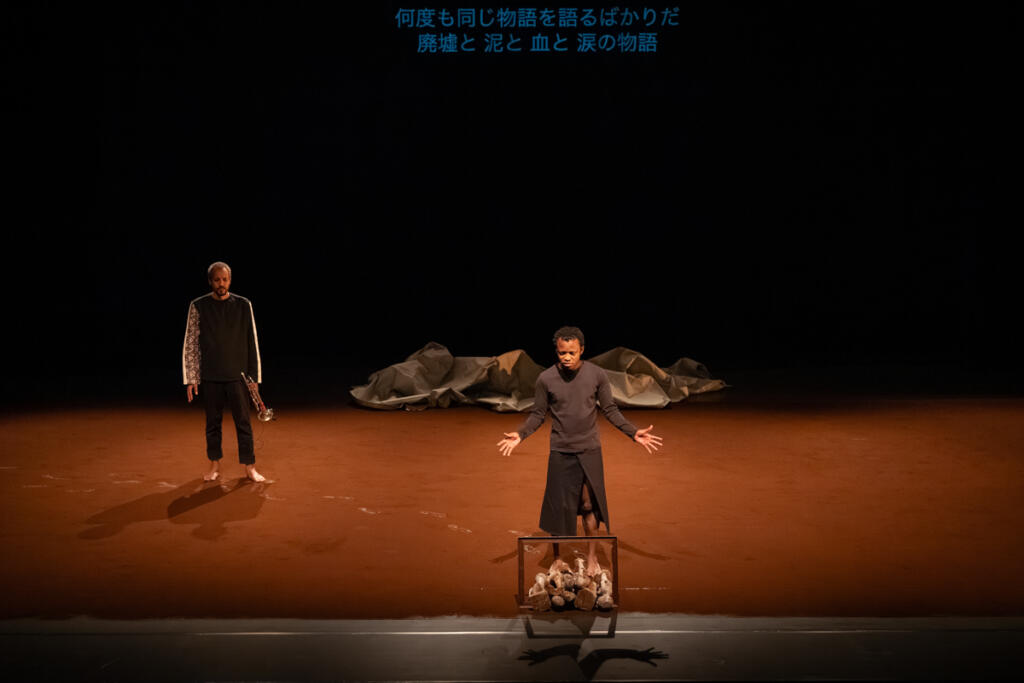
Faustin Linyekula (center) and Heru Shabaka-Ra (left) in My body, my archive at the Aichi Triennale 2025. Photo: Naoshi Hatori.
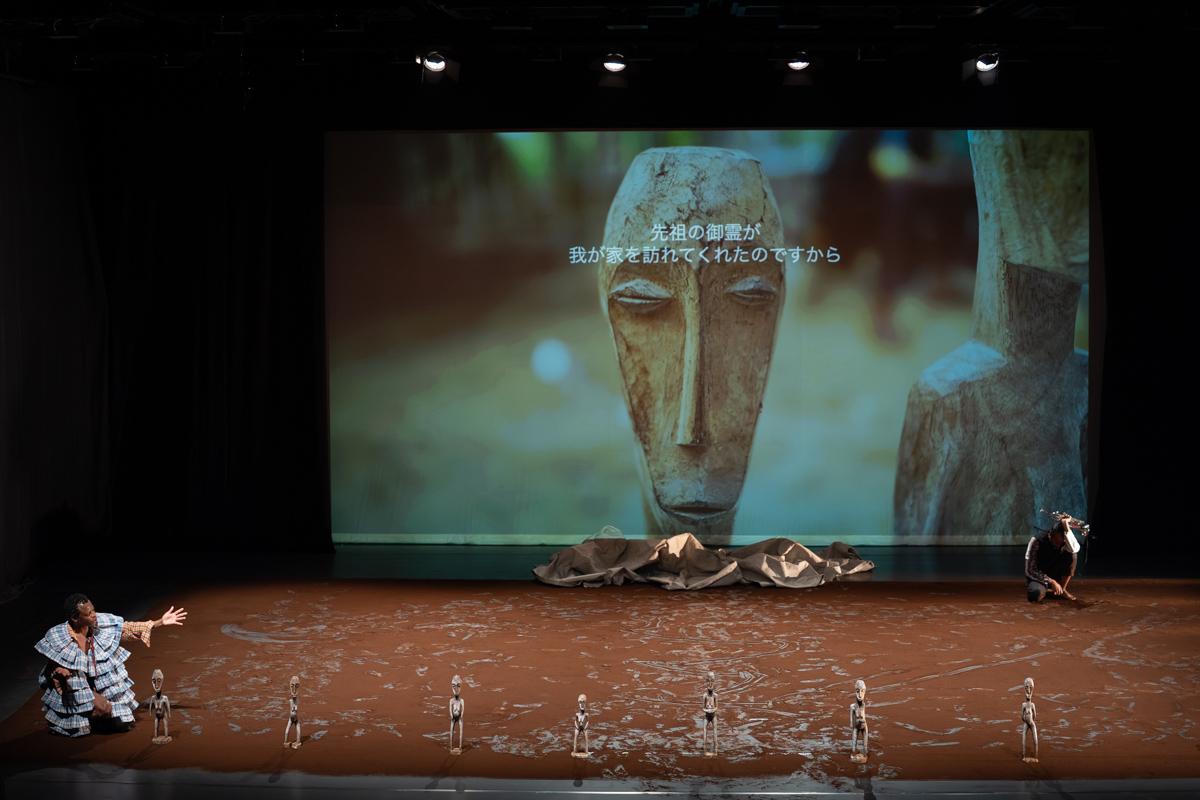
The program doesn’t list a stage designer despite the set’s ingenuity. The largely empty stage houses just two props. An angular-shaped, bundled tarp sits upstage, hiding behind it all the pieces needed for Linyekula’s frequent onstage costume changes. An empty frame on the floor downstage contours the eight statues laid horizontally, like stacked femurs. The performance area is delineated by a large rectangular surface—its rich brown, vibrant with red and yellow tones, conjuring the look of African soil—which I initially took to be some sort of carpet. The marks left on the surface by the performers once they began moving dispelled my first impression. I wondered for a moment whether there was genuine soil onstage, until the way in which even the most vigorous stomping raised no dust convinced me otherwise. After the show, I discovered the production team’s secret: the floor was covered with ground coffee. A prime colonial good and a continuing major cash crop in many East African economies forms the literal base of an anti-colonial dance piece. The coffee looks stunning onstage and outperforms soil itself in the role of African land.
Once the audience settles in, the show starts off gently, with the projected video of a body of water opening onto a foggy vista: an approaching dot slowly growing into a one-person canoe. As the vessel approaches the camera head-on, the person’s face becomes clearer and clearer—dark skin stretched taut over a skinny frame, crisscrossed by lines of age, smiles, and worries—until it gets so close that it fills half of the frame. Freeze-frame. Linyekula takes center stage to introduce the person as the sculptor Gbaga from a village in northeastern DRC. Linyekula briefly introduces the project, Shabaka-Ra, and himself: “My name is Kabako. I’m a storyteller.” He describes his work as scavenging for stories across the lands of his home country—encountering stories of ruins, of tears, of people doing their best to remain dignified. The screen lifts into the fly space, marking the prologue’s end.
Linyekula begins to dance. Or, rather, to speechify. His four limbs move almost separately in a determined, sober rhythm. They tense and aim forward, bend and extend, point and retract. The movements flow, but in a linear and arrhythmic fashion, like a full-bodied sign language. The Russian theatre-maker Konstantin Stanislavski advised actors to emphasize particular words when declaiming lines, explaining that such stress is like an index finger pointing to the most important word in a sentence. When Linyekula’s hand points, he seems to be making a point too. His stomping foot places a full stop at the end of a sentence. Linyekula’s speech concluding, Shabaka-Ra moves center stage to deliver a monologue. His no-frills, unobtrusive, slow and articulate trumpet playing sounds and moves in a declamatory manner, like an actor in a classical drama delivering an important speech.
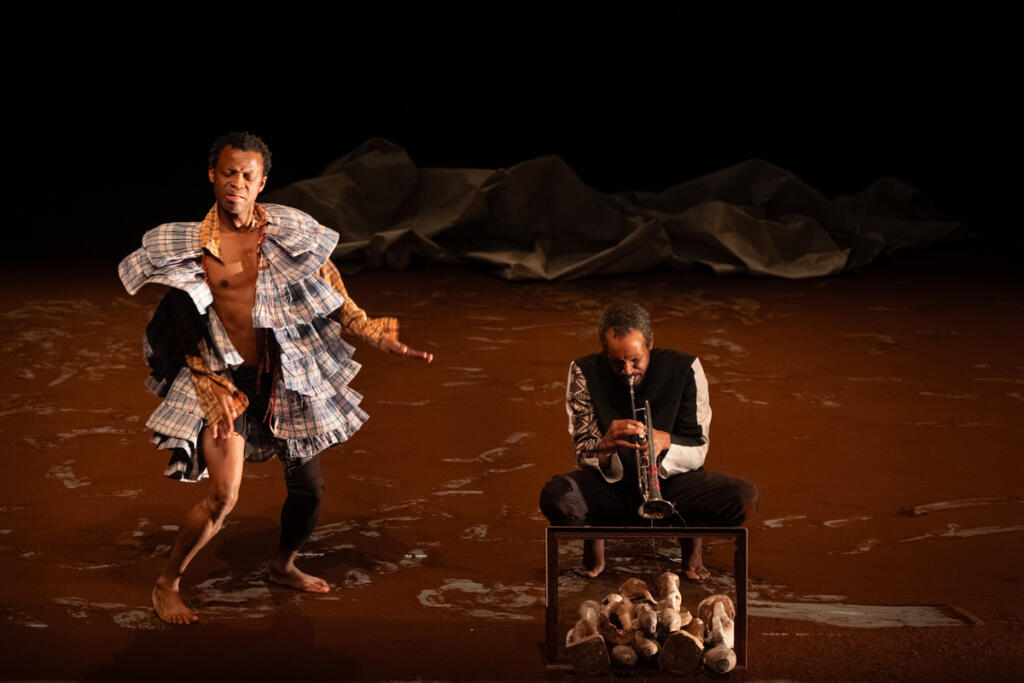
Faustin Linyekula (left) and Heru Shabaka-Ra (right) in My body, my archive at the Aichi Triennale 2025. Photo: Naoshi Hatori.
Over the playback of percussion (credited in the program to Jamos, Passero, and Mobeti), Linyekula switches to rhythmic movement, coordinating his limbs, shoulders, and hips to the beat. Much of the textual commentary on Linyekula’s art highlights his fusion of European and African dance forms. In a 2007 article, Brenda Dixon Gottschild names influences from German Expressionism to the contemporary Congolese pop style Ndombolo.[9] As a theatre scholar from Romania, such chorographic and historical correlations escape me. I’m also unsure to what extent internalized, unconscious prejudices, owing to my whiteness, may lead me to misread My body, my archive in particular ways. But when Linyekula changes his costume into an above-the-knee mass of checkered ruffles and dances frantically, periodically shouting a word I cannot understand, it feels exuberantly African. Designed by Aldina Jesus, the photogenic costume quotes, I imagine, traditional elements while asserting itself as resolutely contemporary, much like Linyekula’s own artistic practice. The hectic ball of fabric seems to capture movement, as in a long-exposure photograph of a dancer floating in a cloud of motion blur.
While singing, Linyekula places the statues in two parallel rows facing one another. As the dancer sings, the musician dances. My body, my archive repeatedly attests to the artists’ versatility, their searching explorations for varied means of expression, their refusal to limit themselves to disciplinary dictates, and their dedication to a collaborative process that honors each artist’s multifaceted creativity. Linyekula’s practices challenge the siloing of artmaking and its separation from social contexts. A recording plays of Linyekula continuing to narrate how he traveled in 2017 to Banataba, where he collected ancestors’ names from his mother’s clan. But all the remembered names were men’s. “Where are the women?”, Linyekula’s technologically amplified question resonates through the space. He recounts that he asked Gbaga to revive the spirits of the erased and give form to the missing, dead women. “Here they are,” says Linyekula, gesturing to the aligned statues. On the lowered screen, we watch footage of Linyekula’s “first encounter with the women,” when Gbaga presented the statues to him for the first time. The video depicts a close-up of Linyekula, squatting in an open-air setting, with many people visible in the background. Linyekula is seen dancing, arms raised, fingers buzzing. Linyekula informs the audience that another ceremony took place in his grandfather’s house when Gbaga traveled to the city to deliver the statues.
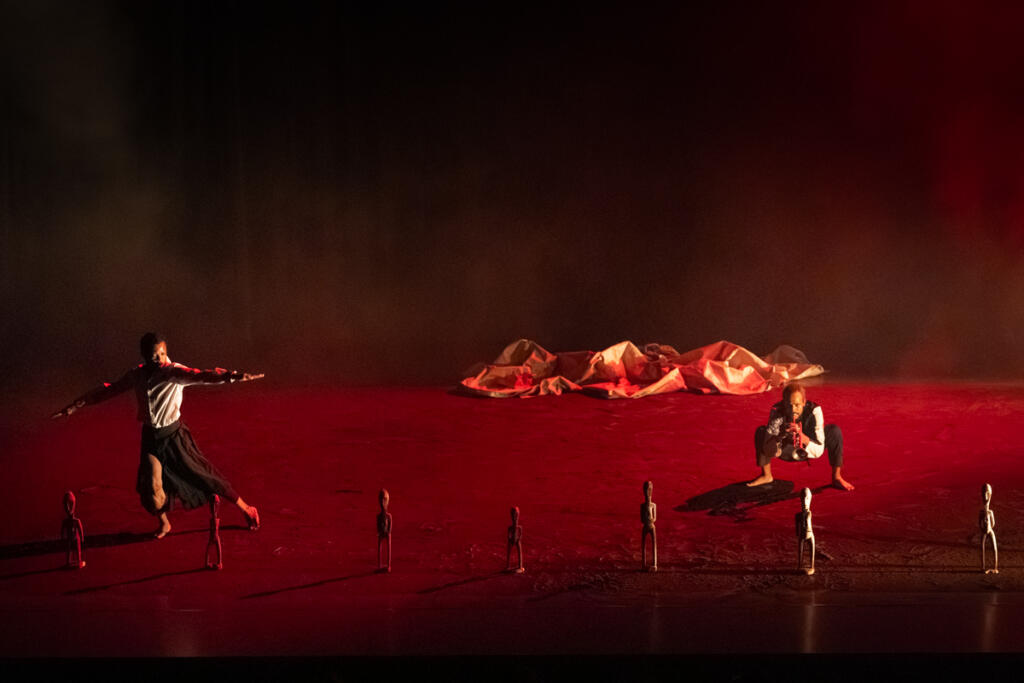
Faustin Linyekula (left) and Heru Shabaka-Ra (right) in My body, my archive at the Aichi Triennale 2025. Photo: Naoshi Hatori.
Another costume change leaves Linyekula in a white shirt and a skirt-like garment. Smoke slithers onto the stage. The floor turns a red-velvet-cake red, a warm blood red under the blunt, monochrome, all-engulfing red lights designed in collaboration with Christophe Glanzman. Linyekula dances fast, frantically, disarticulated. Everything toning down, Shabaka-Ra’s trumpet sounds strangled with sobs while Linyekula collects the statues again. On a darkened stage, a footlight casts a comforting path of light diagonally across the stage. One downlight fixture projects a conical beam, creating a circular pool of light on the stage floor. The circle slowly expands. Linyekula rearranges the statues in the circle. This is the statues’ third and final formation. Their choreography—sketched as I I __ 〇—seems scriptural. In the quiet, an unsettling, whizzing, buzzing sound feels like it’s traveling through the whole theatre. The somatic effect is achieved through placing speakers at various places throughout the house. Linyekula removes his white shirt, dips two fingers into a paint container, and dabs white dots onto his face and bare torso. Spectral electronic sounds—layered droning, low thumps, and deep, resonating frequencies—gain momentum. Credited in the program, the composition is Nierica by Joachim Montessuis, a French performer experimenting with digital art and noises. On the SoundCloud page where the track is uploaded, a screenshot of an unidentified text explains that “nierica” is a small round mirror worn by shamans to facilitate trances during which they see into the realm of dead ancestors. As Linyekula circles again and again along the inner and outer perimeters of the arranged sculptures, the round shape becomes a portal through which he attempts to communicate with his matrilineage. The sound and dance accelerate: fast, roaring, and violent; thumping and screeching; mighty and unappeased.
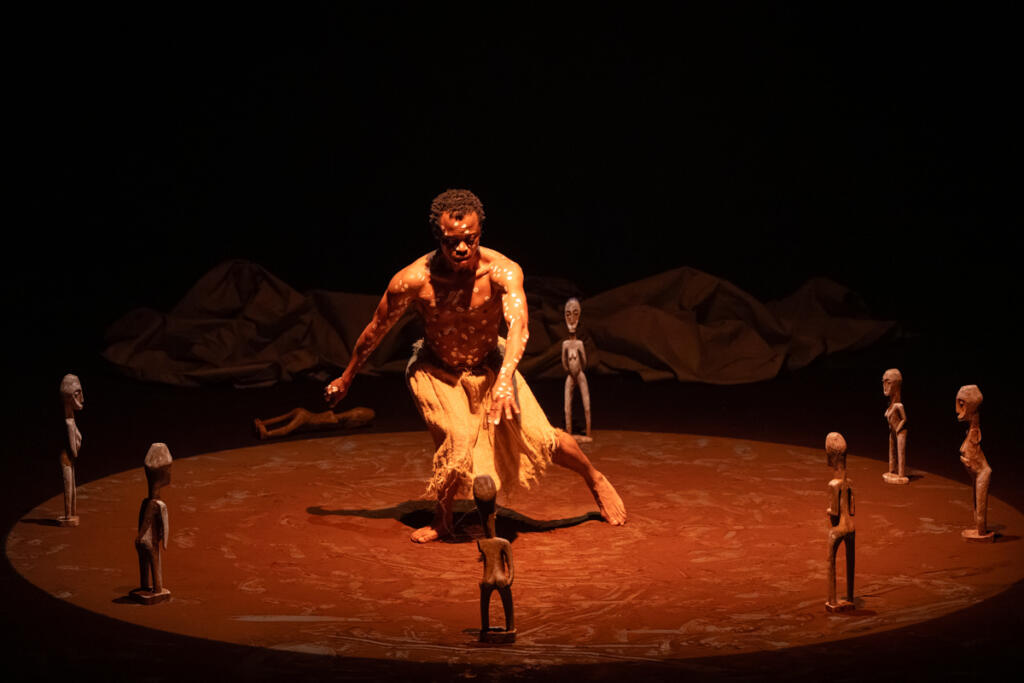
Faustin Linyekula in My body, my archive at the Aichi Triennale 2025. Photo: Naoshi Hatori.
As the trance reaches its paroxysm, the scene cuts to Linyekula singing what sounds like a soft lullaby. The ancestors are mothers, after all. Shabaka-Ra is catching his breath, sighing, then seemingly crying. Linyekula gently gathers the statues, places them into the tarp, and puts the comfortable black clothes back on. “It’s still me, Kabako.” In near darkness, he collects the tarp—a big bundle, a heavy burden, a crushing inheritance—and carries it offstage. The lowered screen brings the performance full circle as we watch Gbaga sailing away in his canoe. In the darkening auditorium, the trumpet has the last word. As Linyekula and Shabaka-Ra take their final bows amidst the audience’s applause and under full house lights, the terrain behind them lays bare its scars. The choreography imprinted onto the ground coffee.
My body, my archive—through its artistry, emotional range, and conceptual depth—also left indelible traces on me as an audience member. Yet I missed someone too. Why does a performance about the absence of Congolese women from archives of every kind replicate that erasure onstage? I wish I had seen Linyekula and Shabaka-Ra joined on stage by at least one Congolese, African, or Black woman artist, pushing back against her continued marginalization like her foremothers before her. The eight statues may represent women, but only in objectified form. And women, dead and alive, deserve more than being reduced to spectral presences and the topics of performances. Where are the women?
[1] “Faustin Linyekula brings his stories from the DRC to Aichi Triennale 2025,” Nataal, August 20, 2025, https://nataal.com/faustin-linyekula.
[2] “Faustin Linyekula brings his stories.”
[3] “Faustin Linyekula brings his stories.”
[4] “Faustin Linyekula brings his stories.”
[5] Margot Luyckfasseel, “The body as archive: Interview with Faustin Linyekula,” Performing Arts Program Book, https://aichitriennale.jp/artist/item/Aichi_PAbook.pdf.
[6] “Faustin Linyekula brings his stories.”
[7] “Faustin Linyekula brings his stories.”
[8] Cisco Bradley, “The Emergence of A New Black Avant-Garde: Experimental Music and Text,” The Brooklyn Rail July/August 2017, https://brooklynrail.org/2017/07/music/The-Emergence-of-A-New-Black-Avant-Garde-Experimental-Music-and-Text/.
[9] Brenda Dixon Gottschild, “’My Africa is Always in the Becoming:’ Outside the Box with Faustin Linyekula.” Walker September 1, 2007. https://walkerart.org/magazine/my-africa-is-always-in-the-becoming-outside-t/.
This post was written by the author in their personal capacity.The opinions expressed in this article are the author’s own and do not reflect the view of The Theatre Times, their staff or collaborators.
This post was written by Ilinca Todoruţ.
The views expressed here belong to the author and do not necessarily reflect our views and opinions.