







An Off-Broadway review of Red Bull Theater’s production of “How Shakespeare Saved My Life,” written and performed by Jacob Ming-Trent at The Public Theater
By Antonio
“The play’s the thing” in Jacob Ming-Trent’s inspiring play “How Shakespeare Saved My Life,” produced by Red Bull Theater at The Public Theater. In this theatrical retelling based on his true stories, there is not a moment to let the given circumstances weigh you down. The comedy and the tragedy must lift Jacob up and move him forward. To be in his congregation and hear his testimony was the most religious experience I have had in a very long time. He made us all enablers to this passionate exploration of his past by making the audience his partner with the line “Play on!” He wanted us all to leap forward together, and I was happy to go down the rabbit hole with him. This is a church that I would attend every Sunday.
Jacob grew up fast in Pittsburgh, and at 12, we find out that his mother has called the cops on his father, who has to leave the family home but promises to be back soon. As Jacob leaves for school, his mother, his personal Iago, tells him that he is the man of the house now and he is on his own. To ensure he understood the assignment, she reminds him that this world was not made for him and that he is permanently in danger. So when he arrives at school and accidentally enters the wrong class, he hears the words of Shakespeare for the first time. He is awakened hearing Coriolanus being read by a fellow student and is reborn when reading the St. Crispin’s Day speech from Henry V. His destiny is set that day as he has become a Shakespeare prodigy. Jacob’s entire physicality and sense of self shifted in this moment. Almost like magic, his innocence vanished; he could see the world clearly and had found a guiding light in Shakespeare.


Jacob’s life was a series of challenging events that would have been insurmountable to most young people. His mother kicked him out of his home at 16. He dealt with a father struggling with addiction, and he moved to NYC at 17 to become an actor. A teacher critiqued his work by saying, “Frankly, my dear boy, you sound … Black, but your more egregious sin is, you sound … fat.” And yet he finds, in the words of Shakespeare, ways to respond to life’s challenges. Also, growing up in the 1990s with that particular mix of music, rap, poetry, and Shakespeare, it all seems to propel him to make his next move. Jacob finds strength in his knowledge and discovers a deeper meaning in all of these Shakespearean characters. He connects admired artists like Tupac and Biggie Smalls with the 400-year-old street poet, reminding us that Shakespeare writes for the people.
There are beautiful light moments where Shakespeare helps him lose his virginity and survive an English teacher who wants no more Shakespeare in her class. But there is also a part of this story that he prefaces with a warning: “Some people don’t want me to tell this part of the story, I got to.” He tells us about being unhoused and hungry in a park in NYC, where he is befriended by a crew that puts new members through a series of tests. The first is a rap battle, because you have to know how to use your words to belong to this crew. The final test is a violent beatdown. Jacob wakes up in pain and severely hurt, only to reveal that he loved it, that it felt like love to him. From there, his life with the crew leads to drug use and gun violence, and he remains with them for several years. There is something deeply Shakespearean in the storm Jacob finds himself caught inside, where, if you are lucky enough to survive, this new life brings you closer to your fate.
Ultimately, theater saves Jacob’s life. His love of Shakespeare, combined with an amazing Ian McKellen impersonation, gives his life purpose. “Casting lady, it’s Shakespeare or die, and I wanna live.” Jacob has an incredible ability to inhabit these characters and the mental flexibility to navigate their differing points of view. He brings heart to the people who populate his memories and is committed to finding the value in their stories. Of course, his desire to create something out of his experiences is what makes his play so theatrical and joyous. Shakespeare opened his mind to the possibilities, and theater gave him a home.


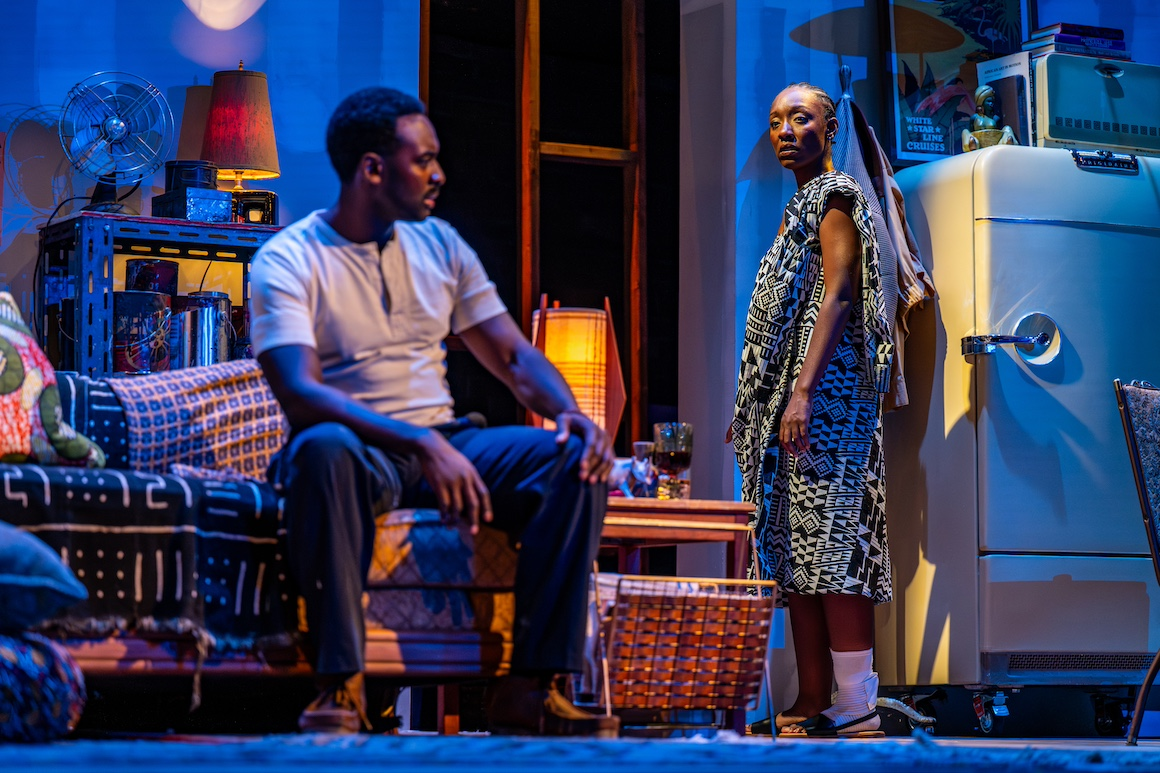
Jacob is an amazing performer, and his love of acting, Shakespeare, and theater is evident in every moment of this play. The amazing director, Tony Taccone (Public’s The Harder They Come), embraces the story and illuminates the heart at the center of this journey. Takeshi Taka’s simple set design creates wonderful energy, complemented by Alan C. Edwards’ lighting design. The single church pew becomes a grounding presence amid this colorful world, giving Jacob a physical place from which to tell his story. I also loved the God Phone, which provides beautiful moments of vulnerability. Original music and sound design by Jake Rodriguez also support the story well, bringing us back to the era.
Ultimately, Jacob is still haunted by the knowledge that he has a black hole where his heart used to be, and it is slowly killing him. He goes to God to ask for a miracle, and the spirit of his father reunites him with his tribe, and the black hole is gone. He has been so hurt by his mother, and she has been hurt by her father, and the generational trauma has seemed inescapable. But the chance meeting with a boy taught him that one act of forgiveness could change the world by zero-point one percent. The moment he forgives his mother, he finds the strength to tell his story. Perhaps that is where theatre becomes part of the forgiveness itself, giving Jacob a place to turn the wounds of his past into testimony and allowing an audience to receive that testimony together. The congregation he creates does not erase what happened to him, but it gives those memories somewhere to live beyond the pain. And we are all the better for living in a world that is zero-point one percent better.
*The Peace Prayer of Saint Francis, Saint Francis of Assisi (1182–1226)