



The morning of the day I saw Narcissister’s spellbinding and stunningly original Voyage Into Infinity I had been working my day job at a bagel shop. “There’s no flow!” I overheard one of the managers whisper to another longtime employee. She was right. Me and two other relatively new employees were, to put it bluntly, a bumbling mess. We were running into each other, dropping bagels, missing orders and operating in a generally flow-less state. I thought of this off-hand comment a lot during Voyage Into Infinity, but only for the sheer contrast it presented. Here were three people (Women? Girls? Dolls? Objects?) and their glorious machine operating with perfect flow– every intricate interaction setting off a chain reaction of varyingly spectacular and baffling consequences. Is it a dance piece? Is it a scientific presentation? Is it a treatise on feminine labor? A play? A concert? A circus? A magic show? I couldn’t tell you, but I will say, Voyage Into Infinity is gorgeous and unlike anything I’ve ever seen.
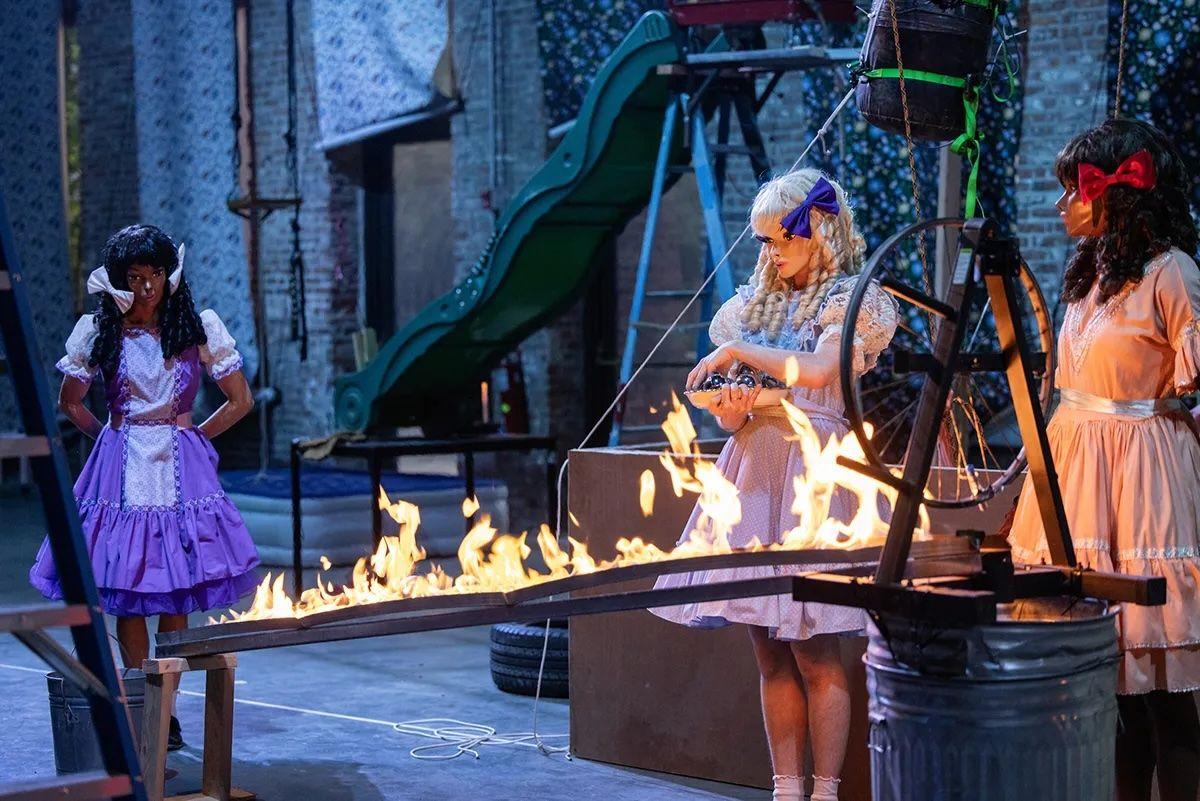
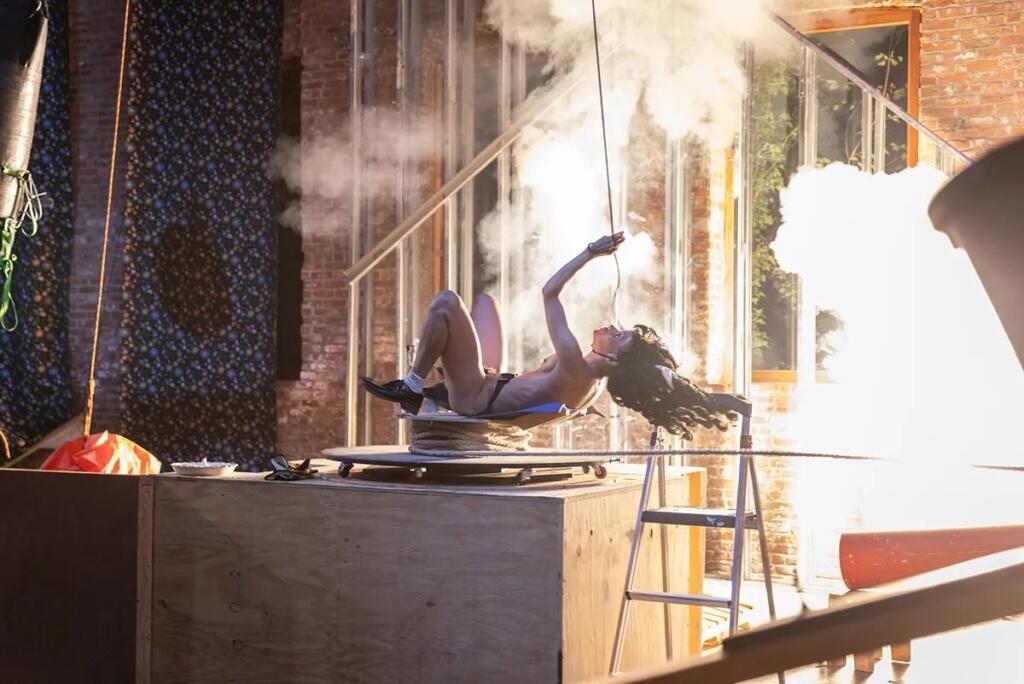
Drawing inspiration from Peter Fischli and David Weiss’s Rube Goldberg machine documented in their video The Way Things Go (1987), Narcissister presents us with a sprawling stage filled with buckets, balls, pallets, strings, and levers, all ready to fall, rise, swing, burn, and break in interesting and unexpected ways. The set, built by Nathan Benett, Mike Berlant, Cade Duff, Tyler Giordano, Chris Lesnewski, and Travis Spinks with rigging by Noah Price is striking to look at even before Narcissister and her two additional performers, Effie Bowen, and Jessica Emmanuel creep on. And then there’s the live scoring by Holland Andrews, stunning and frequently chaotic. Both landscape and soundscape are simultaneously a huge mess, and all clearly carefully calculated.

PC: Walter Wlodarczyk
But if the stage must must be physically, logistically calculated for the chain reactions to work, I wondered at times how intentional each of the performer’s actions were. Are they all supposed to map clearly onto an allegory about feminine and racialized labor? After all, this piece makes visible all the setting up of the Rube Goldberg machine. Unlike the seemingly self-producing actions in The Way Things Go, these “narcissisters” at times trigger reactions (both from the machine and the audience), and at times are part of them. Or is the piece too instinctual, too abstracted for direct symbolism?
I suspect, and admire, that the truth likely lies somewhere in between. Some actions you can easily ascribe meaning to– a mixed race person pours water into a bucket on a see-saw which raises a white person into the air; a Black person kneels on the ground so a ball can roll across her back as she becomes part of the machine’s track. There is a heavy-handed reading to these moments but the overall effect is much stranger and visceral than any clear statement you could make.
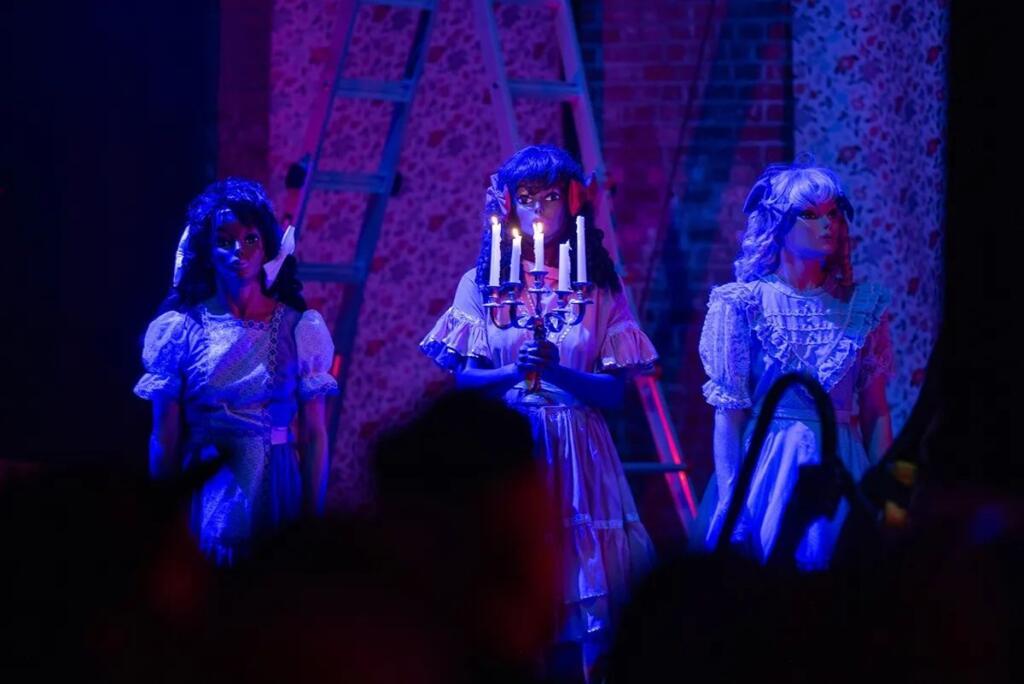
For example, what’s to be made of the themes of girlhood highlighted by Narcissister and Karen Boyer’s colorfully Lolita adjacent costumes and those deeply uncanny 1960’s doll-like mannequin masks? At times this set is a machine these Narcissisters are working at/as, at times it’s a playground that they swing on, play with balloons in, and bike through. What’s to be made of their sexualization as they strip to their similarly doll-like undergarments and then bare (though merkin adorned) bodies? What’s to be made of the fact that one of the performers, based on my research, seems to be not a girl at all, but non-binary?
PC: Walter Wlodarczyk
Throughout the piece I wondered about my fellow audience members’ reactions. Some people laughed– nervous laughter? Glee at the spectacle? Meanwhile I noticed at least three people around me nodding off. And certainly the piece can be slow. Long set ups and stretches of stillness heighten the anticipation for the punctuating moments of spectacle brought to us by Alex Podger’s pyrotechnics. Is this a pacing issue or an intentional choice, again visibilizing an often unseen aspect of what goes into a spectacle? And certainly these moments of spectacle were exciting, I gasped and cheered along with the rest of the audience, but I also wondered, was I gasping and cheering at something sinister? This, after all, was (and outside of the show is) a world on the brink. What does it mean to cheer at its demise?
But there’s something beautiful about reveling in the collapse, breaking things down to build them anew. After all, these Narcissisters are active agents in this machine. They choose what occurs. Despite their objectification, they have agency.
In a talk back after the show, Narcissister (notably still masked) talked about how difficult it is to make punk rock work within the institution. I share this anxiety, but for what it’s worth, I think Narcissister did a pretty great job of maintaining her punk sensibilities and messaging and not only because of the raging performance of the Bad Brains song that inspired the show’s title (band: Justin Frye, Austin Sley Julian, Gregory Fox). It’s clear that for Narcissister, nothing needs to be completely clear. A Catherine wheel is dazzling despite being a historical tool to torture women, a discus throwing statue presides proudly over the set despite being a replica of an identical one owned by Hitler, a Bad Brains song provides a moment of catharsis despite their lead singer making homophobic remarks, a punk rock show takes place on a stage owned by NYU, a pointedly not punk rock institution. Everything is complicated. Everything is messy. And that feels like a gift– to be reminded that despite the collapse, it’s possible to reclaim and rebuild.
This post was written by the author in their personal capacity.The opinions expressed in this article are the author’s own and do not reflect the view of The Theatre Times, their staff or collaborators.
This post was written by Morgan Skolnik.
The views expressed here belong to the author and do not necessarily reflect our views and opinions.