
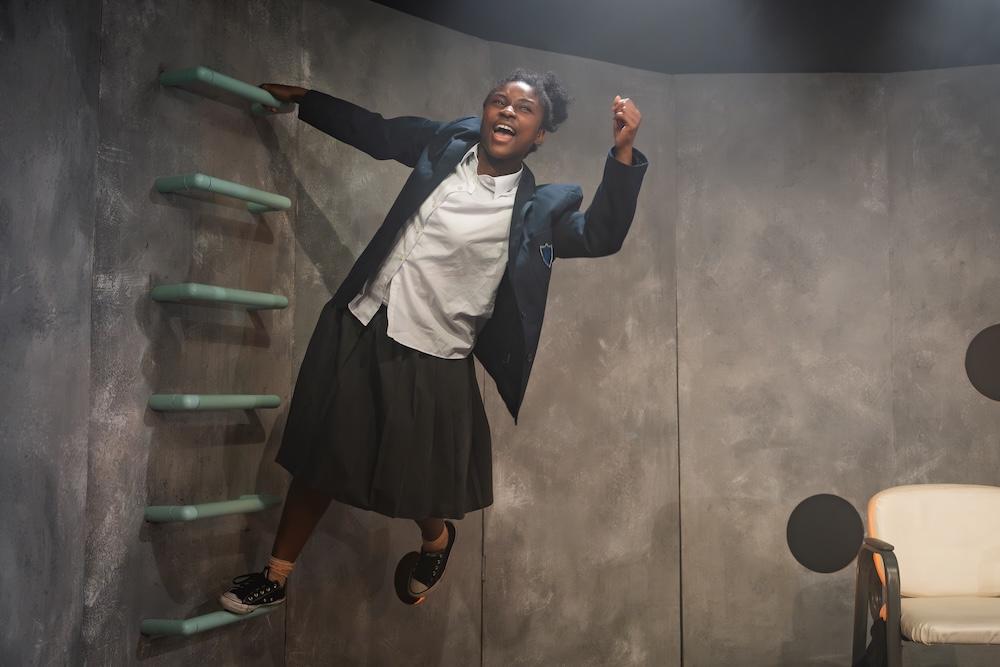





I don’t know how she did it, but by the end of Julia Masli’s ha ha ha ha ha ha ha, performed at the Proscenium at the Drake as part of Philadelphia Fringe, I was cheering through my tears for a work of reparative carpentry. Stripped to its elements, ha ha ha ha ha ha ha is a one-woman clown show. But the Tallin-born, London-based Masli wedges her way into the space between crowd work and group therapy to create a truly transformative theatrical experience. In marketing materials and interviews, Masli insists that ha ha ha ha ha ha ha is a serious show which is mistaken for a comedy; to her great frustration, it won best show at 2023 Edinburgh Fringe. Masli, Julia, if you’re reading this, I agree with you, and so would Aristotle. The catharsis I experienced at this show is not the stuff of comedy, but of real healing.
Masli appears onstage as an otherworldly figure, wearing an asymmetrical and lumpy dress and, instead of a left arm, a bronzed third leg; bionic hand-adorned hats off to costume designers Alice Wedge, Annika Thiems, and David Curtis-Ring. But Masli could perform the show just as effectively in a black bodysuit, because the real power of her look comes from her eyes. Wide and deep as reflecting pools, she has the penetrating yet vacant gaze of a cult leader, perfect for lost souls to project on to.
And this is where her work really begins. Occasionally using the language of a guided meditation, Masli invites audience members to share their problems with her and, unavoidably, with everyone else in the room. The Proscenium theater has a capacity of 121; due to overselling, additional audience members lined the stairwells (my brain alerted me that this was a fire hazard, my heart sped up when fire became a prop in the show). The intimacy of this experience rivalled, I imagine, a one-on-one with Marina Abramovic. Granted, audience participation is not for everyone, and Masli was masterful in moving on from unwilling participants. But for those who did accept the challenge to share, who were open and vulnerable, the reward was total acceptance and love, not only from Masli, but from the entire audience. Together, we helped middle-aged man crowdsurf up the seating risers. The program contains a link to a Love Database, described as “an attempt to help audience members who, during her shows, said they were looking for love.” And Emily, if your long-distance girlfriend Sylvie needs a ride from the airport when she visits in November, hit me up.
Because the show’s dialogue comes down to audience contributions, each performance is inevitably different. And yet, I found myself wondering how different every show could really be. My fellow audience members, to any one of whom I would, for the record, donate a kidney, were dealing with run-of-the-mill life tragedies—divorce, loss, feelings of stress and powerlessness. Masli has the ability to absorb these sorrows, and then she reveals her gospel: it is the responsibility of all of us to shoulder each other’s burden. With a puckish glint, she recruits more and more audience members to join her onstage, working towards collective healing. As a Jew, I understood these efforts as tikkun olam, repairing the world. My single favorite moment of the show was technically not part of the performance. As Masli headed offstage to grateful applause, she made eye contact with one participant and signaled to him to distribute to the rest of us some food he had received as part of their interaction. It was a tiny gesture of caring—how much hunger can you really satisfy with a small pizza that has been cut, per instruction, into 168 pieces? — and yet it left me feeling like all my problems had been solved.
This post was written by the author in their personal capacity.The opinions expressed in this article are the author’s own and do not reflect the view of The Theatre Times, their staff or collaborators.
This post was written by Abigail Weil.
The views expressed here belong to the author and do not necessarily reflect our views and opinions.