





Plays about famous people have always held special attraction to dramatists, theatres and audiences. Plays about famous artists (such as actors, musicians, painters, and poets) have held a particularly strong position in this context. The considerable critical attention of Piaf by Pam Gens at the Royal Shakespeare company in 1978, and Shaffer’s Amadeus in 1979 at the (Royal) National Theatre, led to a world-wide surge in the number of such plays. Looking at the body of such plays, it is interesting to establish the position of each play in relation to different scales. One scale is that of maximum to minimum authenticity, defined as a match between historical facts and the use of those facts in the plays. A play might thus consist (almost) entirely of a compilation of words actually written by the artist in question, or the historically documented character may (possibly) have served as the inspiration for the dramatist to write a play about an artist. A second scale is that of the function of the artist character in a given play: at one end of the scale are plays that focus on the life of the artist character(s) central to the play, while at the other end of the scale are plays in which the artist characters serve the purpose to (re-)present wider issues. A third scale focuses on the constellation of characters within a given play: are the artist characters presented mainly among themselves, or within wider contexts including non-artists.
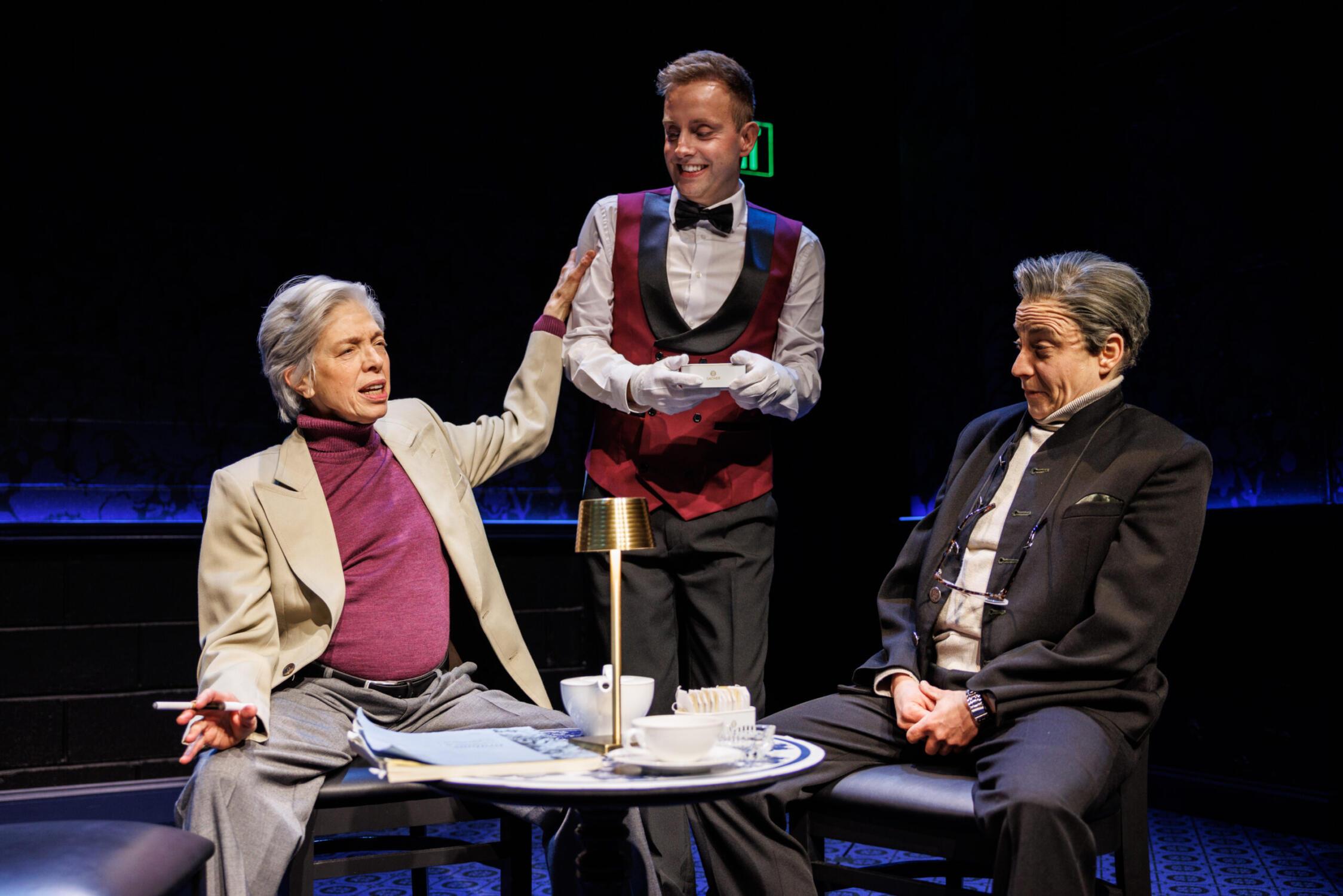
Last Call is a play by Peter Danish about composer/conductor Leonard Bernstein and conductor Herbert von Karajan. Danish was in the Blue Bar at the Hotel Sacher in Vienna some time ago, reading the book of Bernstein’s collected letters. The waiter in the bar then told him that in 1988, he had been witness to a chance meeting, in that very bar, between von Karajan, who was taking a drink while preparing for his concert the next day, and Bernstein. Danish was so inspired by the waiter’s experience that he started writing Last Call right away, that very evening. It premiered in New York, off-Broadway, at New World Stages, on 12 March 2025, directed by Gil Mehmert, with Helen Schneider as Bernstein, Lucca Züchner as von Karajan and Victor Petersen as the waiter.
The Hamburger Kammerspiele collaborated with the US-organisers and brought the German Language premiere production to its venue in Hamburg, opening on 18th February 2026. Gil Mehmert had translated the text into German; he directed the production with the same cast as in the New York production — American actor / singer Helen Schneider as Bernstein, German actor Lucca Züchner as von Karajan, and German actor and singer (countertenor) Victor Petersen as the waiter. The German production was presented under the title Last Call – Letzte Runde: Bernstein und Karajan nehmen einen Drink.
In the program notes to the German production, Mehmert explains the decision to cast two female actors in the roles of the conductors: At the time, the film Maestro about Bernstein had just been released and had sparked controversy because Bradley Cooper, the actor who played Bernstein was criticized by some for using a prosthetic nose, making him look too much like Bernstein. Mehmert wanted to avoid such discussion, wanted to be able to focus on the inner, artistically sensitive natures of the characters, and had his ideal cast already in mind: Helen Schneider and Lucca Züchner. He also sought to add alienation to the role of the waiter, by casting this role with a counter tenor, Victor Petersen, who transforms from the waiter into Maria Callas for one scene and presents the aria Il dolce suono from Lucia di Lammermoor (further alienation was achieved in this context by Petersen climbing atop a chair and putting on a full length evening dress that hid the legs of the chair, thus making his presentation of Callas tower high above the conductors.
It was in the admiration of Callas that Danish showed the characters of Bernstein and von Karajan in rare, but even more profound, agreement. In comparison, the majority of their dialogue focused on their differences and their incomprehension of the other’s human nature and resulting way of living their lives and approaching, understanding, and interpreting music.
Schneider and Züchner were brilliant at conveying the essence of their characters, the hedonist and the ascetic, respectively, playing with their differences and opposite views, but also allowing an insight into an underlying deep appreciation of the other (revealed in voice-over moments of quiet thought while they are using the toilet). Petersen convinced with a thick Viennese accent and demonstrated considerable musical talent and ability in his soprano aria. The 90 minutes of the fast-paced, witty encounter between the two conductors flew by, captivating the capacity audience (of around 400).
This post was written by the author in their personal capacity.The opinions expressed in this article are the author’s own and do not reflect the view of The Theatre Times, their staff or collaborators.