






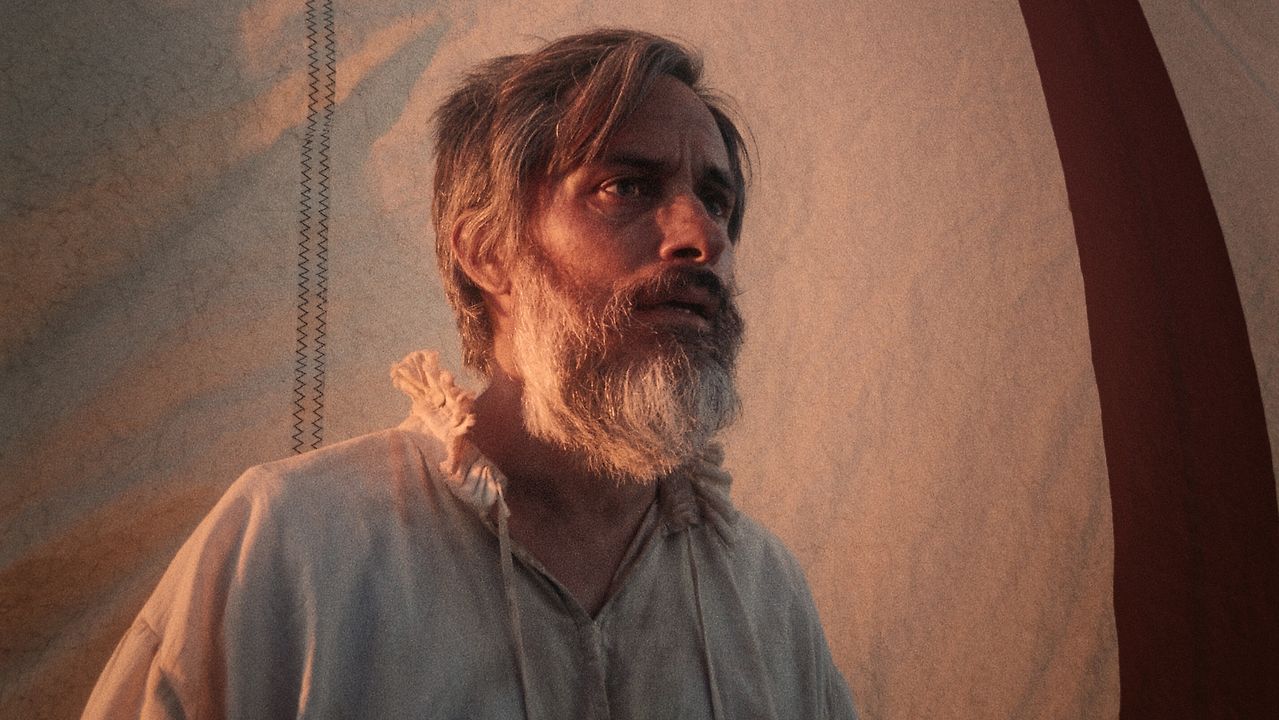
What were the conversations you had with Gael about playing this myth? It’s a quietly funny performance, and he plays him as such a small man, which you physically frame him as such.
From the very beginning, he was really into it. Oftentimes, he mentions, ‘I’m an anomaly because I’m part Caucasian and part Indigenous.’ Half of him is Native, the Mexican side. And for him to play the part is interesting because he’s of the colonizer and the colonized as well—just like Filipinos, just like anybody, any nation that’s been colonized by Europeans or other nations. So it’s an interesting discourse for him. It’s internal, because he knows the discourse will go from Magellan, out to Cortés, and then to all those Aztec things. He has this vast knowledge of history. And with that, with that foundation from him, you can see commitment.
Gael really inhabited the many factors of Magellan. When we connected with him, four years ago, he started studying Portuguese and Spanish, and all these connections of tone and tonalities of the centuries of changes between Brazilian Portuguese and Portuguese Portuguese. He kept discussing it so well. He really, really committed, that’s the good thing about him. And the commitment is not just about acting—there’s a lot of knowledge stacked in his head and in his soul, and he knows what he’s doing. He speaks through his soul. His soul is very historical as well, and you can sense that.
I’ve seen the film three times now, and the thing I always come back to is that opening. It’s almost as if the Indigenous woman is reacting to the movie starting. What was on your mind when making that your opening?
This is always the biggest thing amongst Indigenous people. The tale that the white man will come to save us. You go anywhere in the world, any Indigenous culture will say, ‘One day a messiah will come, and he’s a white man.’ What I really wanted to do with the very first image was dispel the myth that they’ll come to save us. From what? We’re already emancipated in our own cultures. Why do we need this white man? But also, mythologizing is very much a part of it. Every culture has it, so it’s an accepted norm and an invented norm and everything. Culturally, it’s a universal perspective amongst Indigenous people. I wanted to start with that, the connection between the colonizer and then eventually the fractured colonized culture.
As much as you wrestle with the colonizer, your work is shaped by having grown up under the Marcos dictatorship. Your films make clear that the Philippines is a country searching for identity and always falling under these leaders. There was Rodrigo Duterte, of course, and now it’s under the rule of another Marcos. Do you think there’s a way forward, out of these cycles?
I don’t know. It’s really complicated, because the idea of being under a more powerful nation is one we seem to fixate on. The idea of liberation and emancipation in a country like the Philippines is absurd, until now. Everything we do is connected to the concept of security with another power. Just because there’s a threat, the idea that we’re helpless without the aid of someone like, let’s call it, America. Right now, the biggest threat in Southeast Asia is the conflict in Taiwan, just like Ukraine and the Russian invasion, or Gaza in Palestine. In Southeast Asia, it’s Taiwan.
This is the flashpoint where everything will happen, and when Xi Jinping decides to just take it, I’m sure they’ll do it. Everybody will be affected. That’s the thing that scares the Filipino right now, and it’s so connected with the past. It’s still America over us, it’s still colonized. The idea of colonization is still with us, just as the superpower of America is. So it’s a complex issue for us.
That ties into what we started with and what happened with Venezuela today. There’s just this overwhelming fantasy that the superpowers know best. It never ends.
It will happen with Taiwan. They did it with Tibet. Reality bangs on our doors and we wake up today, and it’s real.