



Many, especially prestigious, new productions of Chekhov’s The Seagull in the UK and USA commission new translations or versions of the play. For example, in 1985, for his West End production, director Charles Sturridge presented the translation by himself and Tania Alexander. The cast included Vanessa Redgrave as Arkadina, her daughter Natasha Richardson as Nina, Jonathan Pryce as Trigorin and John Lynch as Konstantin. Peter Hall used a new version by Tom Stoppard for his 1997 production at the Old Vic, starring Felicity Kendal as Arkadina, Victoria Hamilton as Nina, Michael Pennington as Trigorin and Dominic West as Konstantin. The National Theatre production of 2006, directed by Katie Mitchell, with Juliet Stevenson as Arkadina, Hattie Morahan as Nina, Mark Bazeley as Trigorin and Ben Whishaw as Konstantin, used a version by Martin Crimp, usually referred to as “paired-down”.
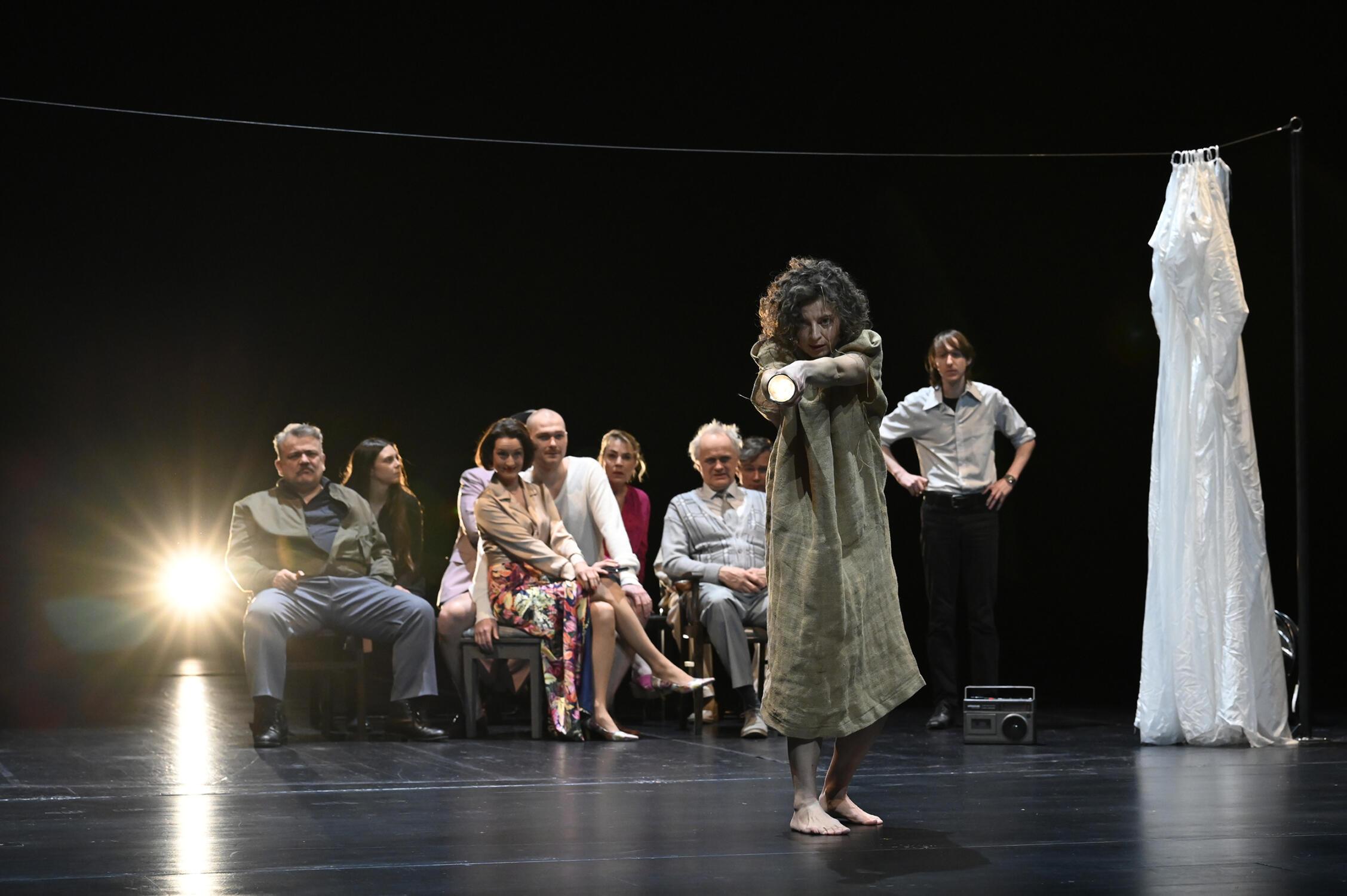
Crimp’s version has now received its German language premiere at the municipal theatre in Bremerhaven. The production ran for two hours without interval. The company’s head of theatre, Peter Hilton Fliegel, created the translation and served as production dramaturg. Director Tobias Rott located the plot and characters in the latter part of the 20th century, to judge by the music the characters listened to occasionally on a portable radio cassette recorder. The set by Cornelia Brey made use of the entire stage space, which felt vast, consisting of three distinct areas: an indoors area, a separate cubicle with glass walls, and an outdoors area assumed to represent the shore of a lake. Those elements were arranged on a revolve, which turned ever so slowly to efficiently accommodate scene changes (the indoors area had moved mainly out of view, and the lake area had come fully into view as the scene changed from one to the other. For the changes of time, the revolve turned at much higher speed, with the actors dancing to the music chosen for that passing of time. The initial scenes of the play established the languor enveloping the characters, also allowing time for actors and audience alike to get used to the acoustics of the space without amplification.
While I do not remember much of the 1997 production by Hall, the haunting memory of almost unbearable sadness characteristic of the 1985 Redgrave/Richardson production came back to me on many occasions while watching the Bremerhaven production – which emphasized tragedy over comedy as well. Marsha B. Zimmermann played Arkadina as a woman driven by her moods, irritating and annoying in how fast and without reason they change. She is aware of this unpleasant aspect of her nature and life but does nothing to stop or change it; rather, she uses her dismay at her own shortcomings as further food for further irritability. It is open to question, as a result, whether she can even be the successful actress the others all say she is – hence her particular vulnerability when Konstantin attacks her profile as an actress. Alexander Smirzitz played Konstantin as a waif of a man, lost in his love for Nina, or his idea of love which he projects onto Nina, and devastated by the lack of feeling, let alone support, from his mother – he realizes there is not as much to her stardom as it seems, but he would like to believe in her stardom and would like the star to approve of his new ideas. Those ideas appear strange to him, and even more so to the others. Only Dorn, the distanced doctor, and in the end Nina, appear to comprehend at least some of those ideas, perhaps only in principle, in essence, or for a moment.
Leon Häder presented Trigorin, the successful poet, as a driven man – driven by his creative urge, which he vividly describes as governing every aspect of his life and which does not allow him to live life as it is: rather, he finds that he immediately reflects many moments of that life as material for further creative output. He thus lives in a world of his own fiction: this is what makes him appear callous and uncaring towards others. However, seducing the women who cross his path, for example, for him does not involve engaging with real people but spinning plot narratives and discovering motifs for his writing. If he damages people in the process, it is part of his creative process, and he is prepared to sacrifice others for the sake of his own creativity. Julia Lindhorst-Apfelthaler played Nina not as a completely naïve and innocent girl. Her Nina may not have been able to clearly define what she wanted, but she certainly did not want to remain in the rural environment she found herself in, and she consciously took the risk of following Trigorin and trying her luck as an actress. When she fails, she still does not wish to settle for life in the country and cannot settle for a relationship without love (with Konstantin).
Anna Catarina Fadda played Mascha as a young woman who is just as resolute in the determination about her life as Nina, only in a different direction. Mascha realizes that she will not meet many more people over and above the ones she knows now. Konstantin does not love her, and she is sufficiently down to earth to realize this, and that this will never change in her favor. She also knows that the teacher, Medwjedenko, is in love with her, and although she does not love him, and never will, she marries him and is at least financially taken care of if still very unhappy. Henning Z Bäcker gave his character, Dorn, the doctor, a gentle but inwardly very determined distance to the events and the other characters. His Dorn was realistic about life, saw the exaggerated and fruitless hopes and endeavors of the others, and made sure to maintain his safe distance from any entanglements, always taking his own well-being, as he chose to define it for himself, as the yardstick. He was aware of his professional authority and used it judiciously, ensuring that the dominance of his own interests was never to the genuine detriment of those whose wishes, with regard to himself, he was not prepared to fulfil completely.
Kay Krause excelled at rendering Sorin’s sadness palpable, which grew in view of a perceived squandered life of lost opportunities, enhanced by early onset of physical and mental ailments of old age. Marc Vinzing was convincing as the teacher who has always given in to the desire of others and who is now taken for granted by all. He suffered because at first Mascha did not return his love, and he continues suffering because although Mascha has married him, she still does not love him. Frank Auerbach’s Schamrajew had a hard time managing the estate, which includes his wife and the raft of changing visitors. Angelika Hofstetter was suitably downtrodden as Polina, dismayed both by her life with husband Schamrajew and by her unrequited love for Dorn.
This post was written by the author in their personal capacity.The opinions expressed in this article are the author’s own and do not reflect the view of The Theatre Times, their staff or collaborators.