




The interview took place on January 17, 2026.
Maxim, do you remember your first conversation with Krymov? What did he tell you about the idea of the performance, and what was your first reaction?
It was a conversation for three: Chulpan [EN: Khamatova], me and Dima [EN: Dmitry Krymov]. He told us about his idea, which I immediately liked. The only thing that surprised me: I never considered myself an author before, and here I had to be a co-author. Dima asked us to remember interesting moments from our lives, write them down, describe them, and send them to him. We immediately agreed and started working.
This is your first work with Krymov. You’ve finally met!
The first job, although the offer from him was the second. The first was before the war, about the Meeting of Mihoels and Charlie Chaplin – a performance that Dima premiered with other actors.
How was the rehearsal process?
Dima, as a person, is undoubtedly talented, invents a lot himself. Invents not only the concept or development of the plot, but also in a plastic sense. What is invented, of course, does not always coincide with how the rehearsal process develops. You have to constantly tinker with it. It’s impossible not to show the director what he came up with, and at the same time it’s impossible not to offer him what you come up with. All this is a “brew.” We added one “ingredient”, then removed something. This “brew” then became the production.
How did you work in the style of video projections? Comfortable?
Of course, it’s comfortable, because we appropriated this style for ourselves. From a technical standpoint, it would be right to rehearse everything first, and then later shoot these video projections, but there was no such possibility. The video had already been staged at the moment when we started our live rehearsals. It was an experiment I hadn’t experienced before.
I want to ask you about every element of the play. The music, for example ranges beautifully from Bach to Gubaidulina. Is the choice of musical fragments also a collective creativity?
No, the music is entirely Dimitry’s choice, his prerogative.
You met Chulpan on the set in 1997 in Country of the Deaf by Valery Todorovsky. Then your paths went parallel, but did not cross. What was your meeting like in twenty-seven years?
We crossed paths personally, saying all the time that we should do something together, but it never worked out. On the one hand, because it’s a pleasure for me to be on stage with a person and an artist with such empathy. It’s a pity that we hadn’t done anything together for so long. On the other hand, thank God that we finally connected again, and it is quite possible that in the future we will still have some joint work.

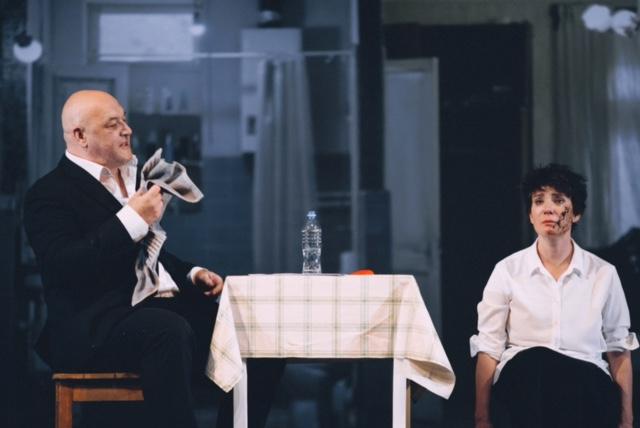
Maxim Sukhanov and Chulpan Khamatova in “Diary of Madmen,” directed by Dmitry Krymov.
You were just born for each other! You and Chulpan manage to balance on the border of tragedy and farce in an absolutely wonderful way. Was this border somehow spoken by Krymov? Is Krymov a director showing or telling?
Krymov is both a narrating and showing director. At the same time, it does not cancel the instincts and intuitions of the actors, their sentences… I always wanted some completely polar things to exist nearby. The more piercing their synthesis is. I can’t say now whose offer prevailed – Dima’s or mine, when I showed something. It happened in different ways. You know, during rehearsals you open your own pores so much that ideas start to come by themselves. It’s quite difficult to disassemble them later, especially when describing it verbally.
I can’t help but ask about the moment when the glass gets into Chulpan’s eye. She left the stage, you began to tell tales from your acting experiences and the audience was really excited, did not understand the game. Did you expect such a reaction?
It was like that from the very beginning. Some part of the hall thinks that it was intended, and some are ready to run to the stage and help. Such a “dramatic provocation”.
The fall of the fourth wall…
It appears often with Dima, and then we rebuild it. The principle of “emerging out” and “dipping” into the character and again into oneself is a red thread through the whole performance.
Despite the abundance of humor, for me the performance was one of the most tragic I’ve seen in recent times. Evil wins. All that’s left for the heroes is to hug each other on the ashes. The support is themselves, no one else. Do you agree with this interpretation?
On the one hand, I agree, as a kind of warning. But on the other hand, there’s a harmonious exit to bows and a connection to the hall. This I see as some hope. Maybe I’m making it up now, but the appearance of Chulpan after my twirling, when she hugs me and then we go out to bow, and the audience begin to applaud, gives hope for the good. We are cleaning the fourth wall again, continuing the language of the play. I’m always in favor of multiple readings of a performance by the audience. The wider this variability, the more interesting the performance.
Before the premiere, I had to worry about you when the Riga National Theater suddenly canceled all the stagings. Fortunately, the premiere took place, as planned, only at another venue. Does it matter to you on which site, in what space the performance is played?
By and large, it probably has an effect, but in that case, it worked out even better for us!. We were so well received in these makeshift pavilions we had rehearsed in! The entrance to the pavilions, through some construction sites and dilapidated buildings, became our natural habitat. Maybe it would have been strange in a way to present the play in an ornate National Theatre than in the one where we rehearsed it and eventually released it.

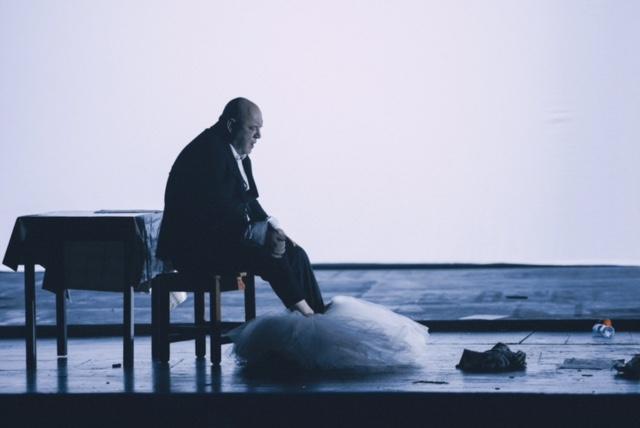
Maxim Sukhanov in Diary of Madmen, directed by Dmitry Krymov.
In one of the interviews you said: “The performance, like a good garden, should be watched.” It works well when the performance is a repertoire. And in the case of “Diary of Madmen” how to do it?
It’s a difficult question. Of course, the “gardener” should keep an eye on it.
What if the “gardener” is overseas?
Periodically, Dima manages to come to us in different countries and look at what’s happening, plus we ourselves are quite gentle about some innovations of our own, because they are born one way or another. Not just improvisation as such, but tempo-rhythmic improvisation. The production itself was not born on the day of the premiere. In my opinion, its birth happened a little later.
In my articles, I always emphasize that in the cinema we see not performances, but their video versions, and we watch through the cameraman’s eyes, not with our own. What do you think about the very idea of Art Seen Films producer Eddie Aronoff to shoot performances for the big screen?
I’m quite dubious about it. People working on the video version should watch it several times to make accurate decisions of what will be shot in close-up, what is medium, what is full plan. This is also a creative act – creating a TV version or video version. The performance cannot simply be filmed by several cameras, then edited and shown. It will be wrong, it’s the wrong language. There is a reaction of the viewer. The spectator in our performance is also a character to some extent. It seems to me that we need to work carefully on this. I haven’t seen the video version of Diary of Madmen, but I hope Eddie’s team did it.
Are you a leading actor or a character actor?
I don’t even know how to evaluate myself from this point of view. I know for sure that when I’m interested in the work and the role, I start “bubbling” with ideas. The character I cultivate appears and manifests itself quite slowly, but then, when it manifests itself, I start to have a kind of “protuberance”. And I don’t know whether it’s a slave or a presenter. In any case, there should be a real equal dialogue with the director. That’s absolutely true . Both the director and the actor must understand, feel and hear each other, and in no case use any other principles in communication. Everything is going very well here.
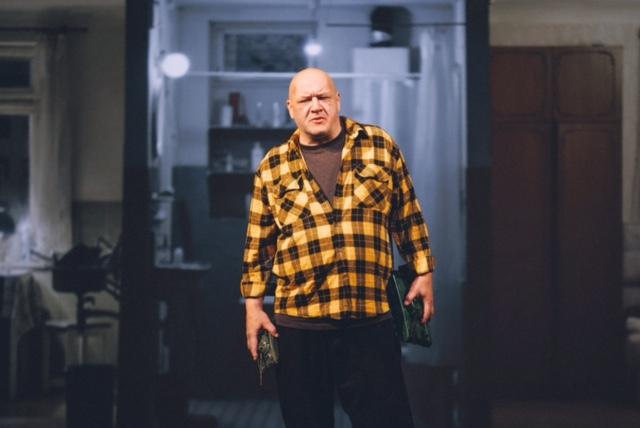
Maxim Sukhanov in Diary of Madmen, directed by Dmitry Krymov.
I’ve wanted to ask you for a long time why your cooperation with Rimas Tuminas was so short-lived? In 2011, you made a play together The Wind In the Poplars based on the play by Gérald Sibleyras, but there was no follow up. Was it not a good fit?
The Wind in the Poplars did not develop quickly and was a game of musical chairs. I started rehearsing from the very beginning, in September. We were supposed to premiere it in November. I played the role, which was then played by Volodya Vdovichenkov. I rehearsed one role, Makovetsky – another, Garmash had to rehearse the third. Then Garmash refused. Volodya Simonov began to rehearse his role. Then Makovetsky refused, and Rimas invited Sukhorukov. The three of us rehearsed: me, Sukhorukov and Simonov. Then at some point Rimas asked me to leave. Apparently, the number of questions I ask was out of place for him. It is quite possible that I slowed down his own process. Vdovichenkov was introduced to my role. Sukhorukov left two weeks later. Rimas called and asked me to come back. I offered to play the role that Sukhorukov played. Rimas told me: “This is not your role at all.” I insisted, and as soon as the three of us began to rehearse – me, Simonov, Vdovichenkov – suddenly something clicked and the ship sailed. As for other projects, when he was about to start, I couldn’t, because I had a film shoot. When he offered me to rehearse Astrov in his Vanya, I, unfortunately, to my shame, said that I did not feel this role. I feel the role of Serebryakov perfectly, but I don’t know this Astrov. I can’t find motivation for this role inside myself. Then he offered me to play the old Prince in War and Peace, but I didn’t see the role there at all. When I don’t feel a role, its volume, I won’t be able to do anything interesting. I said it wasn’t mine… I met with Rimas very often, sat in his office, discussed his fantasies, talked for a long time. All that was left was to start, but there was no beginning… We always communicated with him very tenderly and friendly.
It should be easier for you to work in Europe.
Yes, of course. The only thing (this is especially true of America): a performance comes out, plays for two months almost every day, and then closes. This seems unfair to me in relation to theater. A well crafted performance should exist longer, but, apparently, the commercial conditions are such that it is impossible to do this or it is possible to extend the life of the performance only with entrepreneurial trips. We travel with our performances and play them in different countries and cities.
And thus you prolong their lives!
Yes, with Diary of Madmen in April we have tours in Spain and Portugal, in May – in Israel… And then, of course, this film version. It lives on!
This post was written by the author in their personal capacity.The opinions expressed in this article are the author’s own and do not reflect the view of The Theatre Times, their staff or collaborators.
This post was written by Sergey Elkin.
The views expressed here belong to the author and do not necessarily reflect our views and opinions.