

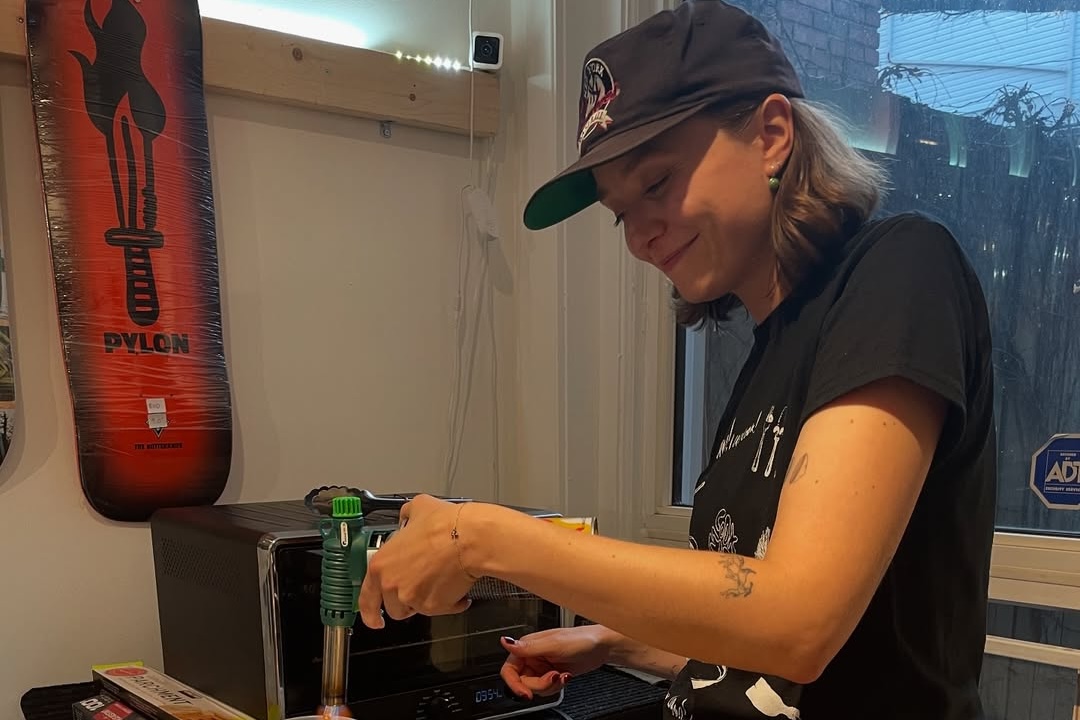



On Tuesday mornings at the Fort York Food Bank, before most people have finished their first coffee, chef Maddy Goldberg is already doing a lap of the shelves, scouting her ingredients for the day.
There’s no menu, no prep list, no spreadsheet of purveyor orders — just donations, a tiny budget and the basics she can usually count on: milk, eggs, potatoes, onions. Everything else is a surprise.
“I walk around for the first 10 minutes,” she says. “I’m picking things, but I’m normally sort of picking maybe one to two items that excite me and those are the things I start to conceptualize a dish around.”
Sometimes it’s acorn squash because it’s fall. Sometimes it’s a random bottle of tahini. Recently, a donated blender opened up an entire world of sauces and dips. Whatever she lands on, she has about two hours to turn it into a hot lunch for roughly 100 clients plus a team of volunteers.
“It’s a full adrenaline rush kind of energy,” she says. “But then it’s also just very wholesome… I’m literally feeding the cutest, sweetest clients who are so grateful that I’m cooking for them.”
When she left for university, it wasn’t for culinary school but for social work at the University of Guelph. At the same time, she was quietly building a second language: food. She started cooking in middle school, spending entire days trying to recreate restaurant dishes. In university, cooking out of necessity very quickly turned into cooking for a small army.
“Initially it was just to feed myself and then it was suddenly like I’m feeding all my friends,” she says. “I was feeding like 20 people at university almost every day.”
A Toronto restaurateur she met through social media pushed her to share what she was doing. Goldberg started a food Instagram in 2014, perfectly of its era, called Cook Eat Sleep Repeat — a riff on “Eat Sleep Rave Repeat.” From there came a string of side gigs in the food industry.
By year five of university, she’d worked with a handful of companies and realized the thing that lit her up most wasn’t casework but cooking. She enrolled at George Brown and eventually landed in the kitchens of Mary Be Kitchen, Aloette and later Salon, where she got a crash course in fine dining. The experience confirmed something she’d felt for a while: she loved the intensity of kitchen life, but not the distance between the food and the people eating it.
“Everyone there… thought of food as like a sport,” she says of her time at Aloette. “They wanted to be the best, work the hardest, have the most groundbreaking food, win all the accolades. I loved the intensity of fine dining and the hard work… but the actual food felt very unapproachable. I just liked feeding people.”
She was also stunned by the level of waste. “People had warned me before but I don’t think it’s that obvious how kind of insane food waste is,” she says. “There’s so much perfection in food… so where does the not-perfect food go? It’s not cute.”
When COVID hit and fine dining temporarily became burger takeout, Goldberg eventually stepped away and leaned into private dining. It started with one pandemic-friendly, distanced dinner for six in someone’s backyard. She posted photos on Instagram, cooked a few more dinners, posted those too — and suddenly, the DMs started rolling in.
The model suited her perfectly: small groups, bespoke menus, essentially no food waste, and the chance to fold in the fundraising brain she’d had since her LiveStrong-bracelet-obsessed childhood.
“At Aloette they would charge essentially the same thing [for dinner],” she says. “In fine dining they’re wasting at least 10 per cent of their costs. I was like, I’m going to have no waste, so I’ll donate 10 per cent of the cost of every dinner to a charity of the host’s choice.”
About a year into running her business, Goldberg took herself to Europe, spending a month and a half in Italy to get serious about pasta. On that trip, she started thinking more formally about what she wanted her career in Toronto to look like when she came back. The private dinners were staying. But she wanted something more directly tied to community.
“I knew I wanted to do more,” she says. “I was like, where, how am I going to give back?”
Back in Toronto, she came across a post: Fort York Food Bank was looking for volunteers on Tuesday mornings. She had the time — and a very particular skill set.
“I messaged them and said, hey, I’m a chef, I used to work at Aloette and I’m interested in volunteering Tuesday mornings,” she says. “They were so excited.”
Before the pandemic, Fort York had a hot meal program alongside its grocery pick-up. During COVID, it shifted to a grocery-store-style model and kept it. When Goldberg reached out, the team was looking to bring back hot lunches.

“So I kind of helped reignite this hot meal program,” she says. “Now there’s I believe there’s a hot lunch as well as groceries at the food bank all five days of the week. I just do it one day, but there’s four other chefs or people that do it.”
She’s been there for “just over three years” — long enough that designing lunch out of whatever’s on hand has become a weekly ritual. The system is simple but extremely improvisational. Goldberg hunts for “fun produce” first — anything seasonal or local that catches her eye. When that’s lean, she looks for interesting pantry items: a jar of tahini, a random condiment, something she can build a dish around for a hundred people.
Recently, the arrival of a simple blender felt like a luxury. “I started doing a lot of blended stuff,” she says. “I made sauces. I love sauces.” One day, that meant turning donated chickpeas into a full hummus plate: homemade hummus, eggs, cucumber salad and pita.
“Hummus is something that so many people assume you just buy,” she says. “Especially at a food bank — it’s hummus, it’s probably not homemade. So it was exciting for me to bring that to the food bank.”
Most recently, this past Tuesday, roasted red peppers became a silky romesco sauce for pasta. It’s still very much work — she compares the rush to the buzz of a dinner rush on the line — but the vibe at Fort York is different from the closed-off world of fine dining.
“I grew up in Toronto so Toronto as a community is so important to me,” she says. “I grew up in the city taking the subway every day to school from a very, very young age. And as much as the city is beautiful and amazing, the reality is there’s so much food insecurity… so much food is getting wasted while so many people are going hungry.”
“What I’m doing at the food bank is taking really, really simple ingredients and making that a meal that feeds a lot of people,” she says. “We’re so easily disconnected from our food and it’s so easy to order Uber Eats now. And then at the same time those same people are complaining about the cost of living in Toronto.”
Her suggestion is small but radical: pay attention to what’s already in your fridge.
“If you spend a bit of time thinking about what’s in your fridge or what might go bad or picking up one ingredient at the grocery store and trying to make dinner with it, that’s something that will actually help change the food system in so many ways,” she says. “Being inspired to cook with what you have is an amazing way to help your community without realizing it, to be honest.”
“Obviously, you can donate to a food bank too,” she adds. “That never hurts.”