





Frontmezzjunkies reports: Off-Broadway’s Mexodus Returns
By Ross
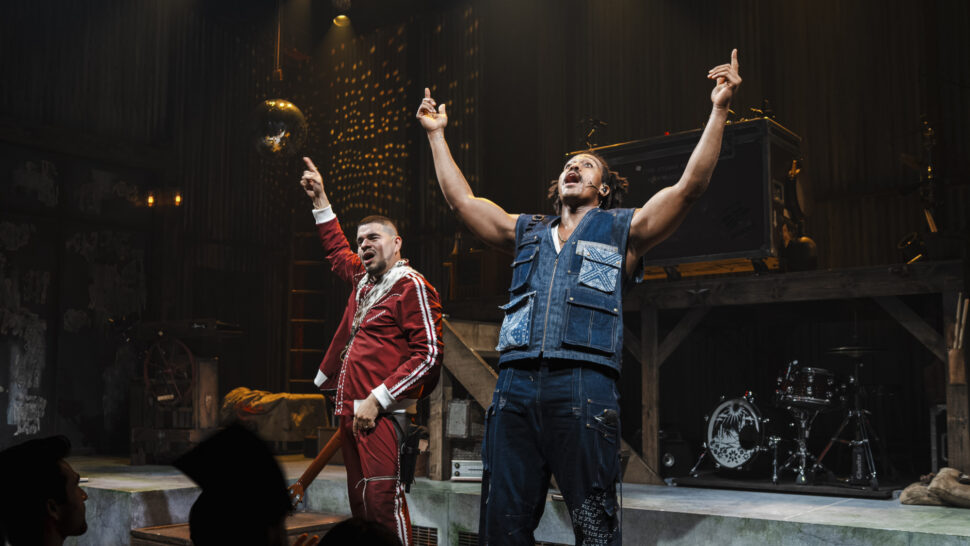
When Mexodus first landed at Audible Theater last fall, it didn’t arrive quietly. It arrived with urgency, sweat, and an insistence on being heard. Written and performed by Nygel D. Robinson and Brian Quijada, the two-person, live-looping musical excavates a largely erased chapter of North American history: the flight of enslaved Black Americans south into Mexico in the mid-19th century, where freedom, though precarious, was possible. Beginning March 6, Mexodus will return Off-Broadway for a 10-week limited run at the Daryl Roth Theatre, running through May 17, a welcome encore for a piece that still feels bracingly of the moment.
Part of what makes Mexodus so galvanizing is its method. Robinson and Quijada perform every role and create every musical layer live on stage, building beats, harmonies, and rhythms in full view of the audience. The looping is not a gimmick but a dramaturgical engine, a way of making history feel constructed, contested, and alive. As I wrote after seeing the Audible run, Mexodus “brilliantly layers and loops history with liberation,” using sound as both archive and protest. The form mirrors the content, showing how stories are built from fragments, repetition, and survival passed hand to hand.
Directed once again by David Mendizábal (Atlantic’s Tell Hector I Miss Him), the production moves fluidly between past and present, tracing Robinson’s family history alongside Quijada’s, and placing Black and Mexican experiences of oppression in a tense, necessary conversation. One of the musical’s most gripping sequences follows Henry, an enslaved man fleeing Texas after killing a white man in self-defense, racing toward the Rio Grande knowing he cannot swim. In moments like this, the show’s intellectual ambition gives way to visceral storytelling. The audience does not observe history from a safe distance; we feel ourselves “running alongside Robinson,” caught in the panic, fear, and hope of escape.
While the looping structure occasionally risks repetition, the payoff is consistently emotional rather than academic. Once the musical architecture locks into place, “the story and the storytelling take over and make Mexodus fly.” The design elements support that propulsion: Riw Rakkulchon’s set evokes a derailed railroad car turned monument and DJ booth, Mextly Couzin’s lighting carves urgency into the space, and Mikhail Fiksel’s sound design ensures the live-built music lands with force and clarity, while Tony Thomas’s choreography sharpens the physical stakes, especially in moments of confrontation and shared recognition.
“Why does the bird in the cage sing?” they ask, citing the Maya Angelou poem, and noting the answer. It sings for freedom because of hope. Because it is an innate expression of the bird’s true nature. Because it is a powerful act of resistance against the bars that imprison. And it is a way to remind itself of liberation and connection. The poem and the song the bird sings are a radical expression of pain, sorrow, and hope against the oppressive constraints of its captivity, and cannot be heard without discovering the pain of oppression.
What ultimately lingers is Mexodus’s insistence on solidarity as a hard-earned choice, not a slogan or gimmick. The show refuses easy alliances, instead dramatizing how oppression teaches division before demanding connection. In revisiting this work now, as questions of belonging, erasure, and survival feel increasingly urgent, its return feels like a continuation of an unfinished but important conversation. Mexodus is not simply recounting history; it is actively resisting its disappearance, looping the past into the present and daring us to listen closely this time.