



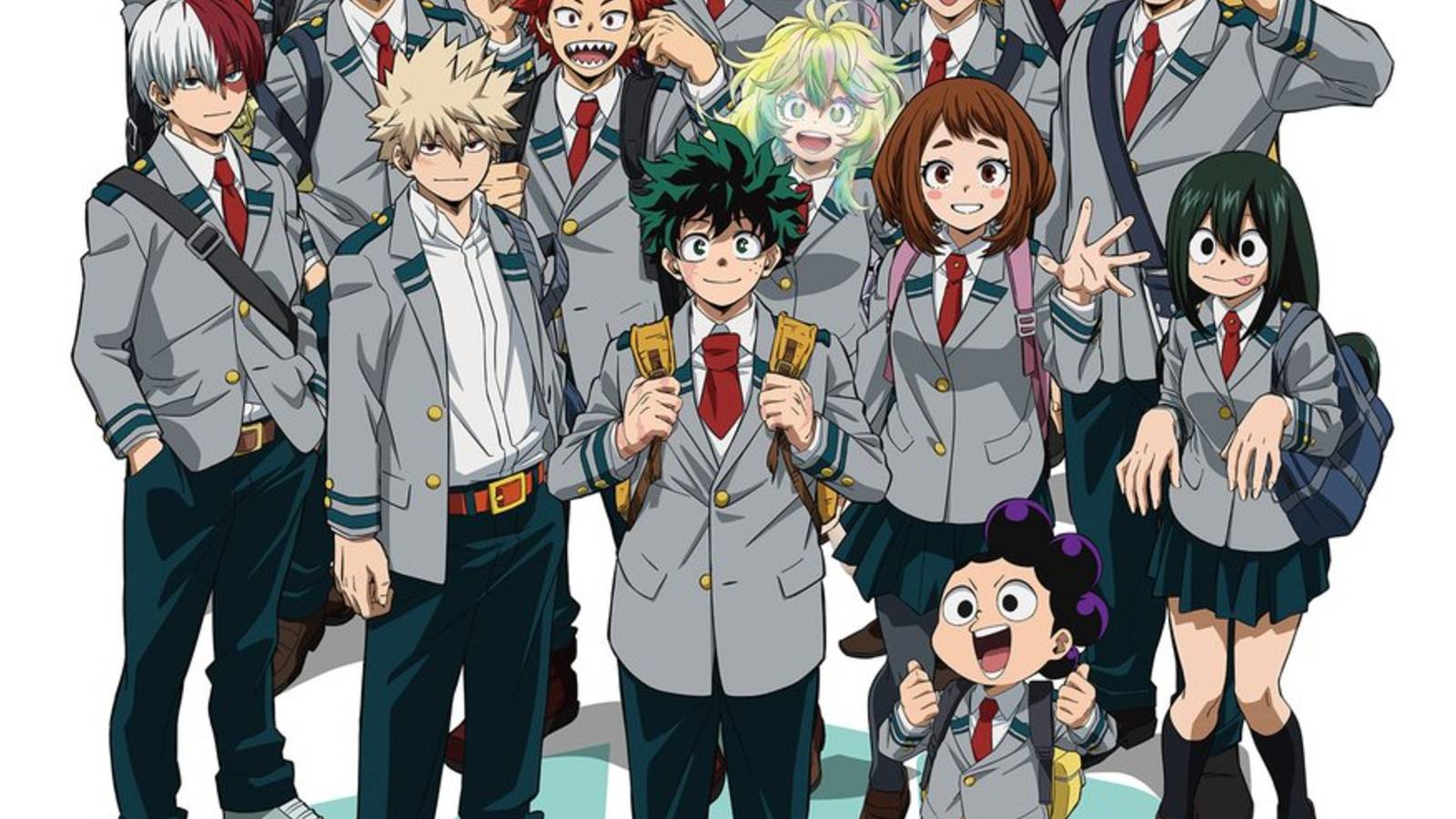
My Hero Academia is the best shonen anime (and manga) of the last decade. At the same time, it’s also the most underrated. This apparent contradiction is the result of two factors. First, toxic fandoms and their online interactions often derailed the discourse surrounding the series. Second, My Hero Academia is too serious and mature for the shonen standard; it requires a level of reflection and understanding that many casual fans don’t expect or want from a genre primarily aimed at teenage boys.
Yes, that’s right, an animated show about superpowered kids going to hero school and fighting villains is one of the most meaningful stories that the endlessly expanding world of animanga ever produced. And now, it’s over. After nine years, the My Hero Academia anime concluded with a spectacular eighth and final season that succeeded in a task that many series (anime and otherwise) fail to achieve: It nailed the ending.
Amazing source material like Kohei Horikoshi’s manga (which the anime faithfully replicated right to the end) doesn’t necessarily mean the anime will be good. Pacing, animation, episode cuts, music, voice acting: all these factors can make or break an adaptation. Luckily, the animation team at Bones did not disappoint. Every episode in My Hero Academia’s final season was flawless, building to a finale that was emotional and heartfelt. But even more importantly, it made sense.
My Hero Academia is about what it means to be heroes. Not in a fantasy world, but in our own, real lives. The premise is highly original: superpowers, rather than being the exception, are the norm. Almost every person has a power, referred to in their world as Quirks to denote their mundane status. When being exceptional is the norm, the words “hero” and “villain” are no longer defined by things like superstrength or shooting lasers from the eyes. Instead, it’s following your moral compass and making the right choices.
Imagine this: In a world where everyone was bitten by a radioactive spider, would Peter Parker still become a hero? Peter’s trigger for becoming a hero is the guilt for not stopping a burglar who ran past him and later killed his beloved uncle Ben. He should have made that step. He should have cared. Because he has powers, and with great power comes great responsibility. It’s the burden of Spider-Man’s powers that motivates him to become one of the greatest superheroes of all time.
Horikoshi flips Spider-Man’s premise on its head. In the first chapter of My Hero Academia, protagonist Izuku Midoriya (aka, Deku) makes that step to save his friend (and bully) Bakugo from a villain, despite not having powers. That moment is the key to interpreting the entire series and understanding its message.
Izuku isn’t motivated by the burden of power like the majority of characters in Western superhero stories (which Horikoshi clearly loves and understands well). What makes him take that crucial first step is the part of human nature that the author believes is most important: the impulse to hold out a hand for people in need. This theme recurs throughout My Hero Academia, but nowhere is it more evident than in the finale.
Izuku doesn’t win the final battle because he was given the most powerful Quirk in the world, One for All. He actually has to get rid of his power to beat Shigaraki. He transfers the Quirks stockpiled inside One for All to his enemy, using them (and the inherited will of his predecessors) to break down the barrier of trauma and abuse that is protecting Shigaraki’s core: a scared boy named Tenko Shimura. Izuku, who dreamed of becoming a hero for his whole life, despite not having powers, now has to get rid of the power his idol All Might gave him. But that’s not how he wins.
After Deku penetrates Shigaraki’s inner world and embraces Tenko at the cost of losing his arms, the latter accepts Izuku’s compassion. At that point, All for One’s personality emerges again and takes over Shigaraki’s body. Izuku is beaten. He lost both arms, and he’s literally crawling on the ground, unable to move. In that moment, Izuku’s real superpower activates: his ability to reach other people’s hearts. His classmates appear on the scene, followed by the other heroes, bruised and battered, who survived the final war. It’s a host of secondary characters with powers that pale in comparison to the arsenal All for One can deploy, and he states so repeatedly in that scene. “They’re worthless scraps,” the villain says. “Trash to burn.” And yet, the first one to step forward and rush him is Hanta Sero, who has the rather unimpressive power of shooting adhesive tape from his elbows. He’s the definition of a filler character, but he challenges the Demon Lord with no hesitation. “I haven’t had a life full of extremes,” Sero says, underlining his status as a background extra. “Still, I’ve watched my friends go through hell… And I bet they’d agree that life is much better without all that tragedy.”
The combined efforts of all the secondary characters allow Izuku to heal and rush through All for One’s attacks to deliver the final blow. His efforts are televised, and the whole world watches as this once-Quirkless boy risks his life to protect them. The people who were gripped by the fear and darkness sown by All for One, who fell into rage and distrust to protect their safety, begin cheering for Izuku. Our hero is wearing an All Might t-shirt, given to him by one of the refugees — the same person who feared that Deku coming back to school at the end of season 6 would put everyone in danger. This is the core message of My Hero Academia: It doesn’t matter who you are; if you hold your hand out for people in need, you’re a hero, and others will follow your example.
My Hero Academia uses its villains to reinforce the same message. They are the leftovers, the waste of the deeply flawed “hero society.” With the mightiest individuals rising as the top heroes, the common folk began to think that it was no longer their responsibility to solve issues or care about others. “I’m sure a hero will come” was the standard reaction. Making heroism part of the system took away responsibility from the individuals. Systems are not perfect, My Hero Academia says. It’s a powerful dose of realism that adds weight to the story.
Even the strongest hero can’t save everyone. This was the flaw in the greatest hero, All Might. He rose to become the symbol of peace because that’s what people needed at the height of All for One’s reign of terror, but he took all the burden upon himself. People relied on him and the other heroes too much. There’s a difference between protecting and inspiring (even if All Might also inspired a new generation of heroes, like Deku and Bakugo). He was too strong, while Deku’s power comes from his weakness. Izuku cries a lot for a shonen protagonist, but that’s what makes him such a great character.
The big flaw in All Might (and the society he built) becomes apparent in the two most important scenes in the series. When a young boy Tenko Shimura wanders the streets after murdering his family (because of All for One’s manipulations), a woman finds him, but unsettled by his demonic grin and shocked expression, she leaves, saying that a hero will take care of it. No one extended a hand towards Tenko (except All for One), and that created the greatest villain, Shigaraki.
In the show’s final episode, we see something similar. An unnamed boy who has been imprisoned and abused by his family due to his dangerous Quirk is accidentally freed from his prison. He stumbles on the street, and seeing happy people around sends him spiraling. “How can these people be smiling,” he asks, when he’s suffered so much. Just as he’s about to unleash his Quirk, the same woman from Shigaraki’s memory, now an elderly lady, approaches. She’s still thinking about that kid she didn’t help, many years ago. But things have changed now. She extends her hand. “Everything is going to be all right,” she says. “Granny is here for you.”
This is where My Hero Academia comes full circle. Izuku didn’t just save the world, he changed it for the better. The message he, and the series, deliver is deeply rooted in our society and the issues we face every day. Year after year, our world becomes more individualistic, and people care less for each other. How many times do we walk past someone in need and think, It’s not my job to care, I have enough problems of my own? I know that’s happened to me, more times than I would like. The harder life gets, the harder it is to look outside our little bubble.
Horikoshi had the courage to make such a real issue the core of My Hero Academia, and the capacity to weave it through a story that is coherent, emotional, and exciting at the same time. Shonen series are famous for inspiring people, but they’re usually about inspiring them as individuals. Never giving up and becoming stronger through adversity is often the core emotional message of the genre, which is perhaps why we see so many professional athletes showcasing their fandom. However, few shonen series made their core message about society as a whole.
My Hero Academia excels for many other reasons, too, in its creative approach to genre tropes. Supporting characters became more meaningful by highlighting their status as such (see Sero’s example above). It also features a meaningful relationship between protagonist and deuteragonist through Bakugo, who destroys All for One’s original body, despite the latter’s claims that the young hero is just a “background character.” It gave us the best rendition of the infamous “talk no jutsu” practice of redeeming even the foulest villains. Deku never gives up on his goal of understanding and helping Shigaraki, and that’s what allows him to win in the end. However, the villain doesn’t get to join the heroes, all his crimes forgiven. Tenko Shimura dies, but he’s finally at peace. Izuku’s actions will make sure that society won’t produce another Shigaraki, as we see in the final episode.
Finally, Deku actually loses his powers in the end. There’s no deus ex machina or magical intervention: he pays the price for saving the world, becoming a “regular” teacher, until, many years later, his friends are able to buy him a techno suit and rekindle his dream. They give back to someone who has given everything to others, but it only happens after eight years. It’s a brave choice for the finale, but Horikoshi stuck to his vision, and he delivered.


No other manga or anime in the last decade has been so faithful to the shonen genre while, at the same time, innovating it so much from the inside. My Hero Academia’s peers are works with equally powerful narratives such as Frieren, which however steps outside the canon of shonen more often than not; or Vinland Saga, which is fully a seinen. My Hero Academia is one of the few works in the genre that lives up to its premise: telling the story of how we all can become the greatest heroes.