








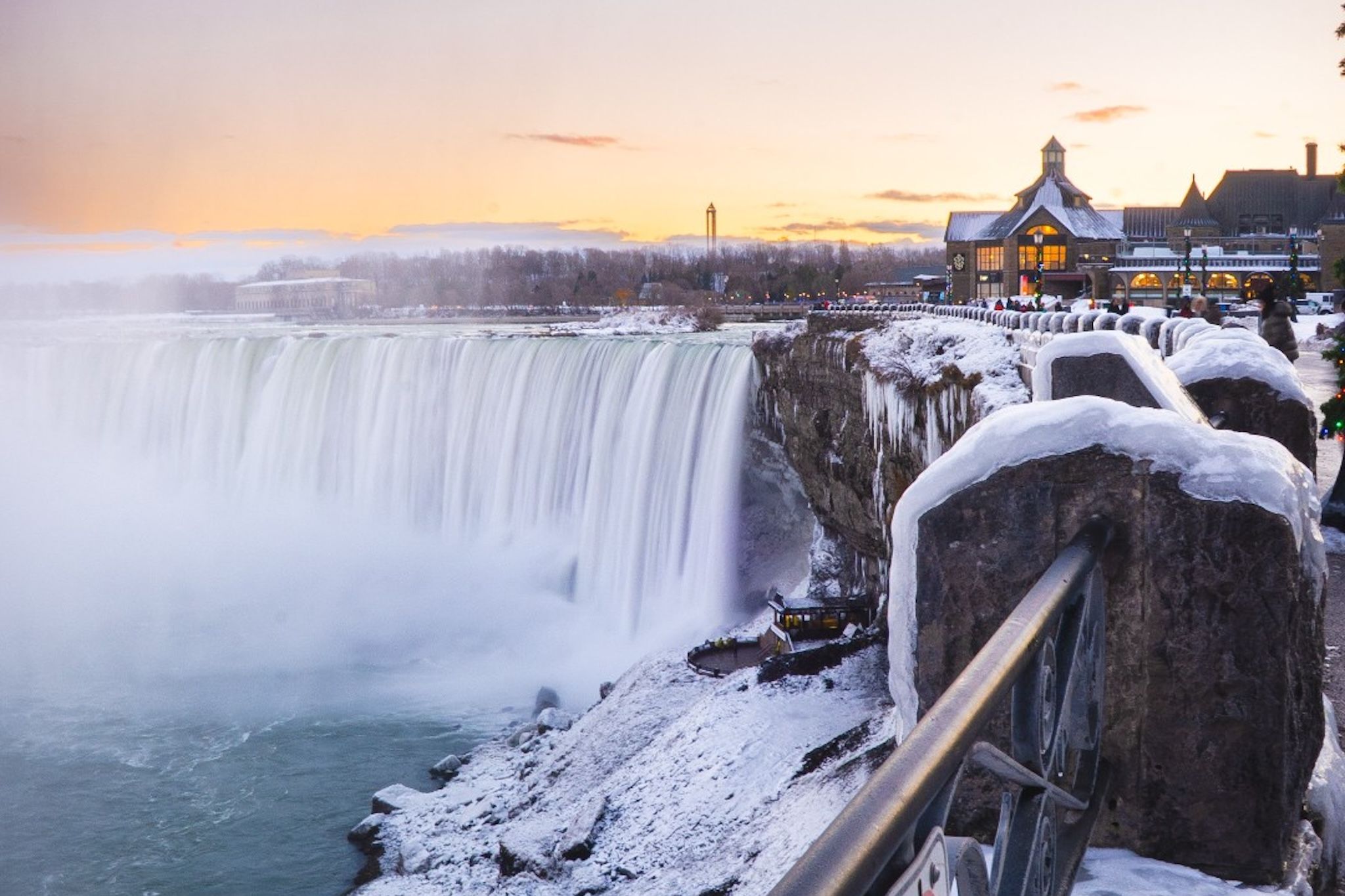
Niagara Falls is frozen! Well, sort of. Ontario’s famous waterfall may look like it has completely frozen over, but the massive rushing spectacle is not even close to being an icicle. We’ve experienced a cold few days here in Ontario, with temperatures dipping to freezing. But despite all of that, Niagara Falls is still flowing. Curious to know why? We’ve got the answer.
Though it may look like Niagara Falls is a massive icicle, it’s actually the mist and spray that have formed a crust of ice over the rushing water. This, in turn, creates the illusion that the falls have stopped flowing.
Surprisingly, the rushing waters freely flow underneath the sheets of ice.
“While the Falls never truly freeze, it does turn into an icy wonderland with all of the mist and steam freezing on the rock and railings around the Falls,” shared Niagara Falls Tourism with Curiocity last winter. “There is just too much water for the falls to stop flowing.”
Niagara Falls has low water flow in the winter
Though the mist and steam do their magic, in the winter, about 75% of the water flowing from Lake Erie to the Niagara River is diverted before it hits the Falls. This occurs through tunnels and canals for hydro-electric reasons. The water then returns into the lower Niagara River, which Niagara Parks shares.
“As a result, the ‘winter flow’ or the volume of water that rushes over Niagara Falls throughout the winter months, is approximately 85 million litres every minute,” they add.
“In contrast, from April 1 through to October 31, approximately 50% of the water is diverted, resulting in the summer flow, which is generally measured at 170 million litres of water every minute.”
It makes sense that having less water also contributes to the chance of seeing a “frozen” appearance. For a stunning view, Niagara Parks recommends heading to the Tunnel Platform for a breathtaking view of the frozen falls.
But, there was a time when Niagara Falls actually froze over. Really!
Has Niagara Falls ever stopped flowing?
It actually did freeze over once, believe it or not. However, it wasn’t in our lifetime.
According to Niagara Parks, the falls “ceased its flow,” for 30 hours in March 1848.
“High winds set the ice fields of Lake Erie in motion and millions of tons of ice became lodged at the source of the river, blocking the channel completely,” states Niagara Parks.
“Local inhabitants, accustomed to the sound of the river, heard an eerie silence and those who were brave enough walked or rode horses over the exposed basin.”
A self-made dam actually held the water back until a shift allowed the built-up weight of water to break through. And thanks to the annual installation of the ice boom, it has stopped this from happening ever since then.
What’s an “ice boom”?
Despite its name, the “ice boom” actually stops potential damage caused by floating ice.
“Before 1964, ice would float each winter from Lake Erie along the Niagara River, seriously impeding power diversions and damaging shoreline installations and bridges,” states the tourist site.
A 2.7 km-long boom was then created to avoid this. It’s made of floating 30-foot-long steel pontoons and is placed between the town of Fort Erie and the city of Buffalo to hold the ice back.
Even with this in place, it doesn’t stop Niagara Falls from appearing any more frozen. If you’re set on seeing a fully frozen waterfall, Ontario has just the spot. During the coldest months, Kakabeka Falls, Ontario’s second-largest cascade, typically freezes over.
So, the next time someone tells you Niagara Falls has frozen over, you’ll know the truth, and you’ll even have another option to offer.
And we’re definitely still in store for more winter action this season so a trip to Niagara Falls is in order.
Recent Posts:
The best things to do on New Year’s Day in Toronto
Roaring waters to ice: Ontario’s second-tallest waterfall stands still in winter