





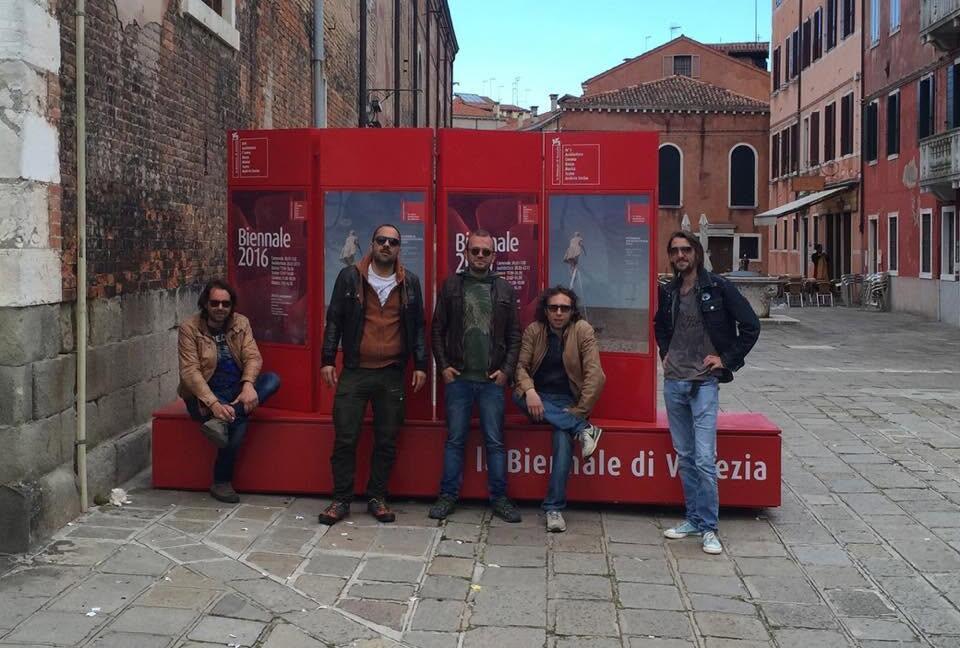
STONE DESIGN Architects – Authors of the project No Man’s Land (2015/2016). Connected by a shared commitment to modern, urban, and sophisticated architecture, in 1999 four fellow students – Ljupco Tasevski, Stojan Pavleski, Ivan Simeonov, and Gjorgi Radovanovic, founded STONE DESIGN, a Macedonian architectural studio specializing in architecture, urban development, and interior design. Challenging conventional boundaries and aiming to bring a fresh perspective to Macedonian architectural practice, they embarked on a continuous architectural journey, approaching each project as a distinct and autonomous subject. Driven by dedication and a search for functional yet distinctive design solutions, the studio quickly became recognized for its efficiency and strong, recognizable aesthetic language. Carefully filtering and developing ideas emerging within the studio, the STONE DESIGN team has applied a refined sensibility across a wide range of projects including public buildings, infrastructure, offices, residential spaces, product design, urban master plans, and special-category projects. Over more than 20 years of international experience, the studio has continuously expanded its capacities through long-term collaborations with an extended network of consultants, partners, and advisors across Europe. STONE DESIGN has been involved in more than 400 projects (of which 300 have been executed), either as lead engineering team or as part of larger international consortia. A decade later (2016–2026), the No Man’s Land project stands as a milestone and a jubilee reflection of the studio’s ongoing exploration of architecture as a critical, spatial, and performative practice. Team: Curator: Stojan Pavleski. Authors/Architects: Stojan Pavleski, Ivan Simeonov, Gjorgji Radovanovic, Ljupcho Tasevski. Collaborators: Natali R. Pavleska, Vlatko Chavkoski, Risto Kokalanovski. More information here.
Ivanka Apostolova Baskar: No Man’s Land asks fundamental questions about ownership, nomadism, and the “open city” how do you see architecture’s role today in speaking to global urban conditions, not just local contexts? How does architecture become a question, not just an object?
Stone Design Architects/Stojan Pavleski (Curator): No Man’s Land represents more of a concept of global instability than an architectural form tied to any specific local context. Within a global framework, we believe that No Man’s Land sought to provide a direct response to questions concerning the relationship between the public and the private. For us, architecture does not begin with form; it begins with asking questions. We do not perceive space merely as a physical category, but as a field of social, political, and cultural relationships. Today, when people, capital, and information are in constant motion, notions such as home, borders, public space, and belonging are no longer fixed categories. No Man’s Land addresses precisely this condition. The creation of No Man’s Land was a response to a global situation, the migration crises and man as a forced nomad. In 2015, these issues were only beginning to emerge; today, we see them as a confirmed reality.
IAB: Alejandro Aravena often emphasizes architecture as a response to social need. How does Stone Design conceive of social responsibility in design, beyond aesthetics and function especially in projects like No Man’s Land that confront mobility, belonging and identity?
SDA/SP: We believe that architecture alone cannot solve social problems, but it can create the conditions that make them visible and collectively experienced. In this sense, our responsibility is not merely to build, but to create spaces that foster critical awareness and contemporary ways of seeing. Within the context of Aravena’s curatorial concept, No Man’s Land is not only about migration; it is about the fragility of all borders – physical, political, and psychological. Today, every city is, in one way or another, a space of constant movement, negotiation, and the continuous redefinition of identities. Architecture should not conceal these processes behind fixed or definitive forms. Instead, it should provide a space in which they can be articulated. We believe that architecture can and should actively participate as an agent in shaping society’s response.

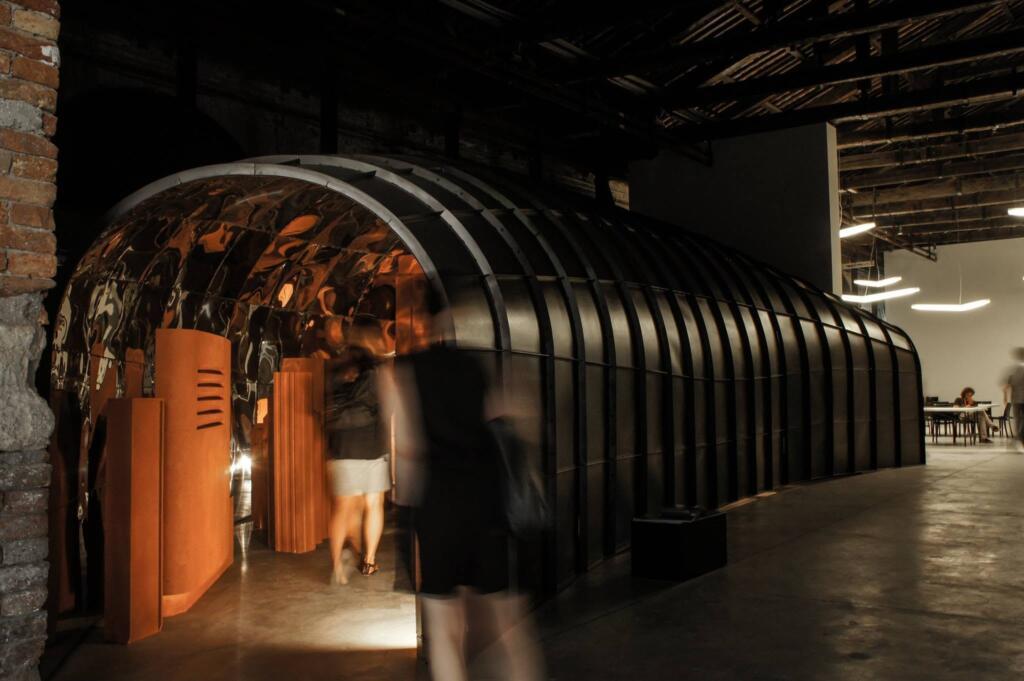
No Man`s Land. Photo credit: Stone Design | Vlatko Chavkoski.
IAB: When architecture is exhibited on an international stage such as the Venice Biennale, what ethical obligation does it carry back into local practice in Skopje and wider Macedonia? Should architecture speak first to its own community, or to a global audience?
SDA/SP: We do not believe that there is a division between the local and the global. Our way of understanding is that the best architectural ideas always emerge from a specific context, but have the capacity to communicate universal themes. We believe that architecture should, first and foremost, be honest to the place from which it emerges, and only then should its strength be sought within a broader context.
IAB: No Man’s Land emerged in the framework “Reporting from the Front” at the Biennale-Architecture back in 2016. How did you translate migration, collective anxiety, and city identity into a spatial narrative particularly through the trompe-l’oeil of the tunnel and reflective surfaces?
SDA/SP: Migration may be part of the narrative of No Man’s Land, but the central idea was to create a space in which the visitor could experience the uncertainty produced by contemporary social conditions. The tunnel functioned as a passage, not only a physical one, but also a psychological threshold. It marked the moment in which the familiar is disrupted, while the future is still not visible. The mirrored surfaces further destabilized orientation, producing a space that appears simultaneously near and distant, familiar and unfamiliar. For this reason, No Man’s Land does not represent a specific city or a specific migration story. It is a spatial metaphor for the condition of contemporary human beings, who constantly move between security and uncertainty, between belonging and alienation. We did not interpret the theme Reporting from the Front as a call to document a crisis, but rather as an opportunity to translate it into an architectural and artistic experience. The tunnel was conceived as a sequence of transitions, while the reflective surfaces challenged any stable sense of spatial orientation. In this way, the constructed space enabled an encounter with one’s own reflection, with fragments of the city, and with other people, without a clear boundary between the real and the apparent.
IAB: The installation used reflective materials and shifting scales of abstracted urban fragments to create a “city recognizably unrecognizable.” How do these formal tools, such as reflection and distortion, help activate the observer as an agent in the piece?
SDA/SP: In the conceptualization of the project, the main objective was to destabilize the sense of security and orientation, compelling the visitor to continuously reconsider the relationship between their own body and space. For this purpose, we used distorted mirrored sheet-metal fragments within the interior surface. The crumpled and fractured nature of the reflective metal creates the impression of unstable, fragmented, dream-like images. The visitor’s reflection becomes an integral part of the subjective perception of the work.

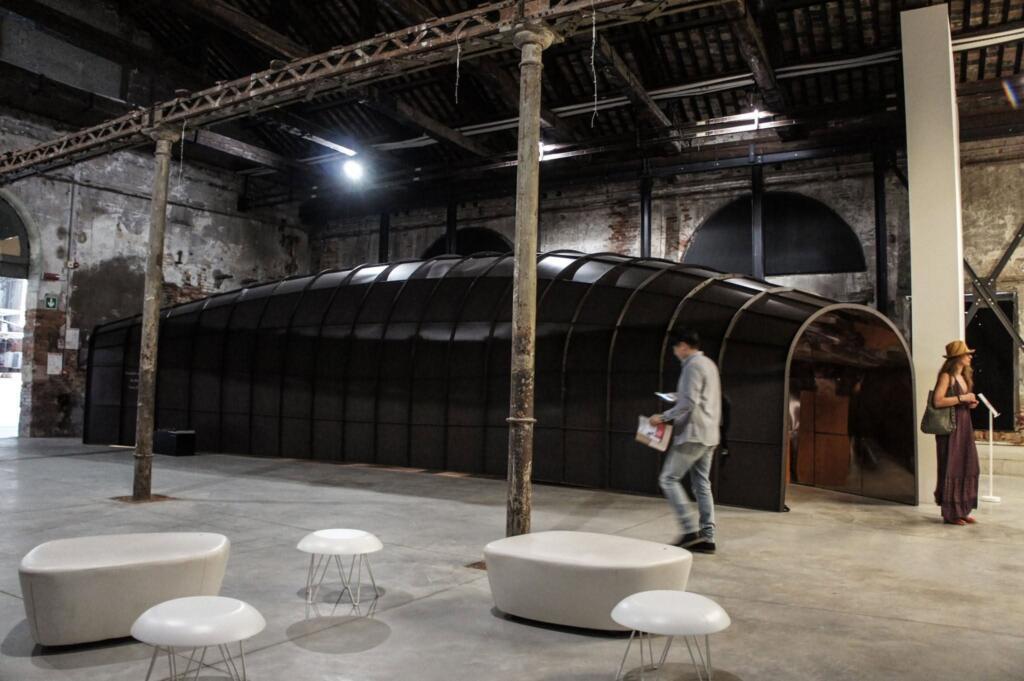
No Man`s Land. Photo credit: Stone Design | Vlatko Chavkoski.
IAB: No Man’s Land juxtaposes “public” and “private,” “cataphatic” and “apophatic” space. How do these architectural concepts influence the way you design – thresholds entrances, exits, passages as lived experience rather than metaphors alone?
SDA/SP: I believe that, in this context, the threshold is not merely a line that separates two spaces. It is a site of transformation, a moment in which a person changes their position, their perception, and their relationship to the surrounding environment. In this sense, architecture is not composed only of spaces, but also of passages. In No Man’s Land, we were precisely interested in this condition of the “in-between.” Passing through the tunnel does not simply signify movement from one point to another, but a gradual departure from the familiar and an entry into a space where expectations are not predetermined. Perhaps the most important spaces are often not those in which we remain, but those through which we pass.
IAB: Stone Design has a long practice in architecture, urban planning, and interior design. How do you balance commercial, practical commissions with experimental, critical work like No Man’s Land?
SDA/SP: Stone Design often approaches architectural projects in an immanent way of thinking both conceptually and artistically, even in contexts defined by a purely functional purpose. In No Man’s Land, we were given the complete freedom that comes with a work conceived for presentation at an architectural biennial.
IAB: How did the experience of working on No Man’s Land change your own architectural practice in terms of methodology, collaboration, or concepts in art?
SDA/SP: Our previous practice also indicates that the approach to shaping was artistic-architectural. Even today, we do not perceive objects as strictly architectural entities; instead, we tend to conceive them as sculptural structures and intervals within the urban milieu. We hope that through this, Stone Design has established its own aesthetic language.
IAB: What is the role of local partners, cultural institutions, ministries, communities in supporting architectural work that aims for global inquiry and local resonance?
SDA/SP: We are pleased that Macedonia continues to be present on the global map, and that every two years the Venice Architecture Biennale is supported by the relevant state institutions, as perhaps the freest platform for projecting architectural thought, without constraints. We saw it as an opportunity for architecture to express itself beyond the boundaries of design principles and to respond to certain global questions. We are grateful to the Museum of Contemporary Art for presenting the project to the local audience as well, a practice that was later adopted by other participants as well.
IAB: If we treat No Man’s Land as a kind of stage for movement and encounter, could this very architectural installation ever function like a theatrical performance space? What conditions would be necessary for architectural space to host living narratives performances, community interactions, ritual, a play?
SDA/SP: I have not thought in that direction before, but perhaps in a certain context the work could be conceived as an open stage for theatrical performances. It might be interesting to develop an experiment in which a work originally intended for exhibition directly communicates as an active participant in an event within a different context. In this way, the work would no longer function solely as an object for display, but as a relational element within another framework of experience.


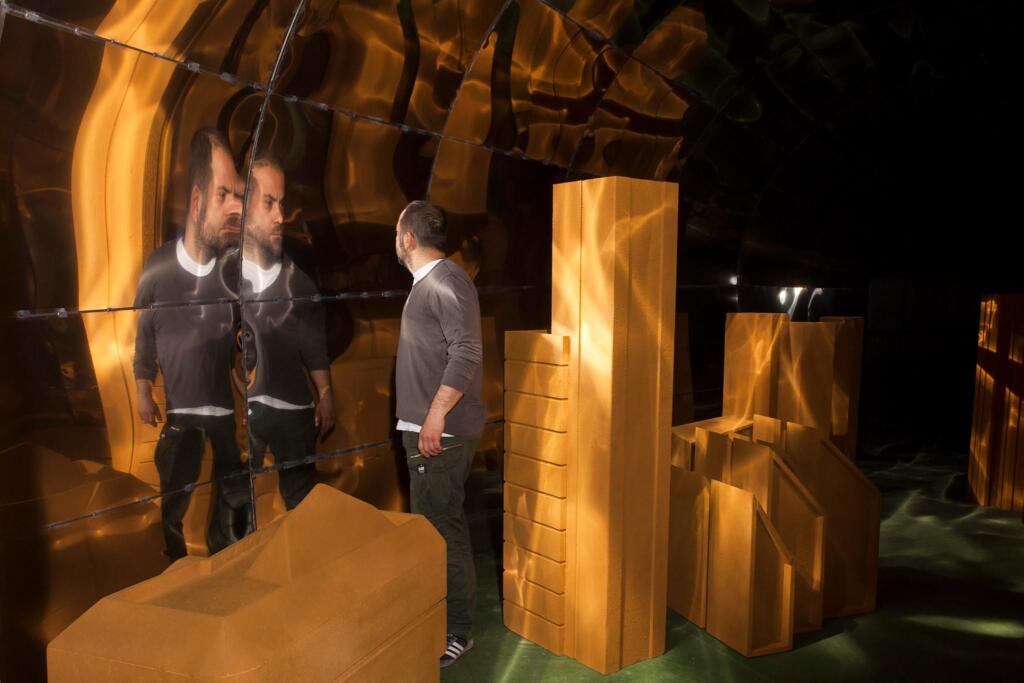
No Man`s Land. Photo credit: Stone Design | Vlatko Chavkoski.
IAB: Could No Man’s Land or a derivative of it be re-imagined for performance, dance, sound, or collective enactment in public space? Is architecture inherently static, or can it be choreographed?
SDA/SP: No Man’s Land can be rethought as a substrate for what you refer to as a collective enactment, in the sense that it would define directions and conditions rather than fixed outcomes. In that case, architecture would no longer function merely as scenography, but as a space that activates performative relations. We believe that in such a situation, it would move away from its static nature and resonate differently within your envisioned context.
IAB: The theme of “recognizably unrecognizable city” resonates powerfully with many post-industrial and post-socialist metropolises. How do you think Skopje’s identity, historically and today, informs your work, especially in relation to global urban narratives?
SDA/SP: The complexity of the Skopje narrative is certainly present in my subconscious, but when it comes to curatorial concepts within a specific biennial framework such as Aravena’s, creativity is directed toward formulating a different kind of response. Architecture is a spatially, historically, and anthropologically specific category. The story of a city cannot and, it seems to me, should not be simply transposed onto the global questions to which No Man’s Land seeks to respond.
IAB: Architecture and cities evolve; often the built work outlives its original context. What future histories do you hope No Man’s Land might belong to as concept, as artifact, as a catalyst for new forms?
SDA/SP: I believe that No Man’s Land carries no post-historical promise, and that the work completed its task at the moment it was contextualized. I hope that history has sufficient memory to preserve enough space for works that have sought to articulate more essential questions.
IAB: Finally: what is your vision for architecture as a discipline in 2030? One that holds accountability for equity, memory, ecological responsibility, and the collective life of cities?
SDA/SP: In the future, I expect that architecture will, on the one hand, fully harness its potential in the search for ecological and humane materials. On the other hand, with the use of AI as an author or co-author in design processes, and the increasing standardization of materials aimed at faster construction, the future engineer will face a significant challenge in establishing their own creative language. Architecture will face the challenge of not becoming unified.
IAB: Thank you very much, dear Stone Design Architects.
Skopje, 2026
This post was written by the author in their personal capacity.The opinions expressed in this article are the author’s own and do not reflect the view of The Theatre Times, their staff or collaborators.
This post was written by Ivanka Apostolova Baskar.
The views expressed here belong to the author and do not necessarily reflect our views and opinions.