






The smoke that blanketed Whitesand First Nation became thicker, darker and more acrid within hours.
By Monday afternoon, debris started falling down from the pine trees. Panic began to grow in the remote Ontario community more than 250 kilometres north of Thunder Bay.
That’s when Daniel Nodin realized it was time for everyone to pack up and flee for their lives.
Although the blaze was still invisible, the retired firefighter knew this: Wildfires cannot kill from far away, but the smoke can.
“You breathe that, then … your lungs might collapse because of the smoke inhalation and the heat,” he said.
Nodin first told his daughter and son-in-law it was too risky to stay.
“I went back around town telling people we got to get out of here –that thing’s going to go out of control,” he recalled saying. “I told people around the reserve, start packing, get going now … we’re in danger.”
Nodin and his family are among the nearly 350 people from Whitesand First Nation and neighbouring unincorporated communities of Armstrong and McKenzie Lake sheltering at a Thunder Bay hotel and wondering if their homes will still be standing when they return.
Many more evacuees from other communities – including the fire-ravaged Collins First Nation – are also in the city as nearly 200 wildfires blaze across northern Ontario. So far the fires have burned more land than all of last year’s blazes and sent hazardous smoke drifting across the province and into several U.S. states.
As Nodin made his way to Thunder Bay, all he saw was smoke and a red glow in the sky. There were long lines at a gas station he passed.
“It was hectic … people were just panicking,” he said in an interview.
His brother Andrew Nodin and his family are also staying at the hotel. They managed to flee Whitesand First Nation with only a few days’ worth of clothing.
Andrew Nodin said he had to leave his German shepherd behind and is worried about the dog “that’s more like a son to me.”
He described harrowing scenes from the road during their escape.
“There were hot ashes landing on my new truck,” he said. “Hot, cold ashes landing from the sky.”
Some people made the perilous journey back to the community to pick up a few more things or take some precautionary measures to protect their homes from the wildfire.
“But I wouldn’t want to risk my life just to go save my personal belongings,” Andrew Nodin said.
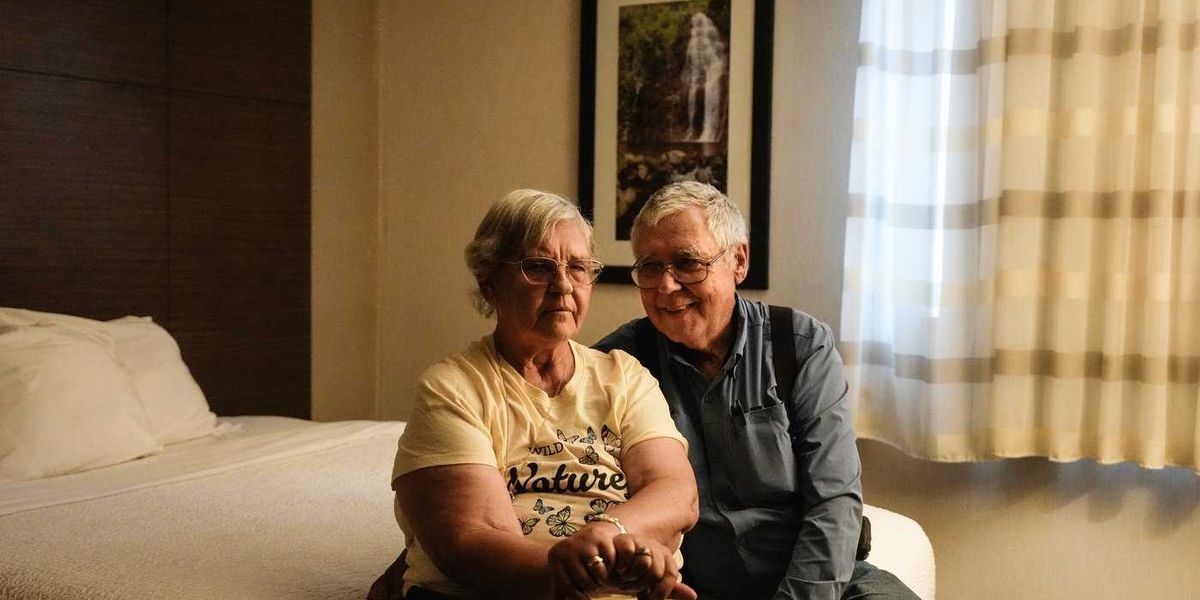
Ella Arney, 75, and her husband left their home in McKenzie Lake at around 11 p.m. Monday.
They packed a few things, including medication, using flashlights because a power line was downed by a burning tree.
“All day it was so black with smoke, it was like midnight,” Arney said in an interview in the hotel lobby. “We were sitting down on our dock and the pine spruce and balsam needles were just like rain was landing beside us.”
She said even the thought of losing her home is devastating.
“It kind of … drains everything out of you knowing that you don’t know if you’re going to have a home to go back to or not,” she said.
Whitesand First Nation offered the senior couple accommodation at the hotel.
Back on the reserve, one of the last people to leave was Darian Baskatawang, a senior adviser to the community’s leaders.
Baskatawang had to wait until about 1:30 a.m. on Tuesday to make sure everyone got out safely.
“When we were leaving, it was under the cover of darkness, there was no stars shining through the smoke,” he said. “There was no light coming through that sky. It was just pure black.”
White Sand First Nation Deputy Chief Yvette Kwandibens is photographed among donations from local residents, in Thunder Bay, Ont., Friday, July 17, 2026. The donations are intended for people who have been evacuated from their communities due to the threats of Wildfires.
THE CANADIAN PRESS/Chris Young
Before the evacuation, Baskatawang said the community organized a cooling centre for Monday because temperatures were expected to hit 40 C that day.
“We had seen smoke in the sky that was very dark, very heavy, and so we knew that there must be a fire nearby,” he recalled.
Baskatawang said he called the Ministry of Natural Resources’ Thunder Bay office at 2 p.m. that day to ask if the community had to be evacuated, or be on a stay-at-home order, but he was assured there was nothing to worry about.
The evacuation order came in the evening, he said.
“People left way before that because they knew the smoke was getting bad, they knew fires were coming,” Baskatawang said.
Whitesand First Nation is paying for the hotel rooms and food for its own members as well as evacuees from the neighbouring communities, Baskatawang said, and making sure that everyone has access to medical care.
“This government, the chief and council, has decided that we’re going to use our resources for the benefit of the entire community regardless of that federal-provincial barrier,” he said.
It’s time for the federal and provincial governments to step up as First Nations communities are burning across the province, Baskatawang said.
Federal Jobs and Families Minister Patty Hajdu, who represents the Thunder Bay-Superior North riding, said First Nations communities’ evacuation expanses will be covered by Ottawa.
“If the First Nation is struggling for cash, they should speak to their regional adviser or they can call their member of Parliament — that would be me — and we can make sure that they get the financial resources they need right away,” she told reporters in Thunder Bay on Saturday.
She said unincorporated towns in the region that had to evacuate are within the province’s responsibilities.
Premier Doug Ford, who also spoke at the press conference, said evacuees from those areas will get support including accommodations, food and access to medical services.
But his Minister of Natural Resources Mike Harris wouldn’t say if Whitesand First Nation will be reimbursed for helping its neighbours in Armstrong and McKenzie Lake.
“Our No. 1 priority right now is making sure people are safe, and we’ll evaluate a lot of those things as we move forward,” he said.
Thunder Bay Mayor Ken Boshcoff said city staff have been working day and night to help evacuees settle in and feel safe.
“It really emphasizes the role of us as a host community to ensure that we will do everything we can for those people who are landing here,” he said Saturday.
The scenes outside Thunder Bay’s Superior Inn were a mix of grief and hope this week. Residents dropped off donations including clothes, food and baby diapers, while the evacuees discussed what they might face when they return home.
Inside the hotel, a large room was filled with donations laid out on tables as evacuees picked clothing and shoes. People lined up next door for dinner while others sat around the tables eating chicken, cooked vegetables and desserts.
Melanie Tibishkogijig, a Whitesand First Nation councillor, said she was overwhelmed by the support and generosity her community has received from residents of Thunder Bay.
“So grateful for everyone thinking about our people,” she said.
This report by The Canadian Press was first published July 19, 2026.
By Sharif Hassan | Copyright 2026, The Canadian Press. All rights reserved.

![25th Sep: UNABOMBER (2026), 1hr 40m [R] (6.05/10)](https://occ-0-171-92.1.nflxso.net/dnm/api/v6/0Qzqdxw-HG1AiOKLWWPsFOUDA2E/AAAABSHKOxDs_gE5lCil__PAU8wSDr669b8W9LkmKgS2diGFCd-rpWn7pYIsjIXW47pOJSjoNf6Pd7A7ztryBztnCQZ7B2UfF7ANTk3f0k5EnS8fHCV6iGInVdzn0lsQBCs_29DZgjul5YOPGZJR8lI3eFt5CGeRIUtV5MvN2ez8Dstumg.jpg?r=286 "25th Sep: UNABOMBER (2026), 1hr 40m [R] (6.05/10)")