![20th Sep: The Change-Up (2011), 1hr 52m [R] – Streaming Again (6.15/10)](https://occ-0-1522-1001.1.nflxso.net/dnm/api/v6/0Qzqdxw-HG1AiOKLWWPsFOUDA2E/AAAABSiXwF_CvWzgRlBh7BbM4hExKOrWIERdJJgW89obJK2feviuv6wwapY_ar6ewA_e_nT8b2PqOARwDQWNL9tYjIviqxDJi23TJtWR.jpg?r=8d7 "20th Sep: The Change-Up (2011), 1hr 52m [R] – Streaming Again (6.15/10)")


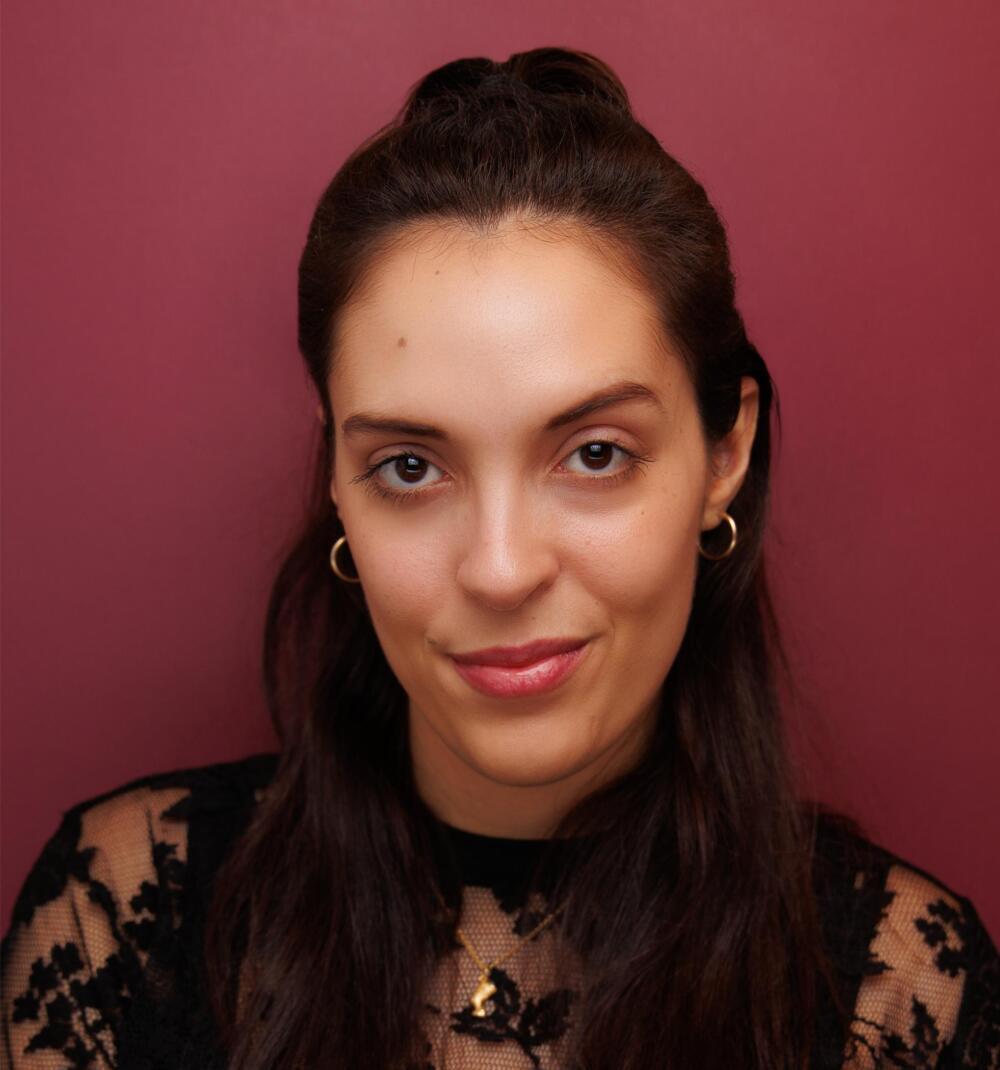
Anissa Naji is a Moroccan-German multilingual actor, comedian, singer, writer, and teaching artist based in New York City. She is fluent in English, Spanish, Arabic (Maghreb & Levant), French and German. Working across theatre, comedy, music, and intercultural performance, her work explores migration, language, identity, and the relationship between humor and belonging. She has performed in productions ranging from Shakespeare and devised theatre to multilingual improv comedy and musical improvisation, including performances at Theatre Row, The American Theater of Actors and the PIT (Peoples Improv Theater) in New York City. Before coming to New York, she has performed in Germany, the Netherlands, Argentina, Colombia and Jordan. Alongside her artistic work, she has worked internationally in refugee advocacy, media literacy, and arts education.
Q: Your work moves constantly between languages, countries, and artistic forms. Do you think multilingualism changes the way theatre itself functions?
Absolutely. Language changes rhythm, humor, emotional timing, even silence. When I perform in Arabic, English, German, or Spanish, I notice that my physicality shifts too. Certain emotions arrive faster in one language than another.
But I also think multilingual theatre exposes something important: communication is never only verbal. Especially in comedy, movement, improvisation, or children’s theatre, audiences often understand far more through energy, rhythm, and human behavior than through literal translation.
That’s why I’m fascinated by multilingual performance and also a fan of Physical Comedy – take Charlie Chaplin or Mr. Bean – those can be watched regardless of language or culture, everyone understands.


Arabic Improv Show, May 2026, photo credits: Aki Shawky.
Q: You perform both scripted theatre and improvisation. What attracts you to improv specifically?
Improv feels like riding a bike downhill and hoping for the best; you have the opportunity to create something brand new in the moment and you are not allowed to overthink it! Theatre is always live, of course, but improvisation removes the illusion of control completely. You are building something collectively in real time with other performers and with the audience.
As someone who grew up navigating multiple cultures, improv strangely feels familiar. You learn to adapt quickly, listen carefully, read the room, translate energy, negotiate misunderstanding. In many ways, immigrant life itself can feel improvisational.
I’m especially interested in improv as a cross-cultural form. Physical comedy, musical improvisation, audience interaction — these things can connect people even when they don’t share the same first language.
Q: You’ve also worked in refugee advocacy, education, and media literacy. Do those experiences influence your theatre work?
Yes, 100%! I think theatre is always about storytelling and making (people`s) stories seen – it`s always political.
Working with refugees and young people taught me how storytelling can create dignity, visibility, and connection. In many spaces, especially for migrants, people are spoken about constantly but rarely allowed to speak for themselves in nuanced ways.
In Jordan I had the opportunity to work as a trainer for refugee children doing “Psychoscial Support through Improv Comedy and Sketch Writing”, where we basically taught children from 10 – 14 years old about their rights through Improv Comedy and Sketch Writing.
I think the best part about that was how much I really learned from them, rather they learned from me.


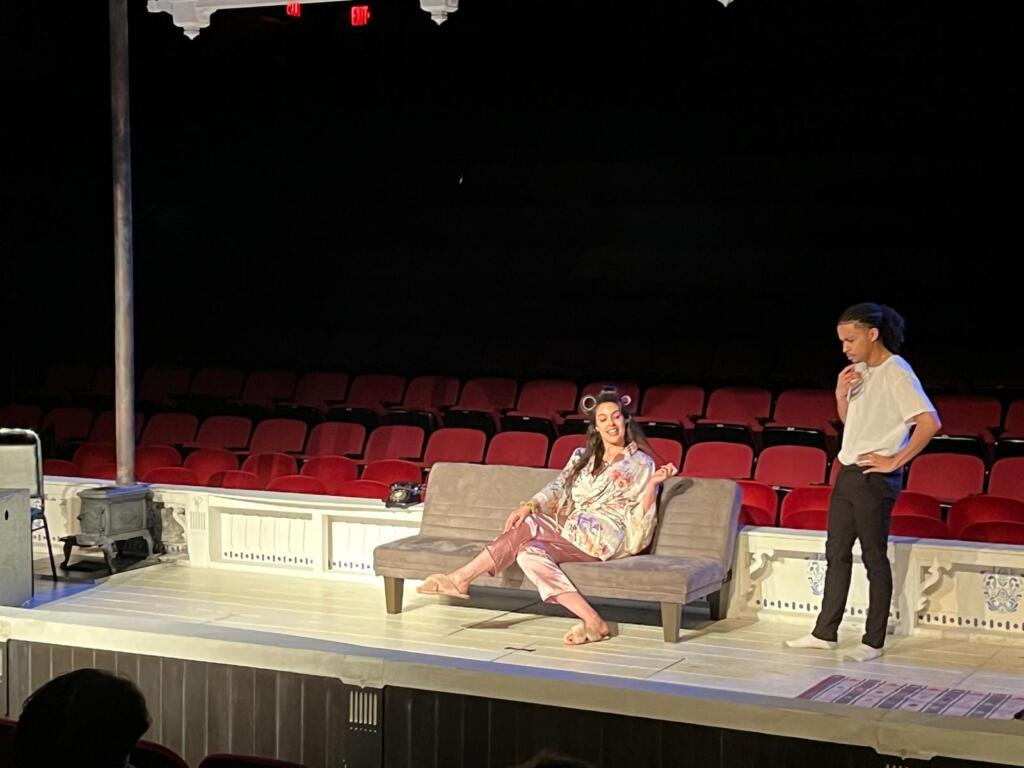
Circle in the Square Scene Night, May 2024, photo credits: Björn Technau.
Q: Much of your work seems to exist between cultures rather than fully inside one. Does that ever feel isolating artistically?
Sometimes, yes. But it can also become a creative advantage.
There are moments where you feel “too foreign” for one space and “not foreign enough” for another. But eventually I realized that existing between worlds allows you to see connections other people may miss.
And that`s why I feel like New York City has helped me so much to embrace this multiculturality in a positive way – it`s okay to be many different cultures and it can even become your superpower!
Q: You recently performed in Off-Broadway productions at Theatre Row while also working in multilingual comedy and musical improv. Do audiences respond differently to these forms?
Yes and no.
No, it`s not very different from one another, because at the end of the day a performance is a performance and people go, because they want to be entertained and hopefully feel some kind of emotion from that experience.
Yes, it is different, because an audience that goes to watch a Shakespeare show engages differently than an improv audience who kind of has to participate and give suggestions to make the show flow.
And that`s the beauty of it: I love moving between those worlds. One night I’m performing heightened classical text; another night I’m improvising songs on stage or performing Arabic-English comedy.
I am very grateful I get to do that and that New York City gives this variety and possibilities to do so.
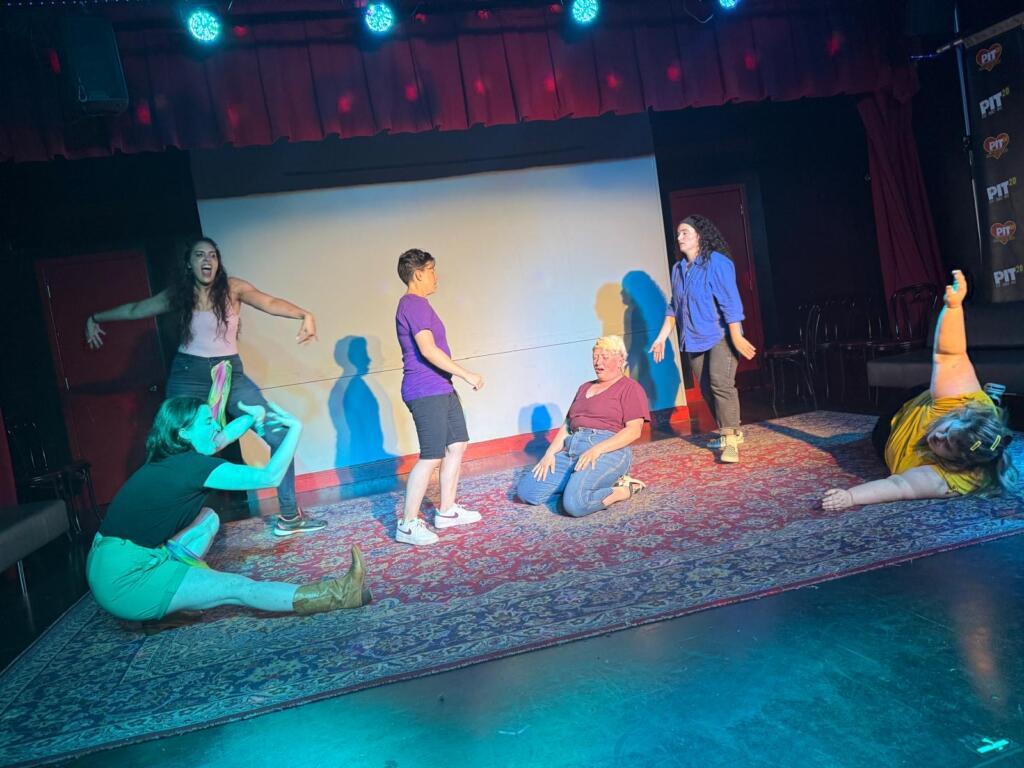
WHIMSYNC Musical Improv Houseteam at the PIT from March 2025 – January 2026, photo credits: Kendall Keener.
Q: New York is often romanticized as an artistic capital. What has the reality of building an artistic life there been like for you?
It’s beautiful and brutal at the same time.
New York constantly humbles you because the level of talent is extraordinary. But it also pushes you creatively in ways I’ve never experienced anywhere else. You can watch experimental downtown theatre, multilingual comedy, Broadway productions, devised performance, and live music all within the same week.
For immigrant artists especially, though, there’s another layer: visas, financial instability, cultural adaptation, survival jobs. There’s often an invisible labor happening behind the artistic work itself.
But I think that struggle also creates resilience and community. Many of the artists I admire most here have built their paths collectively rather than waiting for permission.
Q: What kinds of theatre or performance do you hope to create in the future?
I want to continue building work that feels globally connected and emotionally accessible at the same time.
I’m especially interested in multilingual theatre, audience-interactive performance, musical improvisation, and work that brings together people who might not normally share the same artistic spaces.
“Just as language bridges cultures, theatre connects hearts across borders.”
This post was written by the author in their personal capacity.The opinions expressed in this article are the author’s own and do not reflect the view of The Theatre Times, their staff or collaborators.
This post was written by Fadi Fayad Skeiker.
The views expressed here belong to the author and do not necessarily reflect our views and opinions.