










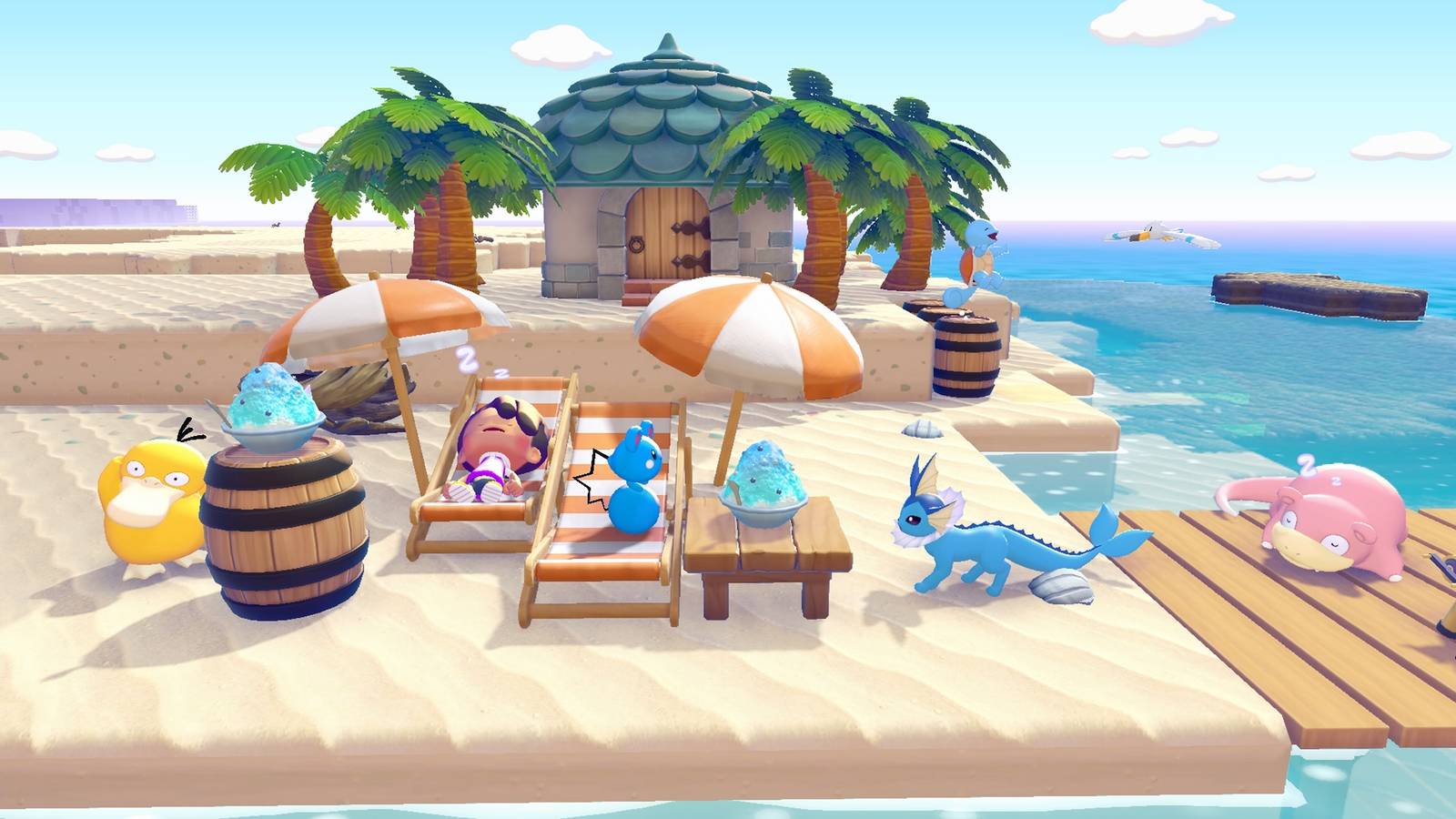
The Pokémon series is, once again, about to evolve. After embracing open-world design and experimenting with real-time combat, The Pokémon Company’s next creative swing is reimagining its monster-collecting series as a cozy life sim. Launching March 5 for Nintendo Switch 2, Pokémon Pokopia seems poised to capitalize on Animal Crossing: New Horizons‘ breakout success in 2020 by copying some of its notes. It’s a flattering transformation fit for a Ditto, but early trailers have yet to make it clear if Pokopia is much more than a convincing copycat.
After a recent hands-on preview event, we now have a better idea of how Pokémon Pokopia is adding its own spin to the life sim genre. Polygon played about 70 minutes of the Switch 2 exclusive, split across an early-game single-player block and a freeform multiplayer session. That revealed several new details about how the game works, including its surprising emphasis on environmental puzzles and TM collecting. While I still have questions about the full scope of it, one thing is clear: Pokémon Pokopia is very much not Animal Crossing.
My demo begins with the kind of long, text-heavy tutorial you’d expect from a kid-friendly Pokémon game. The player character is Ditto who misses their (presumably human) trainer so much that it transforms into a noodly-limbed copy of them, which I got to customize. After meeting Professor Tangrowth, a talking Pokémon who tells me that all the trainers of his world have mysteriously disappeared, I’m let loose into a blocky world that looks like Minecraft through the lens of Pokémon.
I’m quickly taught some mechanics that will be familiar to Animal Crossing players. I gather materials like stones and sticks and take them to a crafting bench, where I can create furniture that I can toss anywhere on the ground. There are daily challenges I can complete to get currency and buy more items and crafting recipes, not unlike New Horizons’ Nook Miles. Even my backpack UI looks suspiciously similar to the one in Animal Crossing.
The similarities stop there. Pokémon Pokopia is as much of a puzzle game as it is a life sim. The early hook is that, to discover new Pokémon, I need to create the right environment for them. The first Pokémon I meet is a Squirtle, laying on the ground, dehydrated. I use my Ditto powers to copy the Squirtle’s Water Gun attack, and then use it on Squirtle to revive them. Squirtle teaches me how to use Water Gun on dried-out grass, creating the “tall grass” habitat, which Bulbasaur can appear in. Bulbasaur teaches me Leafage, which I can use to create more grass, which I can then pair with Water Gun to create even more “tall grass,” where Charmander can appear.


Discovering new Pokémon unlocks Pokopia’s core gameplay loops. It quickly becomes clear that Water Gun and Leafage are just the first examples of what is effectively a suite of TMs. Those attacks stack up fast in the first 40 minutes, as I’m soon able to destroy stone structures with Rock Smash and slice down thick logs with Cut. Each move is kept on a customizable quick swap menu in the corner of the screen, as well as a radial wheel I can call up and assign moves to. Moves also cost a bit of PP, which I need to keep topped off by eating food. It’s the lightest of survival touches.
To gather new moves, I need to solve habitat puzzles. Hitmonchan, for example, will only show up at a training area. What’s that? What moves and materials do I need? I can collect clues scattered around the world that will give me a hint of what I need to make, complete with a little picture to copy. (In the case of Hitmonchan, a clue shows me that I’ll need to place a punching bag next to a bench, which of course then means finding all the requisite resources.)

In some ways, Pokémon has always been a bit of a puzzle game. When you see a new critter, you have to use context clues to figure out its type and what attacks you need to use against it to whittle its health down just enough to catch it. Pokopia finds clever new ways to play with that catch-’em-all idea, even giving players a Pokédex-like habitat catalog to fill out.
In addition to that, each Pokémon I find by building its habitat becomes a resident of the world that I can interact with. Each has a comfort level, which can be raised by giving gifts and completing requests. At one point later in the demo, I stumble upon an Arcanine living in a cute cottage. It asked me to add something warm to its space. Hm, maybe I could go back to my workbench and create a campfire? (Warning: I do not recommend putting a camp fire in your real life cottage.) Every little habitat you build is essentially a new house that you can decorate.

All of this is adorable, but I’m eager to see what the endgame is beyond creating cute little spaces. In the multiplayer session, I was dropped into “Palette Town” — not Pallet Town, curiously — where three other players and I were given free rein to build the place up. I worked on finding the right Pokémon to build a Poké Center, where I could heal my team and clone items. I could do that with other players, though my colleague seemed more interested in using Rock Smash to destroy my work-in-progress habitats. Were we working towards any overarching goal? It was unclear, but I hope there’s some throughline that keeps it from feeling like an aimless collection of chores.
It does seem like there’s a backbone to it all, though. I occasionally find some journal pages that tease the wider story of where the humans ran off to. It seems like that mystery will give the game some structure for those who need it, but still cater to players who just want to make little habitats and collect friends in a peaceful way. It’s Pokémon for the trainers who just can’t stand pitting these little guys against one another, and I imagine that’s an audience who will gravitate towards Pokopia’s good vibes.


![11th Feb: Forensic Factor: A New Era (2025), 2 Seasons [TV-14] (6/10)](https://occ-0-2706-2705.1.nflxso.net/dnm/api/v6/Qs00mKCpRvrkl3HZAN5KwEL1kpE/AAAABaHy9g04uBbx1q8C2krfurqKTDmjrf0TU6GZdQ9HQr2tkaaJGIMawWXuHPAjVzxhU0WyUEJs-KVtKZaixeQenIHV9tCBxxUNowxi5uaXugpuzPCjpHwRgUNMGaaCo_9Cefzvu34B70Az0g4kdPOdRZrRjAfbxYxqNna08kWTu-KGJA.jpg?r=d7c "11th Feb: Forensic Factor: A New Era (2025), 2 Seasons [TV-14] (6/10)")