











We look, we think, we feel — but often, we don’t act. The Neighbours, a well-wrought North American premiere from Waterloo-based playwright Nicolas Billon, encourages audiences to reconsider their assumptions about the comfort of spectatorship. Whether we’re observing a bickering fictional couple or a neighbour’s kitchen window, the show contends, the way we watch holds great weight.
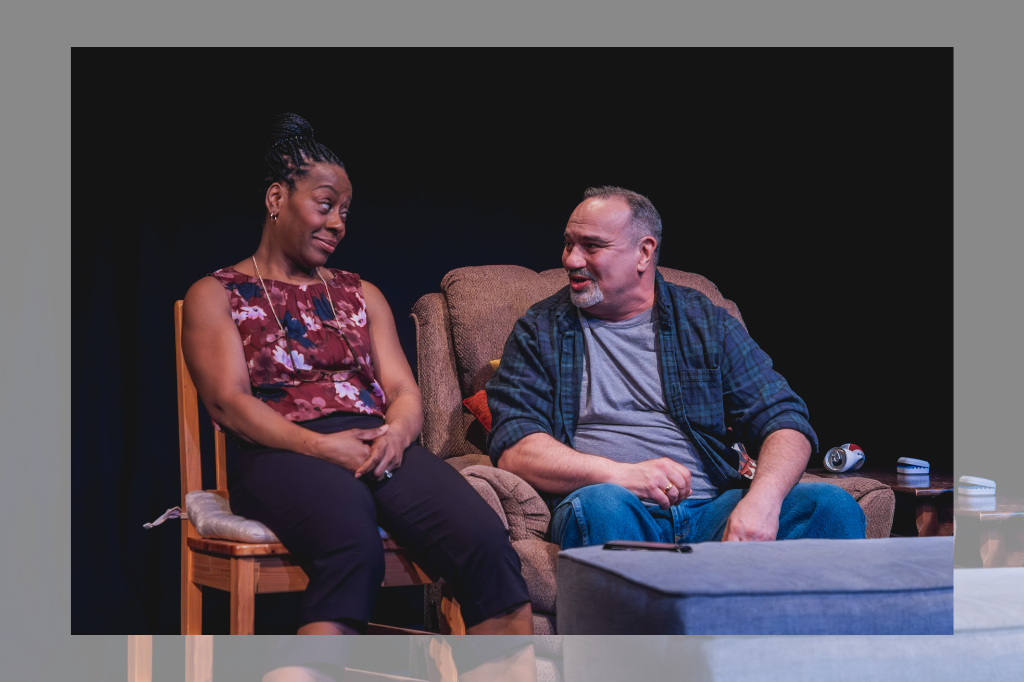
The play’s spectators-in-chief are married couple Denise (Ordena Stephens-Thompson) and Simon (former Intermission columnist Tony Nappo) — she nearing retirement, he already enjoying it. For most of this 90-minute Green Light Arts production, directed by Matt White at the Tarragon Theatre Extraspace, Simon lounges in a fluffy brown recliner as Denise perches, uptight, on a hard wooden chair.
Billon structures the play as a spiral of reveals, and I must divulge a couple of them here. The central one is that Denise and Simon’s longtime next-door neighbour, David, kidnapped a girl named Kayla when she was a decade old. He kept her caged in his basement for 12 years, until her escape seven months ago. It bruises the couple that they raised a similarly aged daughter in close proximity to David and Kayla: “It could’ve been our Sophie,” Denise reflects, voice quivering. They’re initially adamant they had no reason for suspicion of David, an assertion that grows less stable as the show advances.
Two unconventional writing choices enrich this dark subject matter. The first is that Denise and Simon frequently address the audience directly, without ever casting us in a specific role; we’re just spectators, sitting in a theatre. Complex implications follow. Our presence is what prompts the couple to recount the story of Kayla. They reveal perception-shifting secrets to each other, and without us, that likely wouldn’t have happened — these facts had remained buried for years. But despite our ostensible importance, pivotal sequences traverse emotional landscapes of firmly private intensity. So what, exactly, is our relationship to what’s unfolding? How to look, think, feel?
Billon’s second unconventional choice: Denise and Simon’s other next-door neighbour, Au Yeung Wei (Richard Tse), remains onstage for nearly the entire show. Having lately read Billon’s Governor General’s Award-winning 2013 Fault Lines trilogy — consisting, for the most part, of interweaving monologues — I expected Au to launch into a speech detailing his perspective. He’s instead content to flip through a novel on a midcentury-modern chair, his actions only tangentially relating to the primary conversation, as when he chuckles at his book after Simon tosses out an inane joke (like several of Au’s reactions, this is scripted).
The Neighbours’ bet is that our art-decoding brains will expect the script’s climax to involve Au. If this well-groomed senior man is visible, he must be hiding information. Just as Denise and Simon overlooked clues hinting at David’s criminal intentions, the promise of Au’s coming significance prods us to read the couple’s mundane dynamic at surface level. But minnows of tension dart beneath: Simon piles up empty beer cans, Denise grimaces at an overlong monologue about Robertson screws, and the pair argue over memories of a trip to India. Although both perform peacefulness — Simon with Bill Burr-level machismo, Denise with clenched poise — turbulence exists. Does Au notice? Will you?
Stephens-Thompson and Nappo’s rendering of their characters’ relationship evinces remarkable range, colouring the troubled, decades-long marriage with a palette of shades from resentment to affection. Kelly Wolf complements these crystalline performances with a simple set featuring two living-room seating areas nestled among the theatre’s neutral black curtains; above the playing space, a hanging collection of fragmented miniature houses represents a community in tatters. Muddier is an attempt to map the surrounding neighbourhood via house numbers on the floor, framed by Paul Cegys’ lighting design. I think the idea is to make David’s empty residence feel like a constantly looming presence, but in the Extraspace, the ground is obscured from most seats (including mine), meaning this design choice didn’t leave a strong impression.
A slow burn until it’s not, The Neighbours is a confident experiment in revealing everyone — audience and characters both — as bystanders. “Experiment” isn’t entirely praise: this is a very interesting piece of theatre, but also, I think, a little forensic. Given the brutal content, one might reasonably expect more visceral, specific links to today’s world. There’s a spark of social criticism in the play’s treatment of race: it’s specified in the script that Denise is Black, Simon is white, and Au is Japanese, adding a troubling undertone to some of Simon’s more blasé attitudes. But this dynamic is awfully subtle compared to what we hear about the monster formerly next door. That may partially be the point; Billon is defending the importance of paying close attention. At some point, though, we could perhaps use a more explicit argument about why the story matters beyond the confines of this box we call theatre. (If a man like Simon saw the show, would he understand what was being said? Does it matter either way?)
“There are few definitive answers in The Neighbours,” writes Billon in the program, and his play knots together dozens of questions, leaving them for audiences (and critics!) to untangle. I recommend it on account of its strong performances and rigorous dramaturgy. Just be sure your spectatorial mind is at its most attentive.
The Neighbours runs at Tarragon Theatre until March 15; more information is available here. Immediately after, it will transfer to Kitchener for a run at the Conrad Centre for the Performing Arts.
Intermission reviews are independent and unrelated to Intermission’s partnered content. Learn more about Intermission’s partnership model here.


WRITTEN BY
Liam Donovan
Liam is Intermission’s senior editor. He lives in Toronto.
LEARN MORE


