








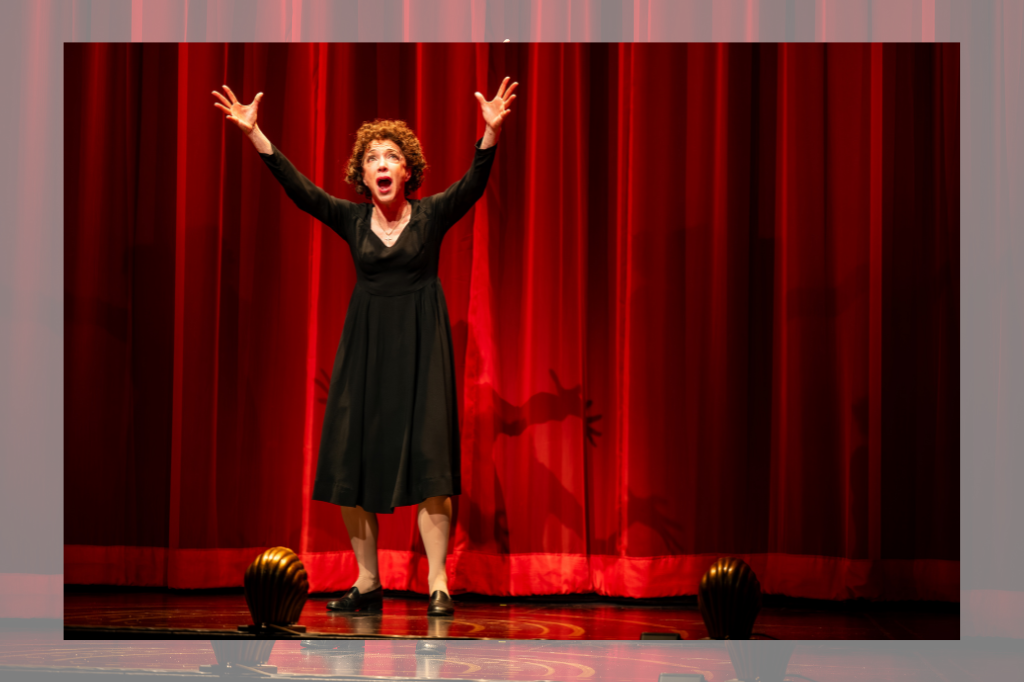
Charting the 15-year relationship between two legendary European performers who met in the context of American showbusiness, Piaf/Dietrich looks at what happens when opposing personalities cross paths.
The show opens in 1960 New York, in the dressing room of Marlene Dietrich (Terra C. MacLeod) — a woman seemingly past her prime. Unsatisfied with her shabby surroundings and taunted by the memory of Édith Piaf (Deborah Hay) through rumours of her proximity, Dietrich is isolated in an industry that used to comfort her. On the stage of another, nearby theatre, we see Piaf limp in, holding a bottle of alcohol.
A flashback ensues. It’s 1948, when Dietrich first approached Piaf as an admirer willing to mentor the younger singer at the start of her American career. From their initial meeting, it becomes obvious that beyond the makeup and bright lights, what secured this relationship between near-opposites was a deep love for performing, and an undeniable attraction at the level of the soul.
Directed by Rachel Peake, the Grand Theatre’s production of this bioplay, adapted by Erin Shields from the contemporary German play Spatz und Engel (The Angel and The Sparrow), finds success in leaning into its metatheatrical elements.
The show interweaves dialogue — in dressing rooms, hotel rooms, Piaf’s apartment, and banquet halls — with songs, which are almost always delivered directly to the audience, concert-style.
Two other cast members, Karen Burthwright and Eric Craig, take on every other role — from Piaf’s lover Marcel Cerdan to waitresses, butlers, and fortune tellers.
When the title characters sing, Peake emphasizes their passion for an audience, often singling them out in front of the Grand’s traditional red velvet curtain, without the distraction of Lorenzo Savoini’s detailed sets. And in scenes featuring both Piaf and Dietrich, their placement is nearly always symmetrical, one hardly able to upstage the other for long. They often find themselves at the exact opposite sides of a table, maybe reflecting that they are two halves of one whole, talent and beauty — a joke Piaf cracks about herself and Dietrich, respectively.
A visible live band plays behind the set (musical direction by Mary Ancheta), and characters sometimes break the fourth wall, as when Dietrich asks the piano to halt rehearsal or the lighting booth to turn up the spotlight to 60 per cent (lighting design by Michelle Ramsay).
Sometimes, in moments of deeper intimacy, the white tone of a lingering spotlight grows warmer. A hot pink light fills a scene of high distress where Piaf refuses to get sober after years of heartbreak, loss, and a car crash (which the script glazes over, only explicitly mentioning it at the start of the second act).
A standout element is Hay and MacLeod’s contrasting physicality. Piaf is incredibly timid, even floppy, compared to Dietrich’s tall spine and pointed toe.
Though Piaf became famous for her raw, emotion-charged performances, I found mechanical movements from Hay — like repeatedly miming a stab in the heart in “Padam, Padam” — endearing, giving the impression of Piaf acting out her French lyrics because they’re never fully understood in the U.S.
Insecure in her offstage life, Piaf uses the stage to reclaim power, perhaps the only place she feels pure confidence. For her part, Dietrich uses her art to exert power — over men by dancing sensually, and to communicate a stance against Nazi Germany by singing to American troops.
Piaf tells Dietrich that performing gave her life purpose, but Piaf’s innate tendency to feel every emotion leads to her downfall, with addiction consuming her. Observing Piaf slowly destroying herself, Dietrich represses her pain, thinking an image of perfection is what the public needs from her.
Dietrich’s costumes, economically designed by Ming Wong, reflect her struggles with gendered self-presentation: at one point she’s booed off stage while wearing a pristine ruffled sequin dress, and returns in dress pants and a button-up shirt.
Piaf and Dietrich were an unlikely duo. But through what happened behind the curtain, under the bed covers, and up on stage, they expressed profound appreciation for each other. The show succeeds in showcasing their vulnerabilities by portraying them as a form of star-crossed lovers — destined not just for fame, but each other.
Piaf/Dietrich runs at the Grand Theatre until March 8. More information is available here.
Intermission reviews are independent and unrelated to Intermission’s partnered content. Learn more about Intermission’s partnership model here.


WRITTEN BY
Kayla Foisy
Kayla Foisy (she/her) is a media and communications student at Western University and culture editor at the Western Gazette. She is also a two-time playwright of Theatre Western, the university’s foremost theatre provider. Based in Toronto, Kayla is entranced by writing and the theatre and excited to pursue a career freelancing in journalism and production.
LEARN MORE