






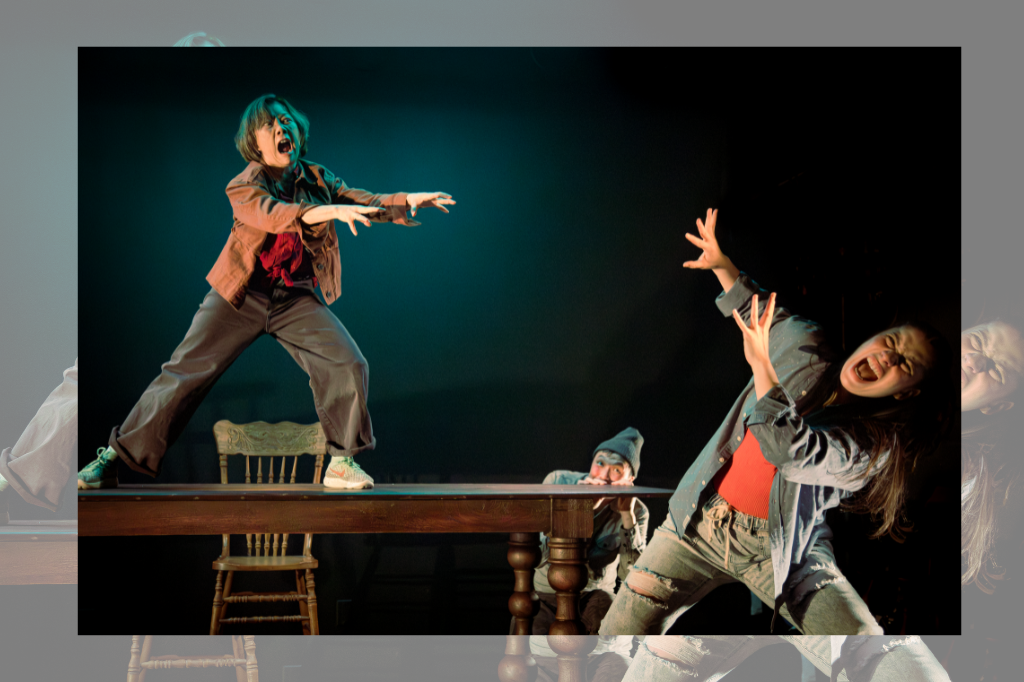
One thing’s for sure — you’ve never seen a show with this much tongue.
Directed by Michelle Smith and collectively adapted by the cast, Pu Songling: Strange Tales brings to life a selection of stories by the prolific Qing dynasty writer named in the title. Popular for his frightening folktales, Pu wrote some 500 stories blending the supernatural with the human. A Theatre Smith-Gilmour production in association with Crow’s Theatre, Strange Tales is an explosion of energy that doesn’t shy away from getting a little freaky. Contorted mouths and wet, lolling tongues punctuate the action, as Smith and the cast explore a sensory playground of facial and sonic expression.
The play begins with the five-person ensemble welcoming us and providing context. They describe some of their favourites of Pu’s stories, an appetizer of the fantastical world into which they are leading us. There’s a focus on storytelling as a sharing tradition — they speak with us directly about the narratives as they unfold. Costume and set designer Ting-Huan 挺歡 Christine Urquhart’s use of plain, everyday clothing underlines the cast as real-life storytellers even as they move through myriad characters and stories.
The first tale is that of Mr. Liu (Dean Gilmour), who can remember all of his past lives. As punishment from the king of hell, he is reincarnated as a horse, dog, and snake. Mr. Liu must learn to live virtuously without harming any living beings, including himself. He escapes the cycle by lining himself up to be splattered by an approaching horsecart.
From there it’s a whirlwind of action-packed stories involving death, head transplants, and a powerful fart. Though the pacing is occasionally too chaotic, Strange Tales offers a collection of social observations still relevant today. Juxtaposing the consequences of unchecked vices with finding humour in utter disaster, the show is not necessarily moralistic as much as a frank portrayal of humanity.
Like Pu’s tales, the production does not shy away from the grotesque or debauched, but fully embraces them. Whether embodying malevolent spirits with twisted faces or brashly horny academics, the ensemble’s over-the-top expressions and physicality are equal parts funny and off-putting. Diana Tso 曹楓 gives a standout performance as a ghoul trying to seduce a man (John Ng 伍健琪) to death. Using her elastic movements and her entire vocal register, she slithers her wet tongue and bulges her eyes, squealing and undulating with captivating control.
Strange Tales deeply roots itself in bodily experience, blurring the mystical with earthly experiences to confront the audience with human behaviours. Urquhart’s bare bones set of a rectangular dining table and five chairs forms the perfect playground to unleash the cast’s unbridled physicality. Smith uses the performers to create a near-constant soundscape that transforms the intimate Crow’s Studio Theatre into an otherworldly expanse. Faint whistling evokes eerie wind, and the slurpy smacking of tongues is fantastically revolting (apologies to the ASMR haters).
Structurally, I feel the play only hits its stride about halfway through. The shorter opening scenes are very quickly paced, with longer, more fleshed-out tales coming later. While it seems that the company is trying to build toward more substantial stories, the uneven pacing hinders the flow.
I was also confused by the choice to include specific costume pieces only in the final story, during which a fox spirit seeks revenge on a violent landowner, given that the rest of the production is kept so minimal. Perhaps the intention is to chart a gradual journey into the world of Pu’s tales, ending with a fully immersed production experience. The impact of this is diluted, however, because there is not enough time to digest this new theatrical language before the play ends. Since the narrative begins quite conversationally and the world-building focuses on evocative embodiment, the sudden transition into significant costuming (and recorded music) is more jarring than transformative — though I am jealous of Gilmour’s lavish vulpine fur coat.
Nevertheless, Pu Songling: Strange Tales is a raucous exploration of the strange and supernatural experience that is being alive. The ensemble brings impressive commitment to their physicality and to creating the entire world of the production. Their heightened exploration of sound and expression yield unique, striking moments that will linger in my memory.
Pu Songling: Strange Tales runs at Crow’s Theatre until February 8. More information is available here.
Intermission reviews are independent and unrelated to Intermission’s partnered content. Learn more about Intermission’s partnership model here.


WRITTEN BY
Columbia Roy
Columbia Roy is an interdisciplinary theatre artist and arts worker raised in Taiwan, now discovering life in Toronto. She’s passionate about arts philosophy, examining culture, and public transit. Columbia is drawn to work that confronts humanity with itself, warts and all, while still embracing the silliness of living. You can always find her knitting, talking to strangers, or waiting for the TTC.
LEARN MORE