





The Off-Broadway Theatre Review: Richard II
By Ross
Quietly and ominously, the first thing we see in Richard II is the blurry figure of a half-naked man pacing back and forth inside a cube. He sits and circles around the edges of what feels like a prison cell, perhaps one of his own making. Or maybe one that has been imposed on him. Either way, it’s a startling, erotic opening, one that seems to tell us more about this production’s reframing than Shakespeare’s opening scene ever could. We already know how Richard’s story ends, yet, inside Craig Baldwin’s sharp adaptation, there is an emotional understanding that seeps into the Astor Place Theatre, that the tragedy lies not in the fall itself, but in the long, complicated, and indulgent path towards it. From that captivating start, Red Bull Theater‘s Richard II radiates as both spectacle and prisoner, fiercely observed and completely exposed.
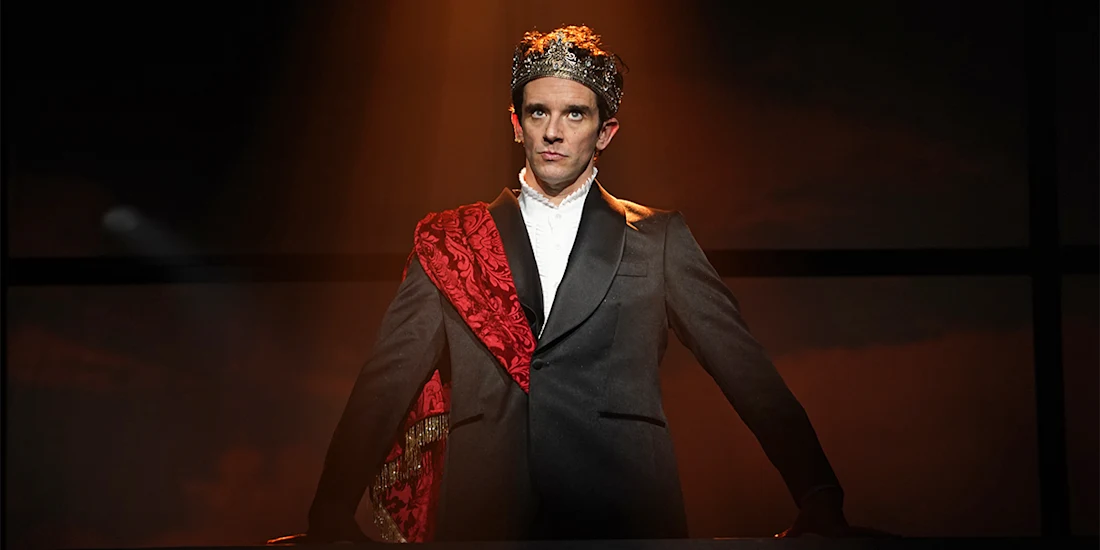
Michael Urie as King Richard is a study in fascinating contradiction, a body defined as much by desire as by dread, and director and adapter Baldwin (STC’s Hamlet) forces him into the confined and controlled space to be exactly that. This king is grandly flippant but not foolish, indulgent but not empty, volatile but never thoughtless. Urie (Broadway’s Torch Song) is exceptional, resisting a purely superficial reading of Richard as a spoiled monarch undone by ego alone. Instead, he finds a way to uncover a man deeply in love; with power, with attention, with other men, and perhaps most of all with the fantasy of himself as a divinely appointed ruler, unburdened by consequence or opinion. Conflict, when it arrives, undoes the emotionally unprepared monarch, his short fuse further shortened by courtiers who both love and exploit him in unequal measure. Urie’s performance captures the twitch and the ache beneath his excess, the private confusion beneath the public bravado.


Dropping the play down in a Studio 54 ultra-glamorous period of decadence and debauchery is not a new conceptual leap; I’ve seen it before at the Stratford Festival in 2024, but here in downtown NYC, it finally feels connected and illuminated in a new way. Sweet dreams really are made of this England, reimagined as 1980s New York, and defined entirely by Richard’s exceptional excesses: boldly sculpted costumes, cocaine-fueled bravado, and a fluid sexuality unveiled, while the work of his casual governance quietly collapses all around him. It’s the Limelight all over again inside set designer Arnulfo Maldonado’s rotating cube. It’s a marvel of matter and metaphor, constantly reconfiguring into whatever is desired: a throne room, a dance floor, a prison cell, and a fortress of walled safety against a determined rebel army. Richard himself perpetually hovers on the margins, listening, watching, and even physically reshaping the space around him, reconstructing the very platform from which he ruled, stood solidly upon, and gave away the crown to the man who would eventually imprison him. It’s a sharply fascinating creation, watching a King listen and reshape his own world, seeing and hearing betrayal and rebellion like a destitute spy, yet powerless to change its course.
Not all performances settle seamlessly into this charged atmosphere. Lux Pascal’s Queen radiates a deliberately artificial and overtly pompous quality that feels somewhat real to the period and the place, but at odds with the production’s otherwise embodied, sensorial stylings. Rather than complicating the spell, the performance occasionally breaks it, feeling drawn, forced, and superficial, unlike anyone else. By contrast, Kathryn Meisle’s Duchess of York brings a sturdy, conflicted presence to the stage, standing firm even when David Mattar Merten’s sensual and conflicted Aumerle, her son, runs headfirst into treason and destruction. Emily Swallow’s Northumberland intensity hardens over the course of the play, as her posture and tone steadily calcify into something openly hostile and disturbing. The stance deepens the atmosphere of simmering hatred that borders (not so slightly) on homophobia within Bolingbroke’s advancing army of masculine men, making the rebellion feel not just strategic, but viscerally cruel and personal.

This is one of Baldwin’s most compelling choices. Urie never leaves the stage, bearing witness to conversations that once happened beyond his awareness. This device enriches the tragedy, transforming the play into an act of self-examination rather than mere political destruction. When Raphael Nash Thompson (standing in for Ron Canada) as the Bishop of Carlisle foresees the beginning of Richard’s fall, the dethroned king sits invisibly beside the newly crowned Bolingbroke, a chilling reminder that understanding, when it arrives too late, offers no salvation. The impressive Grantham Coleman’s Bolingbroke grows increasingly smug and ruthless in deliberate contrast to his ascent, framing his rise as cold calculation rather than destiny.
What ultimately distinguishes this Richard II is its emotional intelligence and stance. Baldwin and Urie manage to make Shakespeare’s famously poetic king feel intimate rather than indulgent, reordering the stripped verse into confession and turning metaphor into lived memory. Love, desire, obsession, vengeance, guilt, and shame are not abstract ideas here but authentic experiences fully engaged with, etched onto Urie’s body as much as his voice. This is a Richard II that is more concerned with an examination of the interior, uncovering a self-portrait of a man who finally understands himself only after losing everything that once defined him.