




Persistence is an act of resistance.
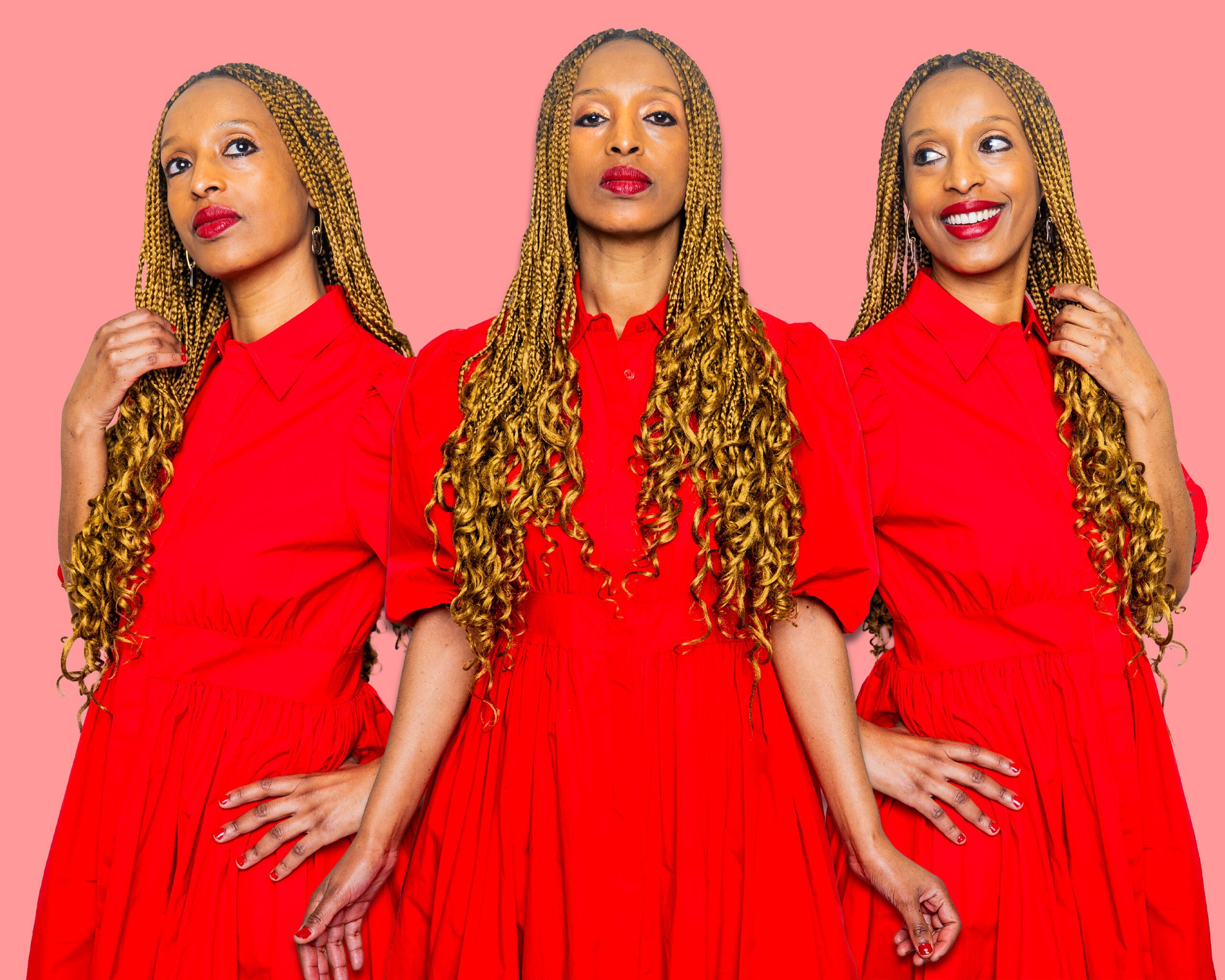
I’ve been thinking a lot about how to continue creating after extremely busy periods, and when competing responsibilities pressure creative time and space. When asked to write a Spotlight on Mumbi Tindyebwa Otu, I got curious. It could be a chance to learn about an artist who I’ve been in the orbit of for my entire career as a theatre creator, but never directly worked with — an artist I think about often when I think about persistence. I wanted to get to know her, to learn from her, and maybe, selfishly, to fuel my own thinking on creation and persistence as a Black woman, creator, mother, and arts leader, among many other things.
I first met Mumbi before she was artistic director of Obsidian Theatre Company, when I auditioned for Dancing to a White Boy’s Song, created with Wendy “Motion” Brathwaite — the first play produced by IFT (It’s A Freedom Thing Theatre) Theatre, which Mumbi founded. We had many other run-ins as we emerged into our respective careers, and were in close proximity again when I was an administrator at Soulpepper Theatre and she was training as a director in the Soulpepper Academy. We both recall running into each other in the Young Centre for the Performing Arts’ hallways and having hurried conversations in the Distillery District’s cobbled lanes. At that time, she had just become a mother and I — not sure yet if motherhood would be part of my creative journey — was in awe of her.
Now, a decade later, with her twins 10 years old, she’s about to direct her fourth play at Soulpepper: Christina Anderson’s How to Catch Creation.
How has she been able to extend so much creative output with such incredible demands on her time?
When I sat with her for this interview, I asked her where she wanted to start telling her story as a creator. Aptly, we were in Obsidian’s office, and she considers Obsidian’s Mentor/Apprentice Program the beginning of her formal artistic training. At this thought, Mumbi laughed: being in this room with someone interviewing her felt like she’d come full circle.
Originally from Kenya but having immigrated with her family to Victoria, B.C. at the age of 14, Mumbi came to Ontario to study biology at the University of Toronto. While in school, she played Tituba in a volunteer production of The Crucible at Hart House Theatre. It was then that she came across for colored girls who have considered suicide / when the rainbow is enuf by Ntozake Shange, a 1976 play that is pivotal and affirmative to many of our careers and lives. She pitched to Hart House that she direct it.
“I was 21 years old and all these incredibly talented Black women who had all graduated from theatre programs and were not getting work — clearly, because this was not a paying gig — came out to audition,” she recalled. Some heavy-hitting names ended up as part of the cast: Andrea Scott, Cherissa Richards, and Nicole Stamp, among others. What would it have been like if these women, who have changed the landscape of our theatre industry as we know it, didn’t get that opportunity?
“There are cores in that play that are still in my work today,” she said. “Interdisciplinary exploration and interplay of movement, text, sound, choropoems: all those elements still grab me. It is part of my cultural identity to tell stories that way.”
“That tracks,” I replied, thinking of all of the work she’s done that I’ve had the privilege to see.
She finished her degree, went back to Victoria, then returned to study theatre at York University. That, she said, was the start of her second life in Toronto.
Mumbi identifies many “shifting points” in her career — moments that really changed the direction of where her work was going. If directing for colored girls was one, Obsidian’s Mentor/Apprentice Program was another. Through this program, Obsidian paid for her to assistant direct with Ross Manson at Volcano Theatre on the play Shine Your Eye, by Kenyan playwright Binyavanga Wainaina. It was part of Volcano’s trilogy Another Africa, which examined the relationship between Africa and the West from disparate perspectives. She thinks of this as a pivotal point in her career because Ross’ work at Volcano inspired her to create IFT, her own experimental theatre company. There were stories she wanted to create, stories she wanted to tell — and she didn’t want to wait for anyone’s permission to tell them.
“Oh, IFT! I feel bad for abandoning it, but I believe it goes with me everywhere I go,” Mumbi laughed. When I spoke on the phone to Motion, her collaborator on many IFT productions, she echoed this same sentiment. “The theme ‘It’s a Freedom Thing’ is something that continues to be expressed in all of Mumbi’s work — the work that she chooses, as well as the ones she creates,” said Motion. “She’s looking at art as resistance, as cultural continuum, as a way to amplify Black voices as well as explore our various stories and empower storytellers.”


When Mumbi started IFT in 2011, she reached out to Motion, who was training with Obsidian as a playwright. “When Mumbi spoke with me about the first project that we collaborated on and she told me the name of it, Dancing to a White Boy’s Song, the way she described her approach to the play, the way she was thinking about conceiving it, really excited me,” says Motion.
The pair worked with three actors and a choreographer to devise the piece that summer ahead of a presentation at the SummerWorks Performance Festival. Inspired by a poem about immigration that Mumbi had written in high school, it took the form of vignettes formed through physical exploration.
“One piece that emerged from there that was really surprising,” Mumbi described, “was a piece about someone whose own culture had become the other. Someone who felt so removed from their own culture and assimilated to the dominant culture.” Mumbi was so fascinated by that separation that it gave birth to a piece about immigration and cultural disconnection called Nightmare Dream. Set at Campbell House Museum, it was the first in a planned trilogy of site-specific pieces.
The second part, Because I love You/Motherland, was set in St. Lawrence Hall. About international adoption, it explored questions around who can claim to be a child’s true mother. The trilogy’s final part has yet to be created.
Mumbi and her collaborators at IFT took on many other initiatives including a panel during WorldPride, inviting writers from Africa to gather around issues surrounding 2SLGBTQIA+ rights in Uganda. “I was responding to what felt urgent from a personal point of view and communal point of view,” said Mumbi of this work. “Experimentation was the key of IFT and also the key of what drives me as a director.”
Another piece created through IFT, which brought DJ and sound designer L’Oqenz into the partnership, was Oraltorio: A Theatrical Mixtape, a musical coming-of-age story about two Toronto girls. I saw this play and loved it. It remains one of the pieces that I was most inspired by from my time working at Soulpepper, where it played in 2018 with Obsidian Theatre.
The Soulpepper Academy, the company’s year-long paid training program, was another key shifting point in Mumbi’s career. Mumbi and Alan Dilworth, current artistic director of Necessary Angel Theatre Company, met when she was studying as an actor at York University and again when she was assisting on Shine Your Eye. At the time, Alan was associate artistic director at Soulpepper and led the Academy’s directing program. He encouraged Mumbi to apply. “Alan pitched it as an opportunity to take a break from self-producing and focus on my craft as a director,” Mumbi recalled. “He was incredible to me during my time there — a huge mentor — really amazing and encouraging to find and refine my voice.”
I’m currently associate artistic director of Necessary Angel, and during one of Alan’s and my many phone calls, I asked him to talk about Mumbi. I knew by how highly he speaks of her, that working with her in the Academy was impactful for him too.
“Mumbi has the strength and emotional maturity to sit in productive vulnerability while in process which, for me, is essential,” he said. “She maintains an extraordinary equanimity around all of the harrowing moments of being a theatre artist and also a director and also a woman and a woman of colour. She’s someone who has really been able to take her experience and keep transforming on a path; that, to me, [makes] an extraordinary artist.”
In the Soulpepper Academy, Mumbi had the opportunity to assist Djanet Sears when she directed for colored girls at Soulpepper. At this point, Mumbi had done a lot of assisting, but she had never assisted a Black woman. “The confidence-building of seeing Djanet lead the room was really affirming and shifted something for me internally,” she said. “Seeing her, I knew there was nothing wrong with me. I was just fine, and I would lead in my own way.”
Her culminating project was directing one of Soulpepper’s mainstage productions, August Wilson’s Ma Rainey’s Black Bottom, in 2018. It was the biggest show she’d ever directed.
When Mumbi recalls her work on Ma Rainey, she sees it as another shifting point. If Hart House’s for colored girls gave her a vocational awakening, Obsidian gave her representation, and Volcano gave her experimentation of form, then Soulpepper gave her scale and the opportunity to really lean into text-focused work. “Having that large of a platform at that point was absolutely essential,” she said.
On the topic of making programming choices at Obsidian and selecting directorial projects, Mumbi expressed, here again, that desire to experiment is a common thread in her work and representation is always a driver, at any angle. It can look like a particular community, issue, or form, or could bring about an opportunity for interesting community and artistic dialogue. “I’m curious about what stories we haven’t told — if the story’s been told before, why tell it again?” she asked.

Mumbi became artistic director of Obsidian in the 2020-21 season, during the COVID-19 pandemic. I asked her why she chose to apply for the position.
She took a bit of a pause, then said that she was already doing work that was in line with what Obsidian was about: creating and amplifying excellent Black theatrical work and creators. She felt it important to serve the community, and give back to a company that has given her so much.
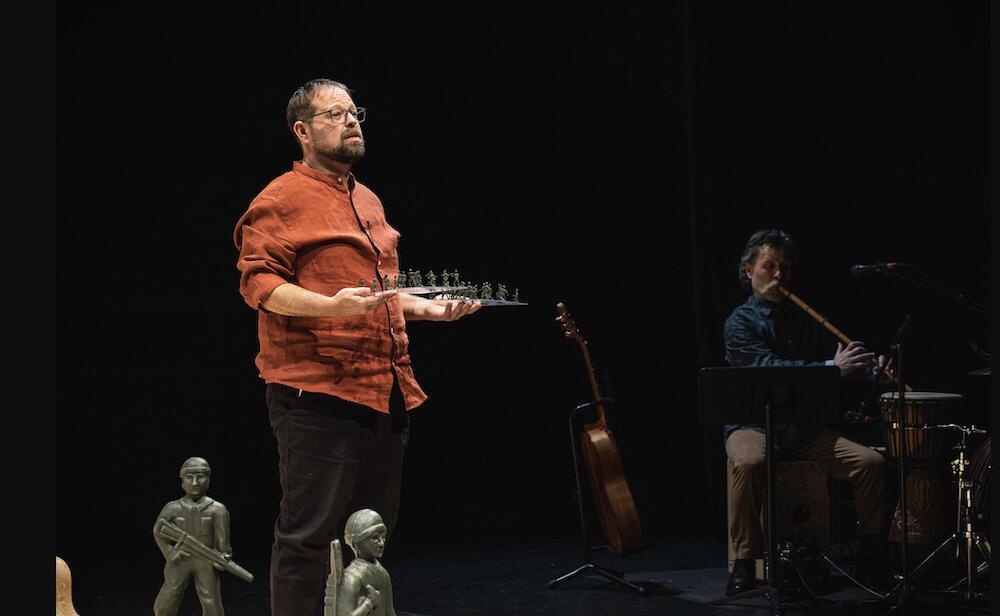
Which brought us to How to Catch Creation, a co-production between Obsidian, Soulpepper, and Nightwood Theatre. Set in San Francisco, the play is about four artists and intellectuals who wrestle with creativity, legacy, and the complexities of love and family. When they uncover the work of a Black queer feminist writer from the 1960s, her words ripple across time, intertwining their lives in unexpected ways. Mumbi says she was really drawn to the intersectional lenses of Black feminism that the characters inhabit — gender, racial, sexual, and intergenerational. She had never seen a play with a Black feminist male. Neither had I. Daren A. Herbet plays Griffin, a man in his 40s who has just come out of jail after 25 years and wants to become a father. It was a unique lens into creation that she hadn’t thought about.
“’How to catch creation?’ is a really active question I’m wrestling with myself all the time,” Mumbi said. “The tension of creating becomes greater and greater when you’re balancing more and more responsibilities. Looking at artists who are facing burnout and wondering, ‘How can I keep doing this?’ — I can relate to all of that.”
So can I.
Mumbi went on to describe the balance of “having kids, balancing a company, and living in an expensive city, and how, many people, post-pandemic, are not being able to sustain the art of creation.” She said the play is also about “trying to preserve the work we do, pass it on to the next generation, keep the fire burning and not burn out.
“There is also a lot of hope and light in the piece,” she said. “I was drawn to that. The Black feminism at the centre is being investigated in a hopeful, fluid, forward-momentum kind of way.”
The last question I asked her — “Why and how do you continue to persist?” — had been the first question at the top of my mind. But her answer fascinated me, and has really fuelled me in the days after. She said:
“Persistence is an act of resistance.”
As she dug deeper into her preparation for How to Catch Creation and looked at San Francisco in the 1960s, she found that Black folks there were fighting against erasure. Erasure of culture, of identity.
Similarly, companies like Obsidian resist erasure, resist the idea that our stories don’t matter. For Mumbi, there’s a huge sense of responsibility in being artistic director of a company like this.
“Because we’ve seen it time and time again, this erasure of a Black narrative,” she said. “And when you look at all the intersections of that — Black female narrative, Black queer narrative — all the intersections of that, and how erasure is a real thing.
“On a personal level,” she continued, as if so much of what she so openly shared with me wasn’t already personal, “I always question: ‘How am I going to do it?’ But the moment I get in the room with actors it becomes clear. We need to tell stories; we need to be in community. Every show I do, I feel like, ‘This could be the last one.’ I’ve felt like this since I became a mom. And yet, 10 years later, I’ve produced more artistic work than ever.”
Two days later, we sat together, again, in a beautiful celebration of Black women in theatre hosted by d’bi.young anitafrika at her beautiful, flourishing, generative Watah Theatre. I think we all were transformed by that night. The next morning, Mumbi left me a voice message.
“You asked me why I keep creating, how I continue to persist, and I think it’s because I’m in too deep,” she said. “I’ve been at this so long, what else could I do? And also, my name in Kikuyu means ‘one who creates.’ So if I didn’t create, if I were to stop, would I be running from my fate?”
In the limited time I spent with her, it doesn’t feel like Mumbi is running from anything. In fact, it feels like she’s running toward — or running in the midst of — many questions, and keeping herself open to the answers.
That week, after twice meeting Mumbi and in a celebration where I was held by many of my Black woman peers and elders, I could feel the answer to my questions opening up. As I was leaving the basement of Obsidian’s office, a space where I too had spent many months exploring my own craft, I thanked Mumbi, at which point she thanked me. But I don’t know if she really knew what I was thanking her for as I walked out of that office once again, into fake spring, somehow different.
How to Catch Creation runs at Soulpepper Theatre from April 23 to May 17. More information is available here.
Soulpepper Theatre is an Intermission partner. Learn more about Intermission’s partnership model here.


WRITTEN BY
Kanika Ambrose
Kanika Ambrose is a two-time Dora Award-winning playwright, opera librettist, and screenwriter. Her plays our place and Truth both earned Dora Awards for outstanding new play in 2023 and 2024 respectively.
She is a graduate of Canadian Film Centre’s Bell Media Primetime TV Program (2022-2023).
Other notable works: Plays: The Christmas Market (Crow’s Theatre/Studio 180/b current, 2025), Moonlight Schooner (Necessary Angel/Canadian Stage, 2025), Opera: Of the Sea with composer Ian Cusson (Tapestry Opera/Obsidian Theatre, 2023). Concert: The Big Easy: Music of New Orleans (Soulpepper, 2024), writer of two pieces on Juno-nominated classical album Known to Dreamers: Black Voices in Canadian Arts Song (Canadian Art Song Project, 2021), Tak-tak-shoo with composer Rene Orth (Opera Philadelphia).
Kanika is associate artistic director of Necessary Angel Theatre Company. This year she is Tarragon Theatre’s OAC Playwright in Residence.
LEARN MORE


WRITTEN BY
Dahlia Katz
Dahlia Katz is a professional photographer who specializes in portraits, promotion, lifestyle, events, weddings, and the performing arts. She is also a director, dramaturg, and puppeteer.
LEARN MORE