





![7th Feb: Rob Peace (2024), 2hr [R] (6.25/10)](https://occ-0-1381-999.1.nflxso.net/dnm/api/v6/Qs00mKCpRvrkl3HZAN5KwEL1kpE/AAAABbnZKWSM0fVdQDh2ADspxEFb41r-FIwfae9vBscgIeck3tYm0VGVL1DbBszHr7zIH2tY8CkWtEMdHtW-x3b7TLm1jLX6lvHzH0qIhIO2aTQrgZjlPzDjeRSFwZxS3p9FMXZp9wtjlf1Lijt4GCh2glyNRS3-tmHvwts86rc7Kvt2IA.jpg?r=0d0 "7th Feb: Rob Peace (2024), 2hr [R] (6.25/10)")




The premiere of A Knight of the Seven Kingdoms, HBO’s latest Game of Thrones prequel spin-off, inevitably set off a new round of conversation about whether Game of Thrones author George R.R. Martin will ever finish The Winds of Winter, the long-overdue sixth book in the Song of Ice and Fire series. He’s still giving interviews where he talks about how many pages he’s written, where he’s stuck, and what he’s working on instead, and fans are still responding with the same gripes, sympathy, despair, and especially jokes about how long Winds of Winter has been overdue. The whole conversation has been rehashed in endless cycles for well over a decade now, and it’s well past time to jump off that particular merry-go-round, and for Martin and his fans to try something else.
Instead of playing the fruitless will-he-won’t-he games online, here’s a better use of your time. Between episodes of A Knight of the Seven Kingdoms — a satisfying, small-scale show that Game of Thrones fans (or Martin fans in general) shouldn’t miss — just read one of his pre-Game of Thrones novels, which are all self-contained and complete, no sequels necessary. In particular, my favorite book of his has always been his 1977 debut novel, Dying of the Light, a swooning, admirably nasty science fiction story that contains just about everything fans admire about Game of Thrones, apart from the dragons.
Dying of the Light takes place in a universe that mirrors what Martin would eventually do with the fantasy land of Westeros. It’s a vast, old setting, crowded with competing factions, damaged by war, and characterized by a casually cold indifference to individuals’ survival. (Martin has set a lot of his science fiction work in this “Thousand Worlds” setting, including some of his all-time best short stories, like “Sandkings” and “Starlady.”)
The novel begins with protagonist Dirk t’Larien weighing whether to answer a summons from his ex, Gwen, who he hasn’t seen in seven years. (Side note: I do not miss the era of science fiction where half the characters had apostrophes in their names to make them sound “exotic.”) When they were together, Gwen and Dirk had a pair of “whisper-jewels” psychically imprinted with their love for each other, and each promised the other, “If you ever send me this jewel, I will come to you, no questions asked.” Six months after Gwen left Dirk, he sent her his jewel, but she never responded. That leaves him resentful and hurt when a package arrives, containing her jewel and no message explaining why she needs him, or why she’s broken her long silence.
Dirk chooses to honor his promise and travel to Gwen, even though she didn’t hold up her end of their bargain. But he goes to her with a complicated mixture of anger, defensiveness, nostalgia, and hope, wondering if they can rekindle the kind of first-great-love passion they had for each other when they were younger and far more naïve. His lovelorn, frustrated longing for something that can’t possibly be recaptured is one clear inspiration for Dying of the Light’s title.
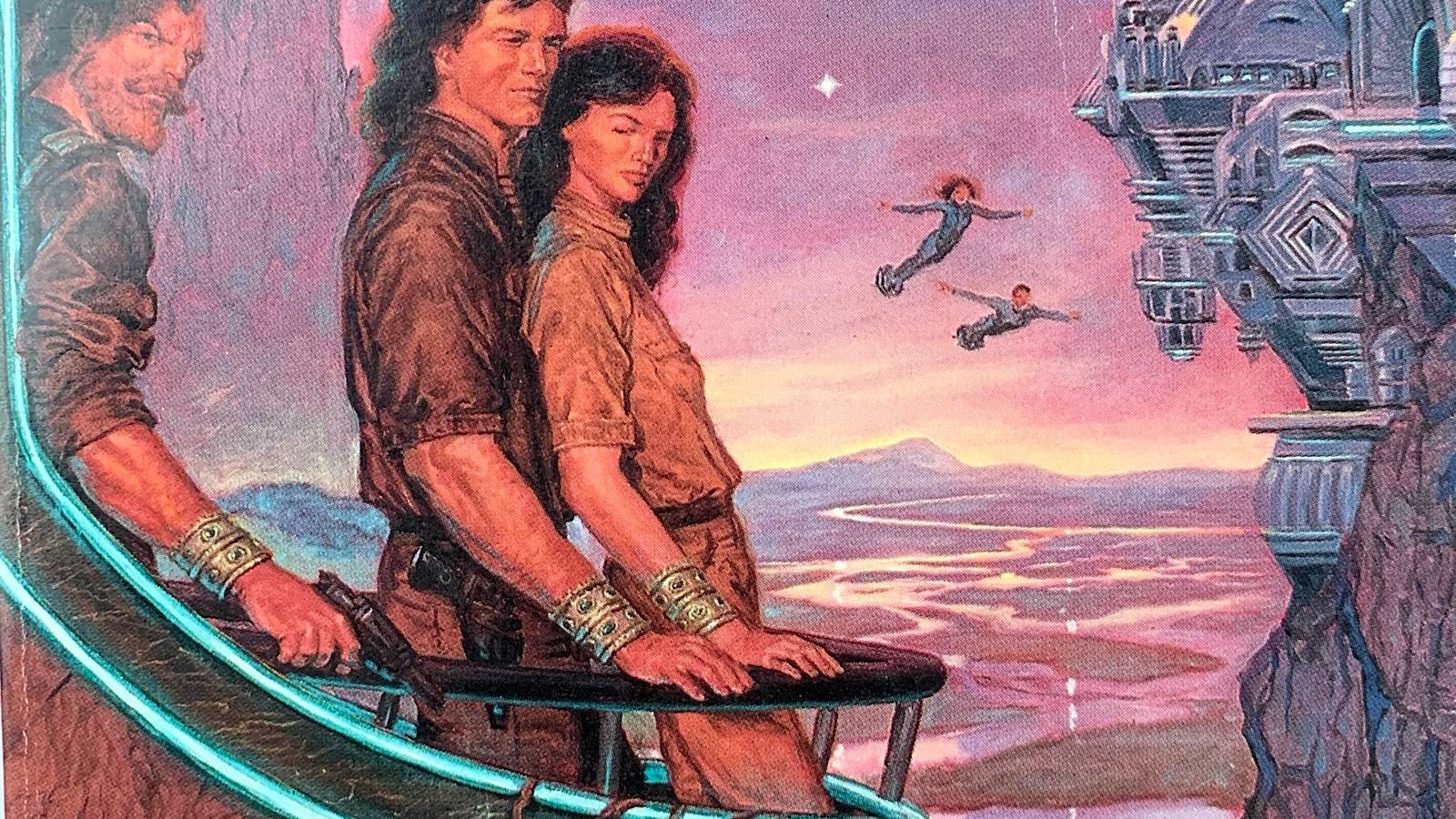
Another comes from the world where Dirk reconnects with Gwen: Worlorn, a rogue planet that was remodeled decades earlier for an interplanetary pleasure fair, celebrating a particularly elaborate cosmic conjunction. Entire cities, now abandoned, were built for the tourists that thronged to Worlorn, and the participating societies seeded the planet with plants and animals from a dozen worlds. Worlorn now has a unique biosphere where these species interact, and which Gwen and a colleague have been studying. But it’s all doomed to die soon, as Worlorn travels out of the solar system and leaves the warmth of its star.
There’s a third reason for that title. Dirk learns that Gwen is now married, more or less. She’s bonded to a man named Jaan from High Kavalaan, a world with complicated, arcane, viciously misogynistic social structures Gwen didn’t understand when she agreed to the bonding. She and Jaan met as scholars and researchers on a world called Avalon, and she misunderstood the nature of the relationship he offered — and the sacrifices and responsibilities it would require from her. Dirk assumes she summoned him to rescue her from Jaan and his conservative, controlling society. The truth is much more complicated. Among other things, it involves the true history behind High Kavalaan’s society, and the dying set of rituals and beliefs that its most conservative and monstrous faction is trying to preserve via a splinter group on Worlorn.
There’s a single, simple romantic thread running through Dying of the Light: Dirk’s selfish, self-aggrandizing hope that he can become the hero of Gwen’s story, and get back together with her. But as with any Martin narrative, few of the characters or situations here come with simple black-and-white morals. No one really qualifies as “the good guy,” though there’s certainly plenty of predatory evil to go around. Martin keeps unpacking layer after layer to the situation Gwen, Jaan, Dirk, and the handful of other people left on Worlorn all wind up in. That simple romantic thread winds through a beautifully complex narrative, tied into centuries of history that presages the similar world-building in the Song of Ice and Fire books. (I laughed on my latest re-read when I got to a detailed section describing the flags representing different worlds — a precursor to Martin’s Ice and Fire obsession with heraldry.)
Dying of the Light is clearly the work of an author still finding his own voice. By the time it was published, Martin was an accomplished short-fiction writer who’d been nominated for most of speculative fiction’s biggest awards, with several wins under his belt. But Dying of the Light feels heavily indebted to fantasy grandmaster Robert Silverberg, particularly whenever Martin launches into a multi-page description of one of Worlorn’s many abandoned, near-dead cities. The passion he’d later bring to describing feasts and food in Song of Ice and Fire is channeled here into describing clever architecture generating ghostly songs, elaborate silver towers and delicate bridges, intertwined slidewalks and low-gravity hover-shafts, coruscating light-waves and a crystalline indoor sea, and so forth and so on, in ways that recall Silverberg’s idiosyncratic writing. The lyricism of these elaborate descriptions sometimes feels forced and imitative, particularly compared to the blunter prose when important things are actually happening.


But the book’s emotional power still stands out nearly 50 years after its publication. I’ve always thought of Martin as the world’s most cynical romantic, and this book is one of the primary reasons. I’ve never read another fantasy author who’s better at capturing the pain of unrequited love, the frustrating distance between idealism and reality, or the endless, fruitless urge to self-mythologize. (The Hedge Knight, the Martin novella adapted as A Knight of the Seven Kingdoms, covers this territory exceptionally well, too.) Martin’s books are exceptionally clear-eyed about the delusions people create for themselves when they’re trying to get what they want — or trying to justify wanting it in the first place.
To some degree, Dying of the Light is about the war for the future of High Kavalaan, a conflict that has as much metaphorical resonance today as it ever had. Jaan’s cultural research has uncovered truths about his society that the conservative leaders of other clans refuse to acknowledge, and they’re denying that truth in order to preserve their power — particularly the power that lets them subjugate and dehumanize women, and anyone from another world. The xenophobic clan leaders of High Kavalaan dismiss everyone but their people as “mockmen” — shape-changing demons who only appear to be human. Some of the cruelest Kavalars have come to Worlorn specifically to hunt, capture, and kill other sentient people for sport, under the pretense that they aren’t really people. The same framing lets these hunters demonize (literally!) and murder other Kavalars they disagree with — unless, like Jaan, their opponents have enough political power to be dangerous.
But the book’s emotional power still stands out nearly 50 years after its publication. I’ve always thought of Martin as the world’s most cynical romantic, and this book is one of the primary reasons. I’ve never read another fantasy author who’s better at capturing the pain of unrequited love, the frustrating distance between idealism and reality, or the endless, fruitless urge to self-mythologize. (The Hedge Knight, the Martin novella adapted as A Knight of the Seven Kingdoms, covers this territory exceptionally well, too.) Martin’s books are exceptionally clear-eyed about the delusions people create for themselves when they’re trying to get what they want — or trying to justify wanting it in the first place.
To some degree, Dying of the Light is about the war for the future of High Kavalaan, a conflict that has as much metaphorical resonance today as it ever had. Jaan’s cultural research has uncovered truths about his society that the conservative leaders of other clans refuse to acknowledge, and they’re denying that truth in order to preserve their power — particularly the power that lets them subjugate and dehumanize women, and anyone from another world. The xenophobic clan leaders of High Kavalaan dismiss everyone but their people as “mockmen” — shape-changing demons who only appear to be human. Some of the cruelest Kavalars have come to Worlorn specifically to hunt, capture, and kill other sentient people for sport, under the pretense that they aren’t really people. The same framing lets these hunters demonize (literally!) and murder other Kavalars they disagree with — unless, like Jaan, their opponents have enough political power to be dangerous.
Dirk is an outsider to all of this, and one of the cleverest and most distinctive aspects of Dying of the Light is the way Martin lets him misinterpret event after event, often making terrible choices out of pride or cowardice. He wants to be Gwen’s hero, but he’s failable and believably human, an absolutely ordinary man stuck in the middle of extraordinary events.
Martin excels at writing this kind of character, and the Song of Ice and Fire books are full of them — flawed and fumbling people who are a long way off from the shining Chosen One heroes that so many fantasy franchises focus on. Martin has a clear empathy for Dirk, the way he has clear empathy for Tyrion and Jaime Lannister or Jon Snow, while still showing how ill-equipped they are against the more ruthless, grasping, and powerful forces seizing control around them.
And yet as with A Game of Thrones and its sequels, Martin holds out hope for the characters’ change, growth, and eventual hard-won victories throughout Dying of the Light. Martin’s sentimental, idealistic side is buried deep in his work, which is mostly about the terrible things people do to each other to gain or keep power, or indulge the power they already have. But that sentimentality emerges again and again in his work, and this novel is one of the tightest and most well-realized examples.
There are no dragons in this book, and no undead armies. But the world-building, the ground-level characterization, the sense of detail and realism, and especially the complicated, fraught emotional drama that made Game of Thrones an international hit are all here. Best of all, the book comes to a pointed, definitive ending — and that’s something Game of Thrones fans should appreciate more than anything at this point when they’re reading Martin’s work.

