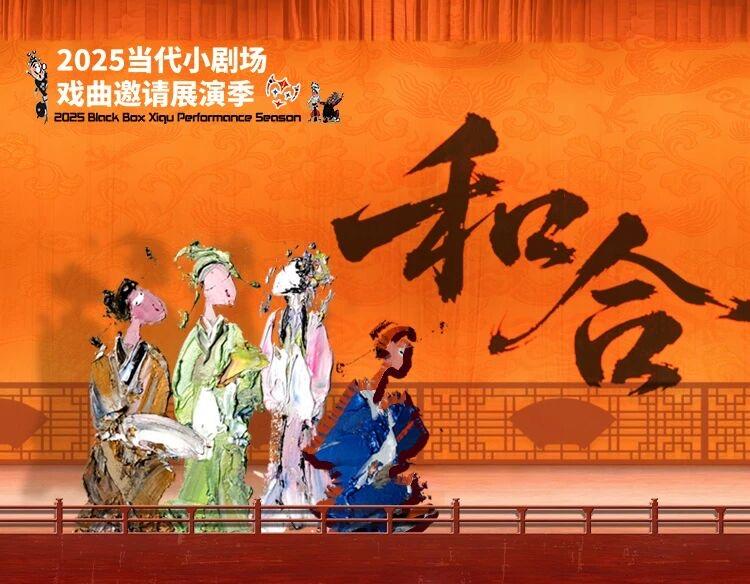


The Dangdai Xiao Juchang Xiqu Jie (Contemporary Black Box Xiqu Festival), operated at Star Theatres, has been a significant engine for contemporary experimentation of Xiqu (Chinese traditional theatre) since its establishment in 2014. Now entering its 12th year in 2025, the festival has supported more than 200 experimental Xiqu projects, drawing millions of audience members from across China. It remains one of the earliest and most influential cultural clusters where emerging Xiqu artists can articulate their creative voices in a flexible, low-cost, and artist-centred environment. Reading the slogan “He He” (和合harmony and collaboration) of this year’s festival and speaking with its founder and CEO, Mr. Fan Xing, I argue that this longstanding initiative has grown into a hybrid cultural space and the meaning of “He He” performatively means a harmonious collaboration between the futurist experimentation and the deep-rooted nostalgia.
As a space of nostalgia, Xiao Juchang Xiqu Jie foregrounds Xiqu as a historically rich and culturally emblematic performance tradition. For centuries, Xiqu was among the most popular forms of entertainment in China, flourishing across both imperial and modern eras. In contemporary cultural discourse, it often functions as a symbolic repository of China’s indigenous or national identity. This nostalgic dimension is not simply aesthetic: it provides Xiqu practitioners with a foundation of affirmation, particularly at a time when the globalisation of performing arts in China raises persistent questions about authenticity, heritage, and cultural continuity. Within this context, the festival operates as a platform grounded in longstanding artistic solidarities. Over the past 12 years, it has welcomed projects from Xiqu companies across the nation, each presenting diverse regional genres that embody the intracultural richness and heterogeneity of Chinese traditional theatre. Through this diversity, nostalgia becomes not a retreat into the past but a way of sustaining a living lineage.
Yet the festival is equally defined by its futurist momentum. While China has invested heavily in revitalising traditional theatre over the past two decades, much of this funding has been channelled into state-owned troupes and national institutions. Star Theatre Village distinguishes itself by being one of the first private theatre organisations devoted to supporting a wide range of Chinese theatrical forms—from traditional Xiqu to contemporary drama. In my interview with Mr. Fan Xing, he emphasised that the origins of Star Theatre Village were rooted in a shared aspiration among young theatre practitioners: “We simply wanted a place to rehearse and create our own productions. At the time, there were very few spaces open to young artists.” This grassroots impulse, grounded in a desire for artistic independence, ultimately shaped the philosophy of the Xiao Juchang Xiqu Jie later when Star Theatre Village became more economically stronger since 2012: to offer a safe, supportive, and exploratory environment for younger-generation Xiqu artists to test new ideas, develop new aesthetics, and experiment with new performance languages.
The festival’s future-oriented ethos is further strengthened by the leadership of its co-artistic director, Professor Zhou Long, a pioneering figure in experimental Xiqu since the 1990s. Professor Zhou is not only a master of conventional Xiqu—he is a recipient of the prestigious Plum Blossom Award, the highest honour for traditional Chinese theatre—but also one of the earliest artists to explore Xiqu’s potential for global experimental performance. His work over the past three decades has demonstrated how Xiqu techniques, dramaturgies, and embodied aesthetics can be reimagined in transnational contexts without losing their cultural specificity. His involvement at the festival reinforces its dual mission: to honour the heritage of traditional performance while encouraging bold reconfigurations of its future. In 2025, the Xiao Juchang Xiqu Jie stands as an intergenerational meeting point where memory and innovation co-exist. It represents a vital cultural ecosystem for young artists, a fertile ground for experimentation, and a dynamic cultural space in which Xiqu continues to grow as both an inheritance and an evolving artistic frontier.
This post was written by the author in their personal capacity.The opinions expressed in this article are the author’s own and do not reflect the view of The Theatre Times, their staff or collaborators.