









I’ve had mixed experiences with night trains.
I’ve click-clacked between Nice and Paris in First Class, stretching out on squishy linen as I’ve watched the sun set over Saint Tropez. I also took the same route, this time starting at Marseille, on a hard couchette, complete with broken air conditioning at 31C, a train breakdown and a panic attack. Most recently, I’ve taken a 54-person carriage across Central Asia with a rate of cleanliness, comfort and friendliness you can only dream of for 12 euros.
RECOMMENDED: I tried the brand-new sleeper bus set to transform European travel – is it worth the €160 price tag?
Result? I was in no way pushing rose-coloured glasses up my nose as I waited for the train at Berlin Hauptbahnhof, for European Sleeper’s brand-new overnight route bound for Paris via Brussels.
This is the inaugural run of a revived overnight route between the German and French capitals, after the popular Nightjet service was axed at the end of 2025. Belgian-Dutch rail operator European Sleeper re-established the service on March 26.
European Sleeper’s route takes a little longer to reach Paris than the Nightjet service did – over 16 hours, instead of around 13 – and takes a different route, travelling through Liège, Brussels, Mons, Aulnoye and Aymeries, before arriving at Paris Gare du Nord. There are also plans to add a stop in Hamburg later this year.
None of this technical detail was on my mind as I waited for the European Sleeper on the platform of Berlin Hauptbahnhof – ready for a journey that, as it turned out, would come with a certain level of charm and chaos.
The first incident of the journey was my fault: despite the repeated gentle reminders from European Sleeper that I needed my PDF ticket with me, I assumed I had one in my e-mails (I did not). I can’t fault European Sleeper’s customer service here – I was at the front of the caller queue within five minutes, and two minutes before the train pulled up, they’d resolved the issue.
RECOMMENDED: Europe’s best new sleeper train routes to try in 2026
Having accidentally hopped on a train to Switzerland instead of the south of Germany just days before, I quadruple-checked all the other details, including where I would be sleeping. Carriage 36, Berth 61, Comfort Plus in a three-person cabin.
But, as quickly became clear to my fellow passengers and me, Carriage 36 was not there. Pandemonium ensued. All the 36-ers and I, panicking on hearing the roars of ‘aufsteigen’ from the Hauptbahnhof conductors, jumped onto the wrong carriage. I eventually found carriage 36 (it was, for some reason, just after carriage 40), and once I entered my berth, things went a lot more smoothly.


I’d be sharing my berth with Fitia, a friendly Parisian by way of Madagascar. We chatted as I poked around the space where we would be spending the next 16 hours or so together.
A large cupboard held three sets of fluffy duvets and pillows, and the ladder we would need to climb to the two top bunks. (I’d be taking the bottom one, which could be folded down over the three seats you sit on during the day). Another door led to a small space with a sink, mirror and fresh towels – a godsend when you didn’t want to trek to the toilet down the corridor to brush your teeth.
I sat at the small table by the window near the one power outlet in the cabin, which Fitia and I would amicably share. Half an hour after we pulled out west, an attendant came by to offer a free welcome hot drink or beer. I dropped a few euros on sparkling wine instead, telling myself I deserved it after my first world platform problems, while my companion ordered a hot chocolate.

Afterwards, I sniffed around hopefully for a dining cart (I’d recently discovered the existence of the onboard restaurants on Germany’s InterCity Express trains), but soon discovered that the route didn’t seem to have one. No bother. I was content bouncing my way back off the shaking walls back to my carriage to my butter pretzel, and happy that you could order snacks like mac and cheese and Pringles off the menu.
As I waited for my cabin to be unlocked by a member of staff – Comfort Plus rooms on this route are only accessible from the inside, if you’ve been given a key (which I hadn’t), or via a steward – I got chatting to our next-door neighbour.
Paolo was a business financial analyst who moonlighted as a YouTuber on the train travel beat. We began speaking through his door, which he explained he always left propped open when not going to bed.
‘It used to be the way that when you were on the night train,’ he said. ‘In the daytime, you are leaving it open and socialising. It was the norm.’

I mused on this as I was finally let back into my cabin. I was grateful for the semi-privacy that the (reasonably) affordable comfort coach allowed (from €99.99 on this route). But while money buys comfort, it doesn’t get you those wildcard moments – ones where you meet strangers in a basic six-person couchette carriage.
But as the train began rocking, I became sleepy. I was helped by two members of staff to unfold my bed – combined with the thick duvet and pillow, it was a far more comfortable sleeping experience than many other overnight services I’d tried. Fitia had now passed out on the top bunk, in what felt like seconds after the staff brought her hot chocolate to order. I briefly mourned our plans to do vitamin-C face masks together, changed into pyjamas and fell asleep almost instantly.

In the comfort of my cabin, I only woke up twice: once when my cabinmate ducked out to disembark at Brussels in the pre-dawn light, and later when a new, fresh-faced staff member popped past to deliver a breakfast box: yoghurt, juice, a hot drink, a soft bread roll with preserves and a solid German breakfast biscuit.
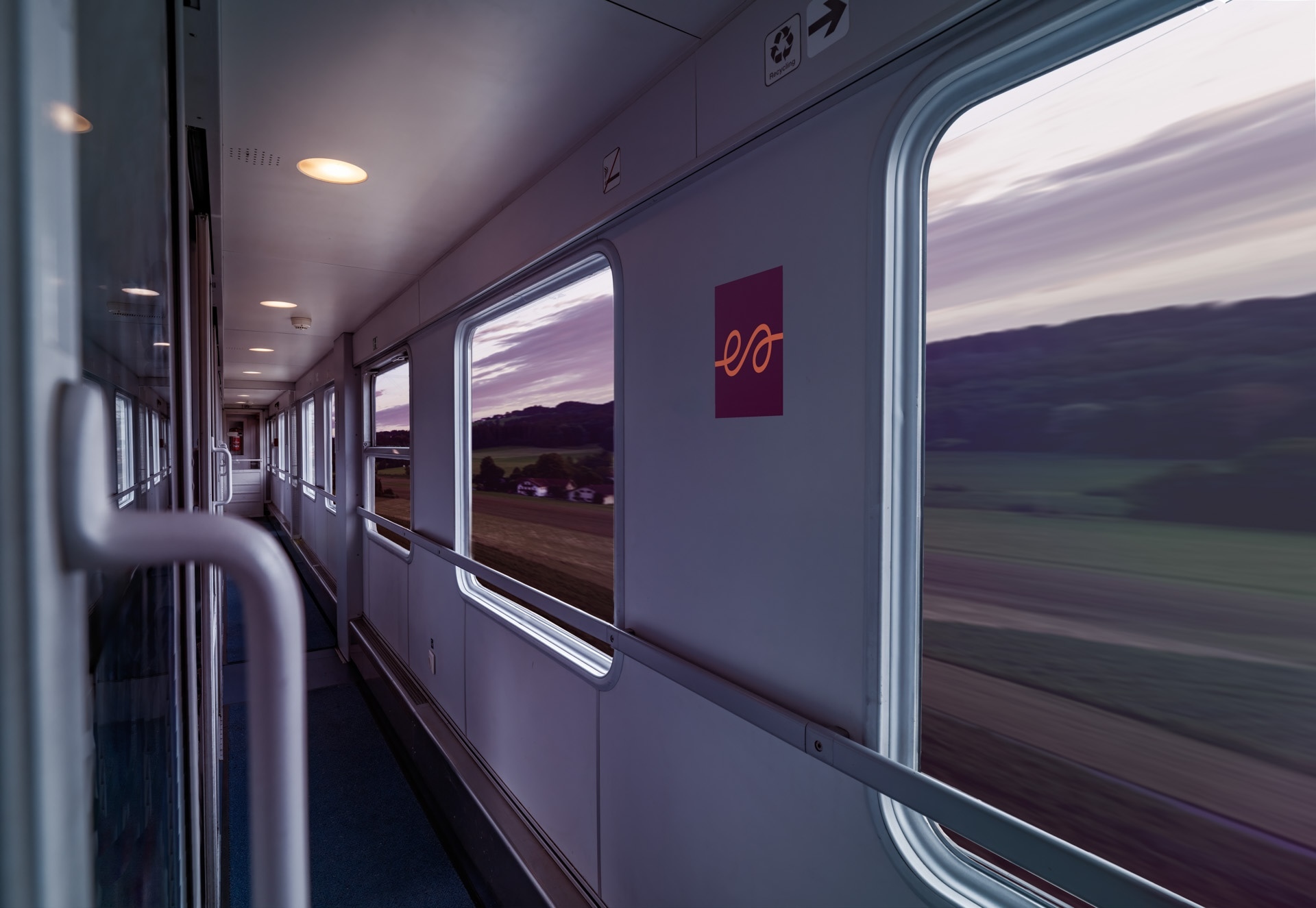
Feeling well-rested, I took to my (now private) bathroom to do my morning skincare. Unfortunately, the tap water had now run out – having never had a private train bathroom before, I wasn’t sure how common this was – but I made do with one of the many free waters we were provided throughout the night. Then, I sat and watched the scenery go by. I had woken up in the French countryside, and before long, the barns and poky villages gave way to the built-up outer reaches of the city.

A little over 16 hours after leaving Berlin (a little earlier than the predicted 16-and-a-half), and after a good night’s sleep, the European Sleeper reached Paris Gare du Nord. I stepped out onto the platform, a little unsure-footed from the shift from movement to stillness, and the overnight language switch from German to French.
It hadn’t been a perfectly smooth trip, but these inaugural journeys rarely are. I loved it all the same. Lessons learned: make sure you have your PDF ticket; the carriages aren’t always in numerical order; you’d do well to pack some snacks.
But with fares from only around €60 for a couchette to get all the way from Berlin to Paris – a night’s sleep included with none of that airport stress – I’d say it’s absolutely worth the price. And while the journey’s not entirely seamless just yet, I’d take it over flying any day.
Kate Bettes was hosted by European Sleeper. As of March 2026 on the Paris–Berlin night train, fares start from €39.99 for a seat.
ICYMI: Europe’s new entry/exit system rolls out this week – here’s what travellers need to know
Stay in the loop: sign up to our free Travel newsletter for all the latest travel news and best stuff happening across the world.


