











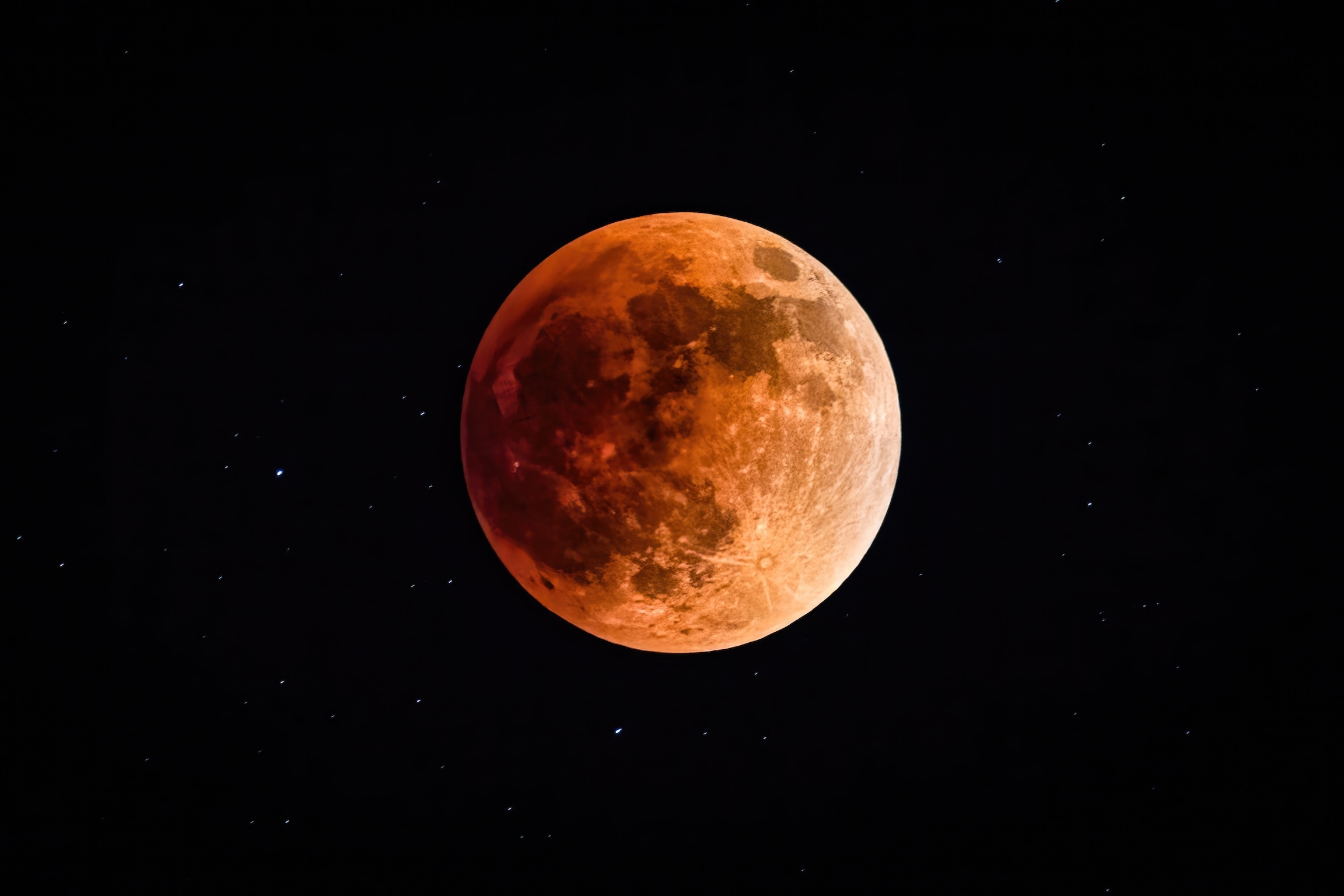
Just two weeks after parts of Europe were plunged into darkness by the mystical, once-in-a-generation solar eclipse, another celestial phenomenon is approaching – this time, though, it’s a lunar eclipse.
These occur when, instead of the moon blocking Earth’s sunlight, Earth blocks the path between the Sun and the Moon, creating an eerie, beautiful red haze over its surface.
Parts of North America, Europe and the UK are set to get a glimpse of the eclipse, so below is everything you need to know about the event and where exactly it will be visible.
What is a blood moon?
The spookily named blood moon occurs when the Earth comes directly in between the Sun and the Moon, and the Moon is engulfed by the Earth’s umbra (its shadow), creating the atmospheric, reddish hue.
The colour occurs because some of the Sun’s rays still reach the Moon, but the light at the violet end of the spectrum is filtered out by the Earth’s atmosphere, so only the red rays reach the Moon’s surface. It’s called Rayleigh scattering, and it’s the same occurrence that causes colourful sunsets.
When is the blood moon and where are the best spots to see it?
According to Time and Date, the full moon will move into the outer part of the Earth’s shadow at 1.23am UTC (a phase dubbed the penumbral eclipse by astronomers). One hour and 10 minutes later, it will move into the darker, denser shadow (the umbra) and begin the partial eclipse before the maximum eclipse is reached at 4.12am, with the Earth covering 96 percent of the Moon’s surface.
In the West Coast of US and Canada, the phases will kick off on the evening of August 27 at 7.33pm, or 10.33pm on the East Coast. However, Europe will be experiencing it in the early hours of Friday August 28 – before sunrise in the UK, but after sunrise in mainland Europe, Africa and the Middle East.
Head to the website’s ‘eclipse central’ guide to see the exact time the eclipse will be visible where you live.
Do I need eclipse glasses?
No – unlike a solar eclipse when the Earth is facing the Sun (and your eyes become more vulnerable to its light), you don’t need special equipment to observe a lunar eclipse – just some good luck when it comes to clear skies.
Did you see that this iconic European hiking trail could soon be reservation-only from next spring?
Plus: This European country is making 126 ancient sites free to visit this month – here’s why.
Stay in the loop: sign up to our free Travel newsletter for all the latest travel news and best stuff happening across the world.


