![30th Aug: The Breakfast Club (1985), 1hr 37m [R] – Streaming Again (6.9/10)](https://occ-0-953-1001.1.nflxso.net/dnm/api/v6/0Qzqdxw-HG1AiOKLWWPsFOUDA2E/AAAABV-fhbCiX__V7Dfbw72DEC5YA8rB9SgUYlbRKkpwtYq07kGB0-ClqJp9BNHfHnHM4zc-BkIC12r110Te2lyxwJxv0y3i61UCIddb.jpg?r=831 "30th Aug: The Breakfast Club (1985), 1hr 37m [R] – Streaming Again (6.9/10)")






A self-described “army brat” throughout her childhood, Gray earned a BFA in acting from Boston University, followed by an MFA in acting from New York University; she credits this rigorous training with allowing her to appear loose, even improvised, on stage. This skill is particularly in evidence during ‘Our Lady of the Underground,’ a ferocious cabaret number in which an inebriated Persephone beckons the workers of Hadestown into her underground speakeasy, flirting and growling and staggering around stage.
“People sometimes think I’m making up those movements in ‘Our Lady of the Underground’ in the moment,” says Gray. “I choreographed that within an inch of its life. It is very, very controlled so that it can look like chaos. That’s the only way to play drunk, I’ve found; it has to be completely choreographed. I might have moments where I think about jumping down into the ground, coming downstairs, but I know what foot I’m doing it on, and I would never trip, because it is choreographed to the hilt.”
Still, “there’s great freedom within that rigid structure,” Gray explains. She’s delighted in bringing her own flourishes into Persephone from the start; Gray auditioned with a large folding hand fan, an allusion to Alvin Ailey’s Revelations that felt authentic to the New Orleans second-line style of ‘Livin’ It Up on Top,’ a vibrant spring-time number that introduces Persephone. That song didn’t fully lock into place until late in workshopping, Gray recalls. “We were so good at living in the darker colors of the play that it was hard to find that level of joy,” she recalls—until choreographer David Neumann set a version of the number that incorporated a raucous, stomping dance break and trombone solo.
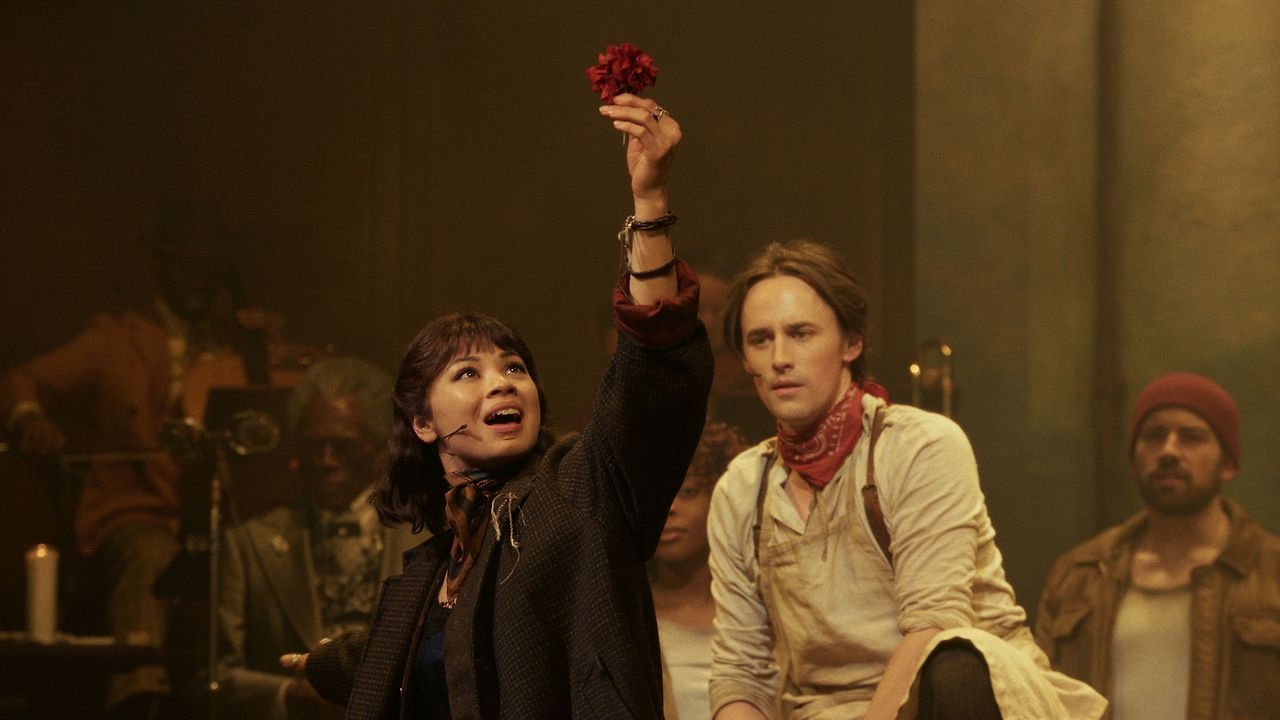
As a folk opera, Hadestown is intricately constructed, with its melodies largely dictating the duration and intonation of the words its cast members can sing, but the challenge of keeping its energies fresh and exciting within that is one Carney and Noblezada also savor. “I’ve always thought of Hadestown as half sung-through opera and half silent film, because I feel like the places where we were able to [experiment] as actors were in wordless moments,” Carney reflects. “We never want to lose the filmic quality within a theatrical performance, because I feel like that’s where the truth most easily lies. I always like to think the theatrical performance is more about turning up the truth—never losing it but amplifying it.”
This strikes a chord with Noblezada. “Our job is to be human,” she adds. “When we go on stage, humans don’t really have a capacity for what we can think and what we can do, even though we have the structure of the story. Patrick Page once told me, ‘With structure, you actually get more freedom to play, because you know the rules.’ As humans, we never stop emoting, and there are ways to still put all of that into our bodies on stage, just in another character’s spirit, ether and essence.”