












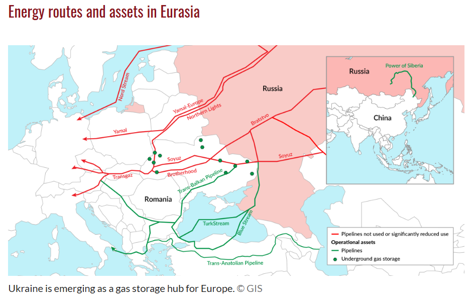
Figure 1
Before February 2022, the world’s oil system worked the way most people assumed it always would: Russia sent crude and diesel to Europe, while U.S. and European refineries sent fuel to everyone else, and the big shipping lanes almost never suffered blockages.
Russia’s invasion of Ukraine smashed that circuit, forcing crude east, stretching tankers, tightening distillate, and exposing how little spare slack existed in the refining and maritime system.
What follows is Part 1 of my analysis of that break – from the 2022 shock through 2024, when the petroleum order had not collapsed but had become brittle enough for the next shocks to cause havoc.
The shock was not confined to Europe or Russia; it rippled outward through tanker markets, refining systems, maritime logistics, and global price structures.
What began as a geopolitical crisis quickly evolved into a structural transformation of the global petroleum system. By late 2024, the system had not broken, but it had become unmistakably fragile. The 2022 shockwave had already reshaped flows, tightened diesel markets, disrupted chokepoints, and exposed vulnerabilities that would later be exploited by further geopolitical escalation.
Europe entered 2022 deeply dependent on Russian hydrocarbons, with roughly 45% of its natural gas and more than a quarter of its crude oil imports originating from Russia.[1]
When Russian forces crossed into Ukraine, the European Union responded with a cascade of sanctions, embargoes, and price caps that severed long‑standing energy ties.
Pipeline gas flows collapsed, forcing European buyers to secure liquefied natural gas (LNG) cargoes at record-high prices. Crude imports from Russia fell sharply, replaced by barrels from Saudi Arabia, Iraq, the United Arab Emirates, and the U.S. Diesel imports that previously were dominated by Russian supply, plummeted, contributing to a widening diesel crack spread (difference between crude oil and diesel product prices) that would persist for years.
The loss of Russian diesel was particularly destabilizing.
Europe had long relied on Russian refiners for middle distillates or diesel, and the sudden removal of these flows created an immediate supply gap. European refiners attempted to compensate, but structural constraints limited their ability to increase output. Several refineries had closed in the years leading up to 2022 due to tightening environmental regulations, poor margins, and pandemic‑era demand destruction.
These closures – Convent in Louisiana, Philadelphia Energy Solutions in Pennsylvania, Marathon Golden Eagle/Avon in California, Kwinana and Altona in Australia, to name a few – removed hundreds of thousands of barrels per day of refining capacity from the global system.
The Organization of the Petroleum Exporting Countries (OPEC) estimated roughly 6 million barrels per day (b/d) of capacity closed worldwide from 2012-19, plus another ~3 million b/d in 2020-21 from the COVID-related demand shock.[2]
The timing could not have been worse.
As Europe turned away from Russian supply, Russia redirected its crude flows eastward. India emerged as the largest buyer of discounted Russian barrels, importing more than 1.8 million b/d by mid‑2023.[3] China expanded its purchases as well, often through “dark fleet” tankers operating with transponder irregularities or ship‑to‑ship transfers designed to obscure origin.[4] These shifts created new long‑haul routes that reshaped tanker markets.
Figure 2 – AI-generated comparison of crude oil carrier classifications.
Aframax and Suezmax crude oil transport vessels previously serving short‑haul Baltic–Europe routes were redeployed to longer voyages toward India and China.
-
- Aframax: roughly 80,000-120,000 dead-weight-tonnes (dwt), about 700,000 barrels. Workhorse for Baltic and many Black Sea crude loads.
- Suezmax: roughly 120,000-200,000 dwt, about 1 million barrels. Common on Black Sea and some longer Russia-to-Asia hauls.
Those freighter sizes taking short Baltic/Black Sea to northwest Europe and Mediterranean runs are used in transits ranging from a few days to a couple of weeks. After Europe stopped taking most Russian crude, the same barrels went mainly to India and China. Baltic region to the west coast of India is in the order of 7,000 nautical miles and about 25-30 days one way (longer via the Cape if the Red Sea is avoided).
Baltic region to north China is an even longer round trip that used to recycle a ship relatively quickly but now ties it up for two months or more (India) or well over three months (China).
With the same barrel volume, far more tonne-miles, each ship completes fewer voyages per year. That is equivalent to a shrinkage of available fleet even if the physical number of hulls is unchanged.
The result was a tightening of global tanker availability and rapidly rising freight rates, factors that would later amplify diesel crack spreads.
The diesel crack spread began diverging sharply from historical norms in 2022. Several forces contributed to this divergence. The loss of Russian diesel imports into Europe created an immediate supply gap.
Refinery closures in the United States, Europe, Australia, and New Zealand reduced global refining capacity at precisely the moment when demand for diesel was recovering from the pandemic. Longer tanker voyages due to rerouted Russian crude tightened tanker availability, raising freight rates.
By late 2023, diesel crack spreads were consistently elevated, often exceeding $40-50 per barrel in Europe, which are levels rarely seen outside crisis periods, whereas under normal conditions it hovers between $8 and $12 per barrel.[5]
This divergence signaled a structural tightening of global refining capacity that would persist into 2024 and beyond. The widening diesel crack spread was not a market anomaly; it was a symptom of deeper structural stress.


Figure 3 – 21st-century diesel crack spread (post 2022 amplification).
Diesel is the backbone of global logistics, agriculture, mining, and industrial activity. When diesel markets tighten, the effects cascade through supply chains. Higher diesel prices increase freight costs, which in turn raise the cost of goods.
The widening crack spread also reflected the growing mismatch between crude supply and refining capacity.
Even as global crude production recovered from pandemic lows, refining capacity lagged. The world had entered a period in which crude was available, but the ability to convert it into usable products was constrained.
While Russia and Europe were reshaping their energy relationships, Venezuela began re‑entering the global petroleum system. In November 2022, the US Treasury issued General License 41, authorizing Chevron to resume limited production and export operations in Venezuela.[6]
This was the first significant easing of U.S. oil sanctions since 2019 and allowed a limited, licensed return of Venezuelan crude. Under General License 41, Chevron ramped up its joint ventures with Venezuelan state energy firm PDVSA from early 2023, with reported output and U.S.-bound exports rising to 190,000-250,000 b/d at various points through 2025, which equates to roughly 160-220 million barrels over that period, though no official cumulative total has been published.
Part of that production went to U.S. Gulf Coast refiners that had long run Venezuelan heavy crude before the 2019 sanctions. Even so, China remained the largest buyer by volume through 2024 (about 65% of Venezuelan exports in 2023 and still first in 2024 at roughly 351,000 b/d), with the United States second.[7]
Chinese refiners imported approximately 470,000 b/d of Venezuelan barrels in 2025,[8] often rebranded to obscure origin.


Figure 4 – Venezuelan crude oil storage and loading infrastructure.
Chinese firms, including CNPC and Sinopec, held billions of barrels in entitlement reserves tied to long‑standing upstream investments. China’s role in Venezuela was not merely commercial; it was strategic. By securing long‑term access to Venezuelan crude, China sought to diversify its supply sources and reduce dependence on Middle Eastern barrels that transited vulnerable maritime chokepoints.
By late 2024, however, US policy signals suggested a potential future shift in Venezuela’s geopolitical alignment.
Discussions around post‑Maduro transition scenarios began circulating in Washington.[9]
These developments laid the groundwork for Venezuela’s eventual pivot away from China and toward the United States in 2026, which is a shift to be explored in Part 2 of this analysis.
As geopolitical tensions reshaped crude flows, environmental conditions disrupted maritime logistics. In 2023-24, severe drought conditions reduced water levels in the Panama Canal, forcing authorities to restrict daily transits. Traffic fell from 36-38 ships per day to roughly 22 by early 2024.[10]
LNG transits collapsed, and petroleum cargoes faced delays and higher costs. This disruption added pressure to global shipping networks already strained by rerouted Russian crude flows. The Panama Canal drought was not directly related to geopolitical conflict, but its effects compounded the stress on global logistics.
At the same time, a new maritime threat emerged in the Red Sea.
In late 2023, Houthi forces in Yemen began targeting commercial vessels using drones and anti‑ship missiles. Initial attacks were sporadic, but they signaled the emergence of a new hazard in one of the world’s most critical energy corridors.[11] Insurance premiums rose, and some shipping companies began avoiding the Red Sea entirely, foreshadowing the crisis that would erupt in 2024.


Figure 5 – USS Carney transiting Suez Canal in route to the Red Sea.
By early 2024, Houthi attacks had escalated dramatically, with 174 Navy and 145 civilian vessels targeted by late 2024.[12]
The Suez Canal, through which roughly 12% of global trade normally passes, experienced almost a 60% collapse in traffic.[13]
Shipping companies rerouted vessels around the Cape of Good Hope, adding 10-14 days to Asia-Europe voyages and increasing freight costs significantly.
The Red Sea crisis intensified structural tightness and boosted freight costs in diesel markets. Refinery closures in Europe reduced local supply, while Middle Eastern diesel exports faced delays and rerouting.
By late 2024, diesel crack spreads were again elevated, reflecting the combined impact of refinery constraints and maritime insecurity.


Figure 6 – Regional refinery closure risk status.
The refining map tightened from 2020-24 as several large crude plants left the system. Shell’s Convent refinery in Louisiana shut at the end of 2020. Marathon’s Martinez plant in California stopped running crude the same year and converted to renewable diesel. Philadelphia Energy Solutions had already closed in 2019 after a fire and bankruptcy.
In the Pacific, BP’s Kwinana and ExxonMobil’s Altona refineries in Australia ceased refining in 2021, and New Zealand’s Marsden Point closed in 2022 and became an import terminal. Phillips 66’s Rodeo complex in California ran its last crude in 2024 as it converted to renewable fuels. Together those exits removed hundreds of thousands of barrels per day of conventional distillation from regional and global supply.
Figure 7 – Estimated buildup of China’s strategic petroleum reserve – 2023 to present.
At the same time, new mega-refineries came online in the Middle East and West Africa: Kuwait’s Al Zour (615 kb/d), Saudi Arabia’s Jazan (400 kb/d), Nigeria’s Dangote (650 kb/d), and Oman’s Duqm (230 kb/d).
These shifts altered global product flows and contributed to diesel tightness. The closures disproportionately affected regions already facing supply constraints, while the new mega-refineries, mostly in the Middle East and Africa, reshaped export patterns.
From 2016-24 China expanded crude storage without disclosing official strategic petroleum reserve (SPR) levels; observed above-ground stocks were estimated at well in excess of 1 billion barrels, the largest national holding.[14]


Figure 8 – Newly commissioned coal-to-liquids production facility in northwest China’s Ningxia Hui Autonomous Region.
In the 2020–2023 security‑driven expansion of its coal mining capacity following the SARS-CoV-2-initiated lockdowns, China also doubled down on coal‑to‑liquids (CTL) technology investments, where CTL projects were framed as a sovereignty strategy aimed at reducing dependence on imported crude, particularly through vulnerable maritime chokepoints.[15]
CTL products include petrochemicals, fertilizer, synthetic liquid fuels, and methane.
By the end of 2024, China’s coal chemical industry had an annual coal conversion capacity of about 274 million tons of standard coal, replacing about 140 million tons of imported oil and gas equivalent.[16]
By the end of 2024, the global petroleum system had become unmistakably fragile. The Russia-Ukraine shockwave had reshaped crude flows and diesel crack spreads had diverged from historical norms. Refinery closures had tightened global product markets, while Panama Canal drought and Red Sea crisis had disrupted maritime logistics. Venezuela had re‑entered the system, and China had built the world’s largest SPR while expanding CTL capacity.
These developments set the stage for the second shockwave that would arrive in 2025–2026: the escalation of Red Sea attacks, the blockade of the Strait of Hormuz, China’s strategic pivot, and Venezuela’s geopolitical realignment.
Endnotes
[1] International Energy Agency, Anatomy of Natural Gas Crisis, 2024.
[2] Organization of the Petroleum Exporting Countries, World Oil Outlook 2045.
[3] S. Energy Information Agency, Country Analysis Brief – India, 2025.
[4] Centre for Research on Energy and Clean Air (CREA), Shedding Light on Shadow Tankers, 2023.
[5] Chem Analyst News, European Diesel Crack Spread Remains Near $40
[6] S. Department of Treasury, Treasury Issues Venezuela General License 41 Upon Resumption of Mexico City Talks, 2022.
[7] Reuters, Venezuela’s 2024 oil exports climb 10.5% amid political turmoil, 2025.
[8] Economic Times, China’s oil investments in Venezuela, 2026.
[9] Reuters, US considering new visa curbs, oil sanctions on Venezuela amid post-election standoff, 2024.
[10] EFE, The Panama Canal returns to “normal” by raising daily crossings to 36 after the drought, 2024.
[11] New York Times, Shipping Costs Soar in Wake of Red Sea Attacks, 2023.
[12] US Naval Institute, Supply, Morale, and Self-Sufficiency: Lessons from the Red Sea, 2025.
[13] UN Trade and Development, Suez and Panama Canal disruptions threaten global trade and development, 2024.
[14] John Kemp, China’s oil stocks and readiness for war.
[15] Oil Price, China’s Renewable Boom Masks a Quiet Coal-to-Liquids Expansion, 2026.
[16] Reuters, Chinese alchemy: Cheap fuel powers coal-to-gas and chemicals boom, 2025.
(Joseph Fournier – BIG Media Ltd., 2026)


![29th Sep: Sinatra: All or Nothing at All (2015), 2 Episodes [TV-14] (7/10)](https://occ-0-132-1239.1.nflxso.net/dnm/api/v6/0Qzqdxw-HG1AiOKLWWPsFOUDA2E/AAAABYoyz5i4Z9AY6wMz8pD0bSsuKbPHyR9yrPRK1rxGppaBIisdEXg9fmBLkpg7NoOmTFc8E-BRQ39LB7-AGyUaZwxC-0Eg9WFHZK6dfRBGM_pFCZVU4h1QwdzLf45ykiZ6ZQfTNvXj384UU7_DXPCPfPqslTxMSYeP3Lj7NuDfRsKAng.jpg?r=5f6 "29th Sep: Sinatra: All or Nothing at All (2015), 2 Episodes [TV-14] (7/10)")