






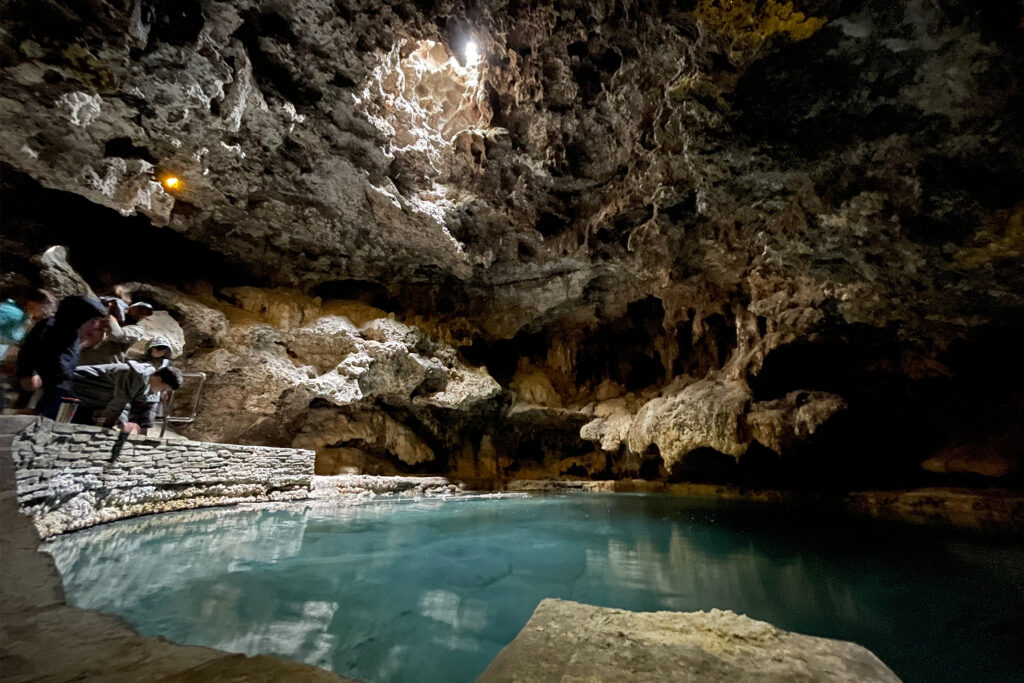
For thousands of years, this thermal hot spring in Banff has inspired residents and visitors alike. Cave and Basin National Historic Site is just one of the nine hot springs on Sulphur Mountain, which is shared by the Banff Gondola.
This awesome national historic site with brilliant blue water and endangered snails is within walking distance from most hotels in Banff. It has water that’s heated by geothermal activity locked deep underground, and a strong, overpowering smell.
Although you can’t soak in this sulphurous hot spring, you can admire its awesome beauty, just like others have done for thousands of years. It’s a place of spiritual significance to Indigenous people that’s been used as a location to gather, with records dating back to pre-Confederation.
An area of key significance
The thermal waters found at the Cave and Basin have played an important role for both residents and the surrounding ecosystem for thousands of years.
Indigenous groups have identified the Cave and Basin as an important and often sacred location where numerous nations gathered for trading, ceremonial and cultural purposes. Yet Indigenous access to the area was permanently altered in the late 1800s as a result of Confederation, and it is still limited today.
In 2019, the Government of Canada conducted a summary of public comments on the Cave and Basin National Historic Site, which included topics on Indigenous involvement and participation. According to the data collected, “the majority of respondents supported an expanded Indigenous presence on site.” Additionally, “Participants clarified that the site was culturally and spiritually important to a number of nations, who also used the area as a meeting place where relationships could be built and strengthened.” This summary of public comment was used to inform the Cave and Basin’s 2020 Management Plan.
In 1981, Cave and Basin was commemorated as a national historic site, and it was described as “the birthplace of Canada’s national parks.” Since re-opening after major renovations in 2013, it has enjoyed the fastest visitor growth amongst all national historic sites administered by Parks Canada. It’s well-known as one of the most visited parks in Canada, so the best way to see it without tourists is in the early morning and late evening.
Home to special snails
Cave and Basin is a special home to a group of endangered snails that can only be found in this important mountain thermal pool. Physella johnsoni, the Banff Springs Snail, only lives in a small part of Cave and Basin Historic Site. These tiny, brown aquatic snails can’t be found anywhere else, and are protected by Cave and Basin’s National Historic Site designation.
The snails are essential to the ecosystem and graze on the microbial community. They break down nutrients, which in turn helps prevent the thermal springs from gathering algae and bacterial blooms.
They only exist here and were placed on the endangered species list in 2000. If we lose them from this site, they might be gone forever.
A funky odour
If you visit Cave and Basin, be prepared for a funky wafting from the thermal spring when you arrive. It’s from the sulphur in the water, and it has a rotten egg smell. To some, the smell can be so overpowering that they can’t stay in the cave for longer than a moment. You can gaze at the pool and take in the plaques on the walking path that detail the history of the place.
If you’re sensitive to strong smells, but still want to see the pool’s brilliant turquoise colour, you might want to bring a mask along with you.
Recent Posts:
Here are Calgary’s top employers of 2026
An exclusive look inside Everwild, a new ritual spa experience near Calgary