






A Magnificent Life feels like a personal story for Sylvain Chomet, even though it’s about a completely different filmmaker. The first animated feature from the Triplets of Belleville writer-director since 2010’s The Illusionist, A Magnificent Life skims across the life story of revered French playwright, filmmaker, and novelist Marcel Pagnol. The film covers the highlights of his childhood and professional career, while zooming in on how growing up in Marseille (a small backwater by Parisian standards, especially in the early 1900s), worked its way into his art, his voice, and his philosophy.
But while Pagnol had a remarkable, storied life — he’s perhaps best known in the U.S. as the director of the tremendous classics Jean de Florette and Manon des Sources — a straightforward greatest-hits run through his career would be a dry approach, and there would be no reason to make it an animated feature. Chomet makes this history his own by framing it as a unique ghost story: one where technically, Pagnol is haunting himself.
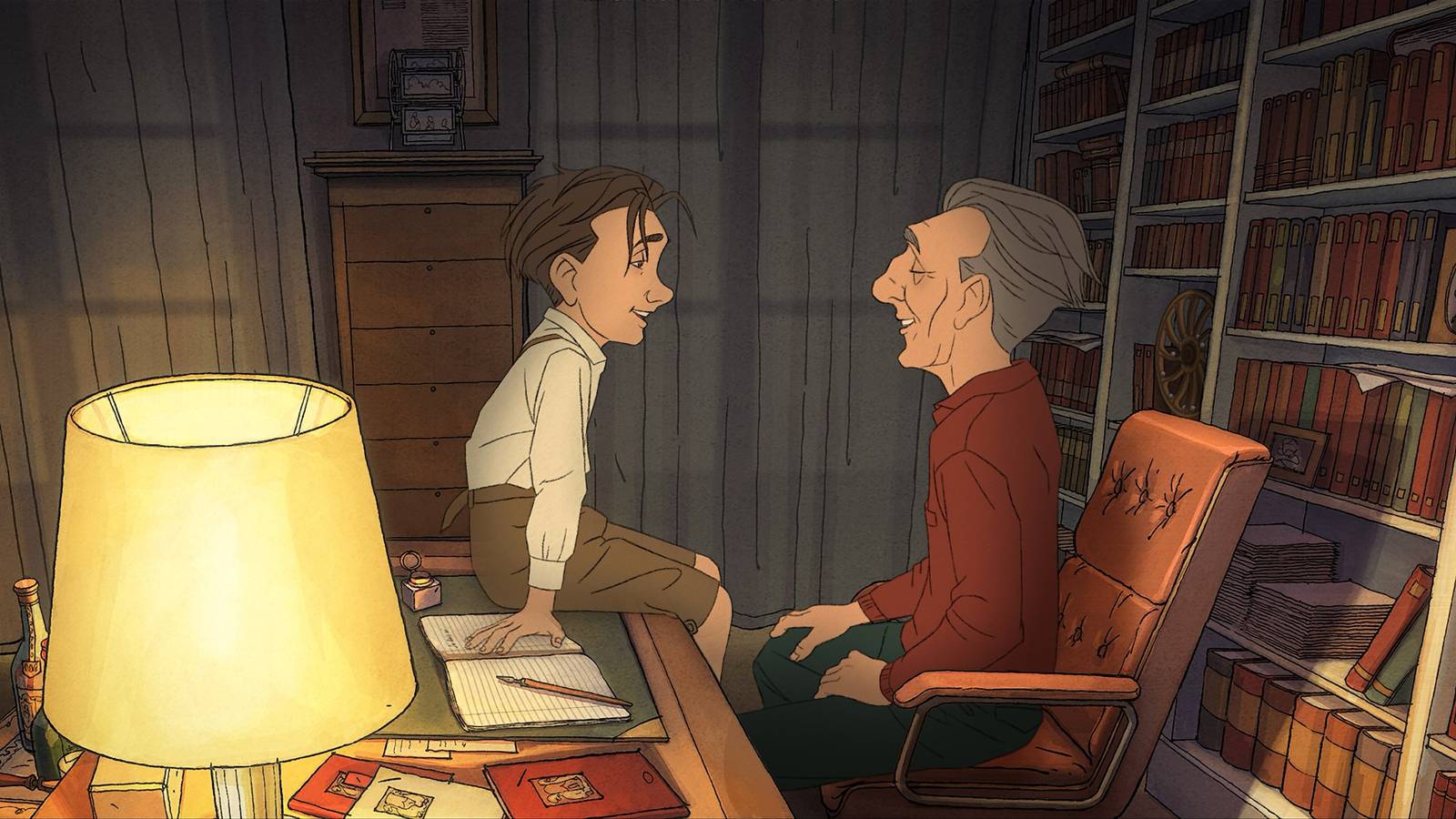
The movie begins with Pagnol at age 60 in 1955, glumly facing down a deadline for Elle magazine, which has commissioned him to write a series of autobiographical articles. Pagnol, who has recently made his final movie (1954’s Letters from My Windmill), sees no place for his work in France’s changing film industry and shift toward youth culture. He envisions the future as bleak, and the past as cloudy, half-forgotten, and irrelevant. Then a young phantom gently confronts him. “Marcel” is effectively the ghost of Pagnol’s childhood self, eager to remind him of his earliest ambitions and potential. The boy leads his older self through a series of recollections about his life, reminding him what his art gave to him and the people around him.
This whimsical approach calls to mind Hayao Miyazaki’s The Wind Rises, an equally personal, loving, fantasy-tinged biopic that’s as much about Miyazaki’s obsessions with manned flight and Japan’s actions in World War II as it is about its putative subject, Japanese aircraft designer Jiro Horikoshi. Miyazaki is contending with the ethics of Horikoshi’s work, while Chomet is studying how Pagnol’s efforts to accurately reflect his hometown in work aimed at Parisian sophisticates who think of Marseille as a primitive backwater — a challenge Chomet contended with himself when he moved to London to become an animator. But both filmmakers extend past the facts of these creators’ histories to consider their impact — how they each affected the world, and how they affected Miyazaki and Chomet, respectively.
That’s a lot for A Magnificent Life to tackle in 91 minutes, particularly given the length of Pagnol’s shifting career. Chomet keeps the script brisk and focused on small, telling moments and details — teenage Pagnol struggling to write poetry for his ailing mother as his younger brother Paul fidgets, reads out loud, or plays the harmonica; adult Pagnol as a filmmaker, genially arguing a Paramount honcho into greenlighting a movie adaptation of one of Pagnol’s plays, starring the original, non-celebrity stage actors, Marseille accents and all.
Only a little of the content of Pagnol’s work comes across in these exchanges. What stands out in Chomet’s retelling is the way Pagnol finds his voice and his confidence. As he navigates his flops and hits, he learns what’s worth standing up for, from making the jump to movies in spite of snobbish naysayers to resisting the Nazi officer who tries to hijack his work. The film is largely genial and moderately paced, particularly by comparison with Triplets of Belleville’s frantic rat-a-tat rhythms, but there’s a steady build to the story as Pagnol grows into his art.
The real charm of the film, though, comes from its ghostly element. Ghost-Marcel hovers around the adult version of himself, not just guiding him, but intervening to assist or protect him. Apparently he can manifest to anyone; he isn’t a mere memory, metaphor, or affectation of the narrative. At various points in the movie, he pushes his adult self into an important “coincidental” meeting, and confronts that Nazi officer to bully him into submission.
And even though he’s the “ghost” of a living man’s childhood, Marcel is surrounded by more traditional ghosts as well. As Pagnol ages and other important figures from his life die, they join Marcel in a gently affirmative chorus, buoying Pagnol and keeping his work on track. One of the movie’s strangest, sweetest scenes has Marcel and the ghost of Pagnol’s mother Augustine quietly conferring about how Pagnol’s doing — an unseen supernatural support system, solely dedicated to looking after him and encouraging him.
There’s a rosy, sentimental positivity to this view of life, death, and creativity, and to the sense of an entire hidden world at work around a well-loved family member who just needs the occasional boost to realize their potential. A Magnificent Life is never going to shoulder aside The Triplets of Belleville in animation fans’ hearts: That movie is a wild experience, a colorfully creative manifesto that warps its characters’ bodies into surprising geometric shapes and sprawls in a dozen unexpected narrative directions. (Chomet is currently working on a spin-off.) By comparison, A Magnificent Life’s animation and storyline are both warm but conventional, accomplished but only surprising in its riff on the supernatural. Its take on Pagnol is surface-level, simple, and uncomplicated, in a way that may rile viewers who prefer biographies with a warts-and-all approach to their subjects’ flaws and failings.
As a basic introduction to Pagnol’s work, though — a prompt to watch his movies, read his books, or catch up on his history — it’s an intriguing, encouraging CliffsNotes tease. And as a wistfully optimistic view of an artist’s life, it hits the same pleasant notes as a lot of cozy fiction. Biographies of great artists often try to define their subjects via grand dramas and dark, defining moments. A Magnificent Life’s perspective is right there in the title: Even in its darkest moments, it’s a hopeful, comforting success story, framed in a way that encourages viewers to look back to their own childhoods, and confront their own wistfully ambitious ghosts.
A Magnificent Life is in theaters now.