










(New York Times) When United States President Donald Trump issued an abrupt order last month compelling the production of glyphosate, the controversial weedkiller known as Roundup, he angered health activists who have long campaigned to ban the product for its links to cancer.
But largely overshadowed in the furor was the order’s mention of something contentious in another way: the manufacture of munitions used by the United States military.
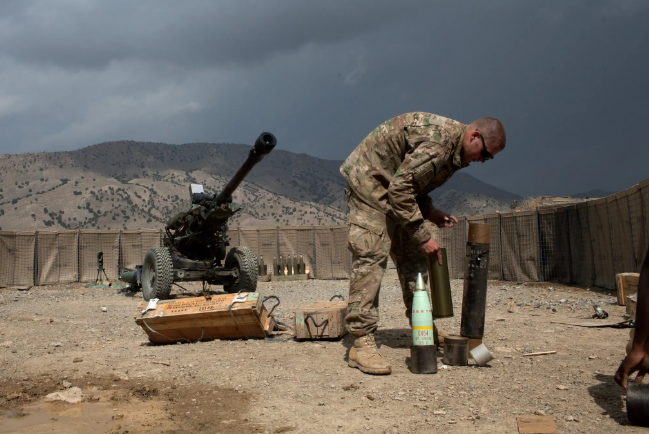
Bayer, which makes glyphosate, is also the only company in the United States that manufactures a form of elemental phosphorus called white phosphorus, which it uses to make the weedkiller. That white phosphorus is also used to make munitions deployed as smoke screens and incendiary devices that can burn property or people.
Concerns about the availability of phosphorus for defense played a significant role in Trump’s move to deem Bayer’s operations a national security priority, according to two people with direct knowledge of the administration’s deliberations. One of the individuals also stressed its importance in light of recent United States military actions.
When asked about the significance of munitions in the Trump executive order, Karoline Leavitt, the White House press secretary, said in a phone call, “The president made this decision based on national security priorities.” She added that the administration is funding research into alternatives to the herbicide glyphosate.
Bayer’s place in America’s military and industrial supply chain is a little-known aspect of a German company that’s behind household pharmaceuticals including Aspirin and Alka-Seltzer. White phosphorus ignites spontaneously when it comes in contact with oxygen. It produces a thick white smoke and can reach temperatures high enough to burn through metal.
Bayer, through its acquisition of Monsanto in 2018, operates the only facility in the United States that produces white phosphorus. It is in Soda Springs, Idaho, and uses phosphate rock the company mines locally.
Bayer uses most of that white phosphorus to make the glyphosate in Roundup, a powerful weedkiller that is a cornerstone of American food production. Roundup has been the target of thousands of lawsuits for its alleged health harms, and the company has spent billions of dollars on settlements.
The company has pushed measures in Congress, as well as in state legislatures across the country, that would shield it from such lawsuits. Bayer has also petitioned the Supreme Court to weigh in on a case that could limit the company’s liability. The court is scheduled to hear arguments in that case in April.
Bayer also supplies some white phosphorous, via intermediaries, to the United States military, which uses it to fill white phosphorus munitions at the Pine Bluff Arsenal in Arkansas.
President Trump’s executive order declared elemental phosphorus crucial to “military readiness and national defense,” and ordered measures to ensure a continued supply. It’s a key component, the order said, in smoke, illumination and incendiary devices, as well as a critical component in semiconductors used in defense technologies.
Bayer’s role as the sole U.S. maker of white phosphorus gives the German pharmaceuticals and agrochemicals giant a position of leverage in both the agriculture and defense industries. It also carries reputational risks for Bayer, associating the company with a widely criticized herbicide as well as with the U.S. military at a time when the president has put the country on a war footing.
Jennifer Kavanagh, director of military analysis at Defense Priorities, a foreign policy think tank, said white phosphorus munitions were typically used in ground operations and by special forces, not in airstrikes of the kind the United States is pursuing in Iran.
But if, for example, the administration were to take action against drug cartels in Latin America or to launch a ground operation in Cuba, forces might be expected to use “these types of white phosphorus munitions to disguise their movements,” said Dr. Kavanaugh, formerly the director of the army strategy program at the RAND Corporation.
Using it is not illegal, though deploying it deliberately against civilians or in a civilian setting violates the laws of war.
Some environmental groups said the president’s focus on military applications is detracting attention from the health concerns linked to a weedkiller. The World Health Organization’s International Agency for Research on Cancer has deemed glyphosate “probably carcinogenic to humans.”
Bayer spent more than $9 million last year to pay 53 lobbyists registered to represent the company’s interests with the White House and various federal agencies as well as in Congress, according to OpenSecrets, a nonpartisan group that tracks lobbying and campaign finance data.
Some of the Bayer lobbyists have close ties to the Trump campaign and administration. Among them is Brian Ballard, who raised more than $50 million for Trump’s 2024 campaign, according to Federal Election Commission filings, and whose former partners include the White House chief of staff Susie Wiles and the attorney general, Pam Bondi.
In June, Bill Anderson, Bayer’s chief executive, met with Lee Zeldin, the administrator of the Environmental Protection Agency, to request an update on glyphosate as well as the Supreme Court case, according to internal emails obtained by the Center for Biological Diversity through a public records request.
“We’re getting a much clearer picture of the unfettered access one of most powerful pesticide corporations in the world has to top officials,” said Nathan Donley, environmental health director at the center, which sued the administration over glyphosate.
Brian Leake, a spokesman for Bayer, said the company “meets with agencies as a normal part of the regulatory process” and that the company has been “transparent about our position on these topics and very public about the issues we face as a company.”
https://www.nytimes.com/2026/03/08/climate/bayer-white-phosphate-glyphosate-roundup-trump-executive-order-munition.html


