












U.S. President Donald Trump’s top trade czar says if Canada wants a trade deal with Washington, it will have to accept “some level of higher tariff” and help to reshore American industries.
United States Trade Representative Jamieson Greer told CBC News’ Katie Simpson on Tuesday that “if Canada wants to come in and participate in this type of reshoring we are trying to do, we are happy to have those discussions.”
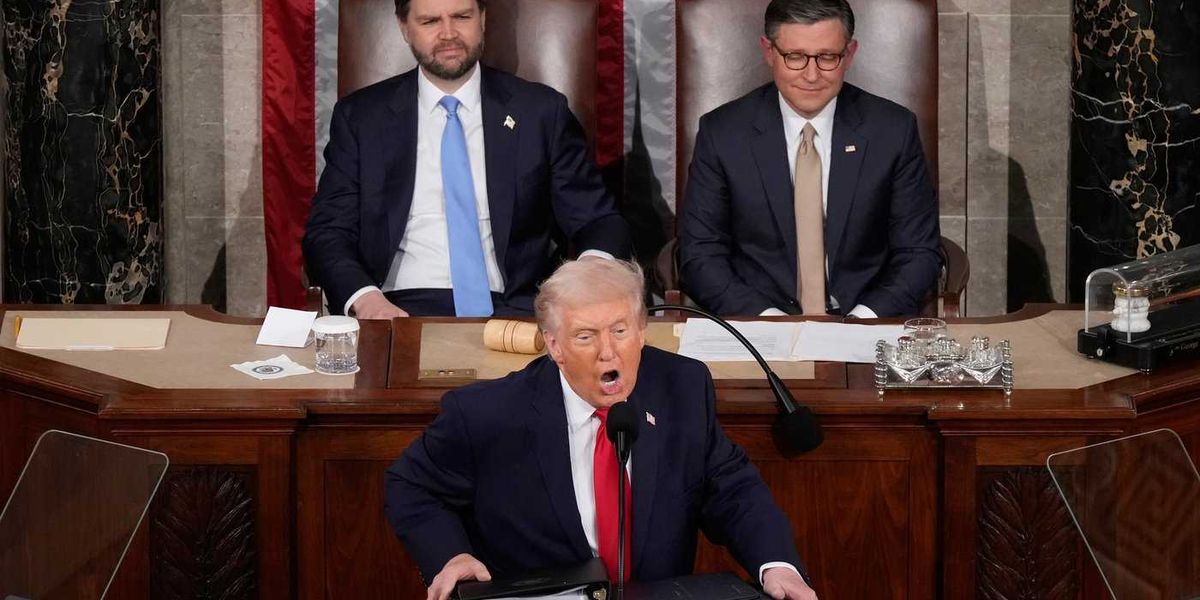
Greer’s comments came after Trump delivered a 108-minute State of the Union address Tuesday night. In that speech, the president told Congress he remained committed to realigning global trade through tariffs — even after the United States Supreme Court struck down a key tool he used to impose those tariffs.
In a 6-3 decision last week, America’s top court concluded it was not legal for Trump to use the International Emergency Economic Powers Act, better known as IEEPA, for his “Liberation Day” tariffs and fentanyl-related duties on Canada, Mexico and China.
Trump signed an executive order hours later to enact a 10 per cent worldwide tariff using Section 122 of the 1974 Trade Act.
A tariff ordered under Section 122 cannot go higher than 15 per cent, and it expires after 150 days unless Congress votes to extend it. It does not apply to goods compliant under the Canada-U.S.-Mexico Agreement on trade, known as CUSMA.
Canada is also being hammered by separate U.S. tariffs on specific industries like steel, aluminum, automobiles, lumber and cabinetry.
While Trump has claimed he is raising the tariff to its maximum level, no executive order has been signed to put that into effect.
Before the ruling, Trump had used IEEPA to pursue an erratic tariff campaign against much of the world. He has claimed tariffs have allowed him to make trade deals — but many of those deals are now in question because of the court decision.
Greer told CBC News other countries have agreed that the United States can maintain a protective tariff while they open their markets to American industries.
“If Canada wants to agree that we can have some level of higher tariff on them, while they open up their market to us in things like dairy and other things, then that’s a helpful conversation,” he said.
Greer will play a key role in the upcoming mandatory review of CUSMA. He said there are open lines of communication with Canadian officials and Canada-U.S. Trade Minister Dominic LeBlanc.
LeBlanc has said he expects to meet with his American counterpart in Washington as early as next week.
Greer argued that when CUSMA came into effect, the hope was that there would be more critical supply chains in the United States and more American content.
“There’s a lot of good in the deal but there are a lot of things where reshoring didn’t happen fast enough. U.S. content didn’t happen fast enough,” Greer told CBC News. “We think that if you … want to have that deal you need to have better rules, stricter rules, to make sure there’s more U.S. content.”
This report by The Canadian Press was first published Feb. 25, 2026.
READ NEXT: Canada just approved US-made jets under threat of massive new tariffs from Trump


![25th Feb: The Dishshawer (2023), 2hr 7m [TV-MA] (6/10)](https://occ-0-953-999.1.nflxso.net/dnm/api/v6/Qs00mKCpRvrkl3HZAN5KwEL1kpE/AAAABbYW-v0WwM2ZCh3OcdWXVEftjuz0wEZgU3xsO9qebrFpVTMOi9T0AlTHmQ_PD0qpEqwqB_tv7wvON_ZuHJ14NwIeD1omeXgcEggxS8bovT9DfEgFcBjuCFVmkHOWCsMsyZ2eVpsRuHyF35eZ8VDWTzRWpojaNiKRRju56HcNxzbUzw.jpg?r=10c "25th Feb: The Dishshawer (2023), 2hr 7m [TV-MA] (6/10)")