












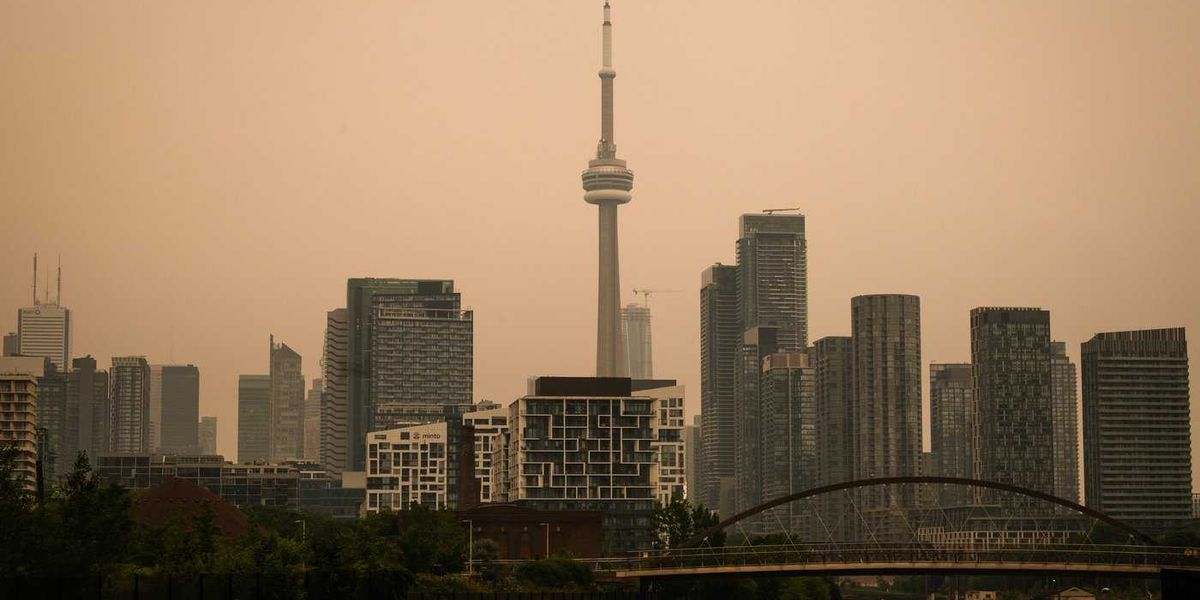
Smoke from wildfires in northwestern Ontario is drifting south and choking the skies over Toronto and other regions.
Environment Canada’s air quality warnings are active from Thunder Bay to Kingston and down to London as several First Nations communities in northwestern Ontario are under mandatory evacuation orders due to forest fires.
Jean-Philippe Bégin, a meteorologist with the weather agency, says winds from the northwest will continue to blanket Toronto and southern Ontario with smoke until at least Friday, when winds are expected to change direction and blow smoke north.
It could bring relief to southern Ontarians by the end of the week but would put communities north of the fires in the crosshairs.
“It’s only displacing the problem,” Bégin said, “as long as the forest fires are not under control and they emit very large quantities of fine particles.”
The yellow-orange haze of particles in Toronto’s air is particularly bad and can impact people’s health, Begin said.
Environment Canada is warning that the risk of smoke inhalation is most acute for children, people who are older or pregnant, and those with chronic illnesses. It’s encouraging people to limit their time outdoors and watch for symptoms of throat irritation, headache and cough, and more serious impacts like wheezing and chest pains.
The poor air quality comes as large swaths of Ontario are dealing with the second day of a heat wave that pushed humidex values as high as 45 degrees in some areas Tuesday.
A person in a face mask boards a streetcar in Toronto as wildfire smoke fills the city, on Wednesday, July 15, 2026.
THE CANADIAN PRESS/Laura Proctor
The extreme heat broke a temperature record in downtown Toronto, where mercury soared to 37.6 C, according to data released by Environment Canada. The previous record was set in 1995 with a temperature of 35.6 C.
When extreme heat occurs alongside poor air quality, Environment Canada advises people to prioritize keeping cool.
Bégin said a low pressure system expected to bring rain across many regions on Friday could bring relief to firefighting efforts in northwestern Ontario and improve air quality by cleaning out particles in the air.
The meteorologist said air quality levels will continue to fluctuate in the region as the wildfires blaze.
This report by The Canadian Press was first published July 15, 2026.
By Kathryn Mannie | Copyright 2026, The Canadian Press. All rights reserved.
