









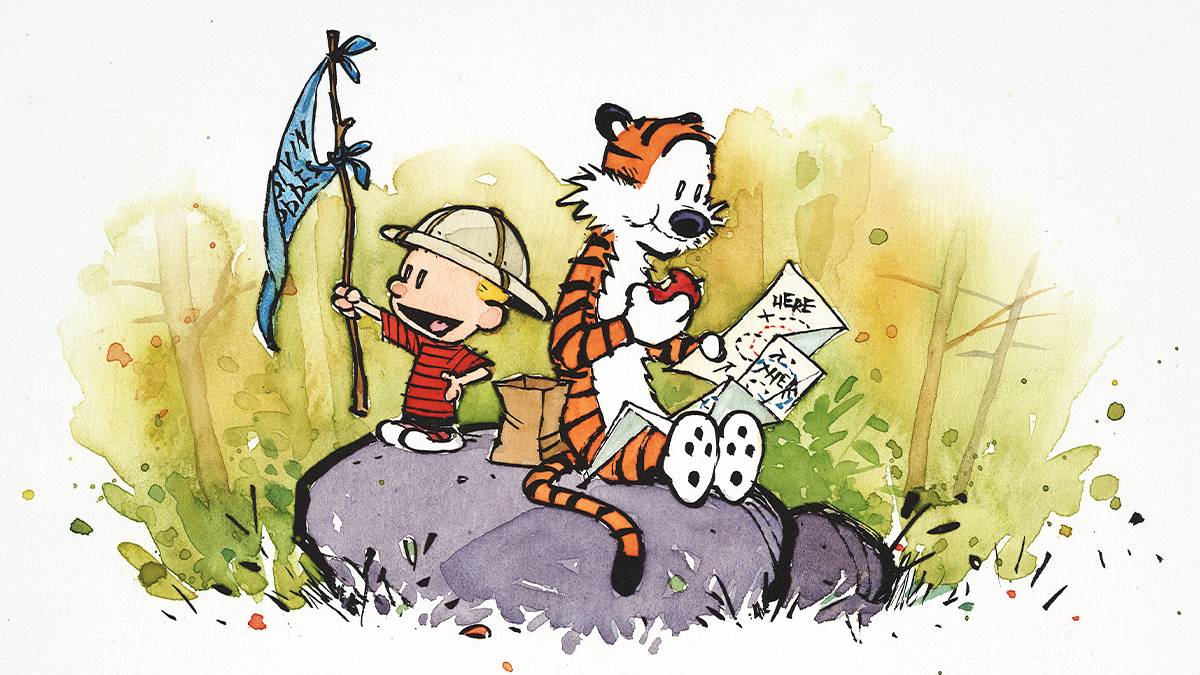
Simply put, Calvin and Hobbes is the greatest comic strip ever. Running for 10 years in newspapers across the country, Bill Watterson’s series about a six-year-old boy named Calvin and his plush tiger Hobbes could be funny, heartfelt, thoughtful, and adventurous, sometimes all at once. Watterson’s simply-drawn, memorable characters also suited the medium of a daily comic strip, though they never seemed like cookie-cutter drawings that could be recycled in various strips (like, say, Garfield). Watterson could also, when the panel called for it, fit a tremendous amount of detail in these little squares that were less than two inches tall.
To determine the greatest Calvin and Hobbes comic panel ever — not an entire daily strip, just a single panel within a daily strip — I figured it would need to have all of the things that continue to make Watterson’s work iconic.
First of all, the greatest Calvin and Hobbes panel ever had to contain both Calvin and Hobbes, and ideally no one else. Lots of strips focused on just Calvin, and they could be very funny, like the ones where he is annoying his teacher. They could also be heartfelt, like the ones with Calvin and his mom. But Calvin and Hobbes is the name of the strip and the core of what makes it special, so it’s got to have the two of them.
The panels where Hobbes pounces on Calvin are hilarious, but the best strip shouldn’t just be funny. Calvin and Hobbes was more than straight comedy. The series featured many entries where Calvin thought about big, philosophical questions about life, death and the universe. The best panel ever should capture the bigness of Calvin’s mind.

The comics could also be very sweet, like the heartbreaking series about Calvin finding an injured baby raccoon that eventually died. But those weren’t funny, and they didn’t include another essential ingredient to Watterson’s storytelling: adventure.
In the comics, Calvin is constantly going on adventures. Sometimes they were real adventures through his backyard. Sometimes they were entirely imagined, like when he falls asleep in class and imagines himself as Spaceman Spiff. These sci-fi adventures are fun, but they didn’t include Hobbes, so that’s a no-go.
Backyard adventures through the forest, however, usually include Hobbes. They also explored a recurring theme in the series, where Watterson celebrated the natural world and lamented its destruction. Adventures in the woods also made great use of Watterson’s details, like his painterly approach to trees. The details of the environment, married with the simplicity of his characters which, paradoxically, never seemed in contrast, represent the best of both sides of Watterson’s drawings.

The single best panel ever also should hold up on its own, outside of the wider comic strip, but also the comic strip medium at the same time. Sometimes Watterson would break the whole medium on his Sunday strips. These are beautiful to look at, but they don’t really represent the comic strip medium, so using one of those feels like a cheat.
To find a Calvin and Hobbes panel starring both characters in the woods that is funny, heartfelt, philosophical, and self-contained, that’s a tall order, but I think I’ve found it. It’s this panel here, from November 9, 1994.

It’s part of a wider panel you can see below, but this one image hardly needs the setup to its punchline. “Sometimes I think the surest sign that intelligent life exists elsewhere in the universe is that none of it has tried to contact us,” is both funny and philosophical, with Watterson’s gentle form of cynicism about human nature. The woods capture Watterson’s details while the simple depiction of Calvin and Hobbes sweetly shows their relationship without even showing their faces. The very fact that it’s in the woods gives it that sense of adventure too, which is why I am convinced this is the best-ever panel in the series.

Another contender was the final panel of the final comic strip, which portrays Calvin and Hobbes on a sled, sliding off into the white wilderness. Watterson’s lack of detail in this final strip is bold and suggests infinite possibility. Its lack of detail feels like a purposeful contrast to Watterson’s characteristic detail. Also, the final panel feels like it’s somewhat unfairly enhanced by knowing that it’s the last we’d ever seen of these characters.

And while it is heartfelt and adventurous — and a perfect ending — it’s not funny, and Calvin and Hobbes was very funny, just like the idea that intelligent life would completely steer clear of Earth.

![30th Sep: Medusa (2026), 2 Seasons [TV-MA] – New Episodes (5.65/10)](https://occ-0-7328-1001.1.nflxso.net/dnm/api/v6/0Qzqdxw-HG1AiOKLWWPsFOUDA2E/AAAABQkJMkmqiTwVAVssiLaXypdC8_G8bX9lDl8cbmpLPQx9n0ooV6GxE1rw1d_3-TUmkJVve12wDYW5kbCXNApBn8s_4gjA7voERkHI2OXecghNIabg-c1TcXINyfIdTyn0PxEDkayccXEnta0r7st2gHo_9oNgBUin3ytekwaf.jpg?r=d27 "30th Sep: Medusa (2026), 2 Seasons [TV-MA] – New Episodes (5.65/10)")